
RMX INDUSTRIES: Visual Intelligence Ambition Meets Funding and Execution Hurdles
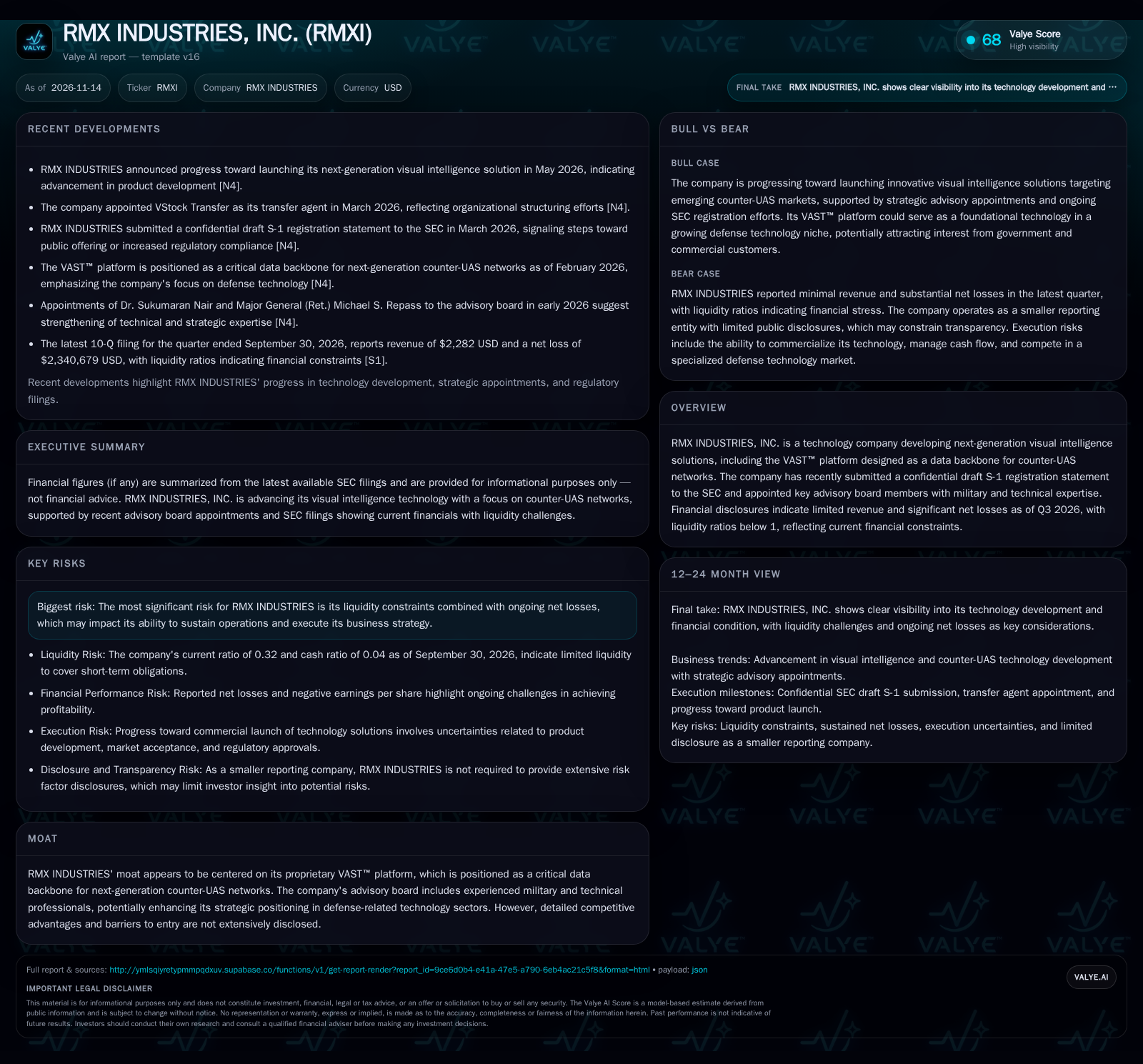
RMX INDUSTRIES, INC. is advancing its VAST™ platform for counter-UAS networks, supported by experienced advisors and a confidential S-1 filing.
RMX INDUSTRIES is developing visual intelligence technology for defense applications, notably its VAST™ platform for counter-UAS networks. Execution risk is high as the company attempts to transition from development to commercialization.
RMX INDUSTRIES, INC. is targeting a critical pain point in modern defense with its proprietary VAST™ platform, aiming to serve as the data backbone for counter-UAS (Unmanned Aircraft Systems) networks. With high-profile advisory appointments and a confidential S-1 registration statement underscoring intentions to access public capital markets, the company is clearly in a strategic build-and-launch phase. This creates a high-stakes situation: can RMX convert its technical ambition and advisory muscle into timely commercial traction before funding gaps force a strategic reset?
Liquidity Squeeze and Early Commercialization Define the Near-Term Picture
As of Q3 2026, RMX INDUSTRIES reported revenue of just $2,282 and a net loss of $2,340,679, indicating that it remains in the pre-commercial or pilot stage rather than having established any meaningful revenue streams [S1]. The company’s liquidity is severely limited, with cash and cash equivalents of $219,167, current assets of $1.88 million, and current liabilities of $5.95 million, resulting in a current ratio of 0.32 and a cash ratio of 0.04 [S1]. This imbalance signals urgent funding needs and little short-term flexibility to absorb operational shocks or delays. In parallel, RMX has submitted a confidential S-1 draft to the SEC and appointed high-profile advisory board members, suggesting active efforts to raise capital and bolster its strategic position as it pushes toward launching its VAST™ visual intelligence platform.
Commercialization Pathways and the Economics of a Defense Platform Play
The core business opportunity for RMX INDUSTRIES lies in delivering its VAST™ platform as an enabling data backbone for counter-UAS networks—a segment where government and critical infrastructure customers face escalating security threats. If the platform succeeds in meeting operational requirements, the company could generate revenue from a mix of hardware sales, software licensing, data services, system integration, or recurring support contracts. Defense procurement cycles are typically long, with pilot projects and multi-stage validation often preceding larger-scale deployment. This dynamic creates significant upfront cash needs and delays in achieving scale revenue.
Operating leverage could be substantial if RMX can transition from bespoke deployments to standardized solutions, but the initial phase is likely to be capital intensive with negative margins until volume ramps. The capital structure is currently fragile, and unless new funds are raised, the company may struggle to cover R&D, business development, and the working capital needed to support even modest contract wins. The economics will also hinge on RMX’s ability to move from single-customer pilots to multi-customer, multi-year agreements—a step that typically requires not just technical validation but also field-proven reliability and robust customer support.
Strategic Advisors and Platform Positioning: Differentiation or Table Stakes?
RMX INDUSTRIES is attempting to carve out a niche in the defense technology landscape by positioning VAST™ as a critical data backbone for counter-UAS networks. Advisory appointments—including military and technical experts—may provide credibility and access to procurement channels, but these are necessary rather than sufficient conditions for success in a field dominated by established defense contractors and rapidly advancing technology startups. Substitution risk is high: government buyers and critical infrastructure operators often prefer proven, interoperable solutions from vendors with deep track records, security clearances, and the ability to scale support globally.
The question is whether RMX’s technology offers a step-change in performance, cost, or interoperability that can overcome the inertia of entrenched procurement relationships. Without clear evidence of such a technical or economic advantage, RMX may be perceived as a niche or point-solution provider, limiting its ability to capture a platform premium or drive recurring revenue streams. In this context, the real test will be whether VAST™ can achieve technical validation and customer adoption at a pace sufficient to outlast better-capitalized competitors.
What If VAST™ Becomes an Indispensable Counter-UAS Backbone?
The most favorable outcome is that RMX’s VAST™ platform is validated through successful pilots with government or high-profile commercial customers, demonstrating clear advantages in data integration, threat detection, or operational efficiency. This could lead to larger-scale procurement contracts, recurring software/service revenue, and a virtuous cycle of reference wins. Strategic advisory appointments may accelerate introductions to decision-makers and facilitate compliance with procurement standards.
Confirmation of this scenario would come from disclosures of pilot wins, initial contract values, or customer testimonials highlighting the platform’s effectiveness. Evidence of repeat or multi-year contracts, integration partnerships with larger defense primes, or recognition in government technology evaluations would also support the upside. A successful public offering or private capital raise that extends runway beyond the next 12 months would further validate RMX’s ability to execute.
Most Likely: Technical Progress, Staged Pilots, and Persistent Funding Pressure
The most plausible trajectory is that RMX continues to advance its VAST™ platform, securing small-scale pilots or proof-of-concept projects with a handful of early adopters while pursuing additional capital to extend its operational runway. Revenue growth would remain modest, with operating losses sustained as the company invests in R&D, field validation, and business development. Execution risk remains high: delays in pilot conversion, technical setbacks, or funding gaps could force cost reductions or strategic pivots.
Evidence confirming this scenario would include incremental revenue increases from pilot projects, continued net losses, and announcements of bridge financings, convertible notes, or equity raises. A lack of multi-year or large-scale contracts, combined with persistent liquidity constraints, would reinforce the base case of a company in extended pre-commercial gestation.
Runway Runs Out Before Traction: Funding Shortfall and Strategic Reset
The adverse scenario is that RMX fails to secure sufficient new capital in time to support continued operations, either due to lack of investor interest, negative pilot outcomes, or competitive displacement. In this case, the company could be forced into aggressive cost-cutting, asset sales, or a distressed sale of its technology portfolio. Without demonstrable customer wins or technical validation, it may be difficult to raise funds on favorable terms, and existing stakeholders could face significant dilution or loss of value.
Confirmation of this scenario would include missed payroll or payables, a going concern warning in SEC filings, delays in product launches, or the announcement of a strategic alternatives process. Negative pilot feedback, failed capital raises, or management departures would further reinforce the risk of a funding-driven reset.
Milestones That Will Determine Whether RMX’s Platform Ambition Can Survive the Crunch
Disclosure of any pilot wins, initial contract values, or partnership agreements with government or commercial customers.
Evidence of a successful capital raise (public or private) sufficient to extend operational runway beyond the next 12 months.
Updates on the timing and outcome of the VAST™ platform’s commercial launch or field deployment.
Any material increase in quarterly revenue, particularly if tied to recurring or multi-year contracts.
Disclosure of technical validation, certifications, or customer testimonials supporting the VAST™ platform’s differentiation.
Changes in net loss trajectory, particularly evidence of sustained reductions in operating burn.
Appointment of additional strategic advisors or board members with direct procurement or customer influence.
If disclosed, backlog or pipeline metrics showing conversion from pilot to production deployments.
Disclaimer: This is research-only, informational analysis and not investment advice. It may include AI-generated interpretation and general industry context. Always verify important details using primary sources.

Comments