
CirTran Corp: Licensing Leverage Meets Liquidity Pressures in Contract Manufacturing
With exclusive rights to HUSTLER®-branded consumer products and a diversified contract manufacturing platform, CirTran Corp sits at the intersection of licensing, outsourced production, and regulatory-heavy markets.
CirTran Corp combines exclusive HUSTLER®-brand licensing with contract manufacturing across consumer categories, aiming for scalable, asset-light growth. [S2]
CirTran Corp’s attempt to blend exclusive brand licensing with contract manufacturing services gives it a theoretically scalable platform in the fragmented consumer goods sector. By leveraging the HUSTLER® brand and offering full-cycle manufacturing, CirTran seeks to attract both direct-to-consumer and B2B customers looking for speed, flexibility, and cost savings.
Liquidity Strain and Licensing: The Two Pivotal Forces Defining CirTran’s Present
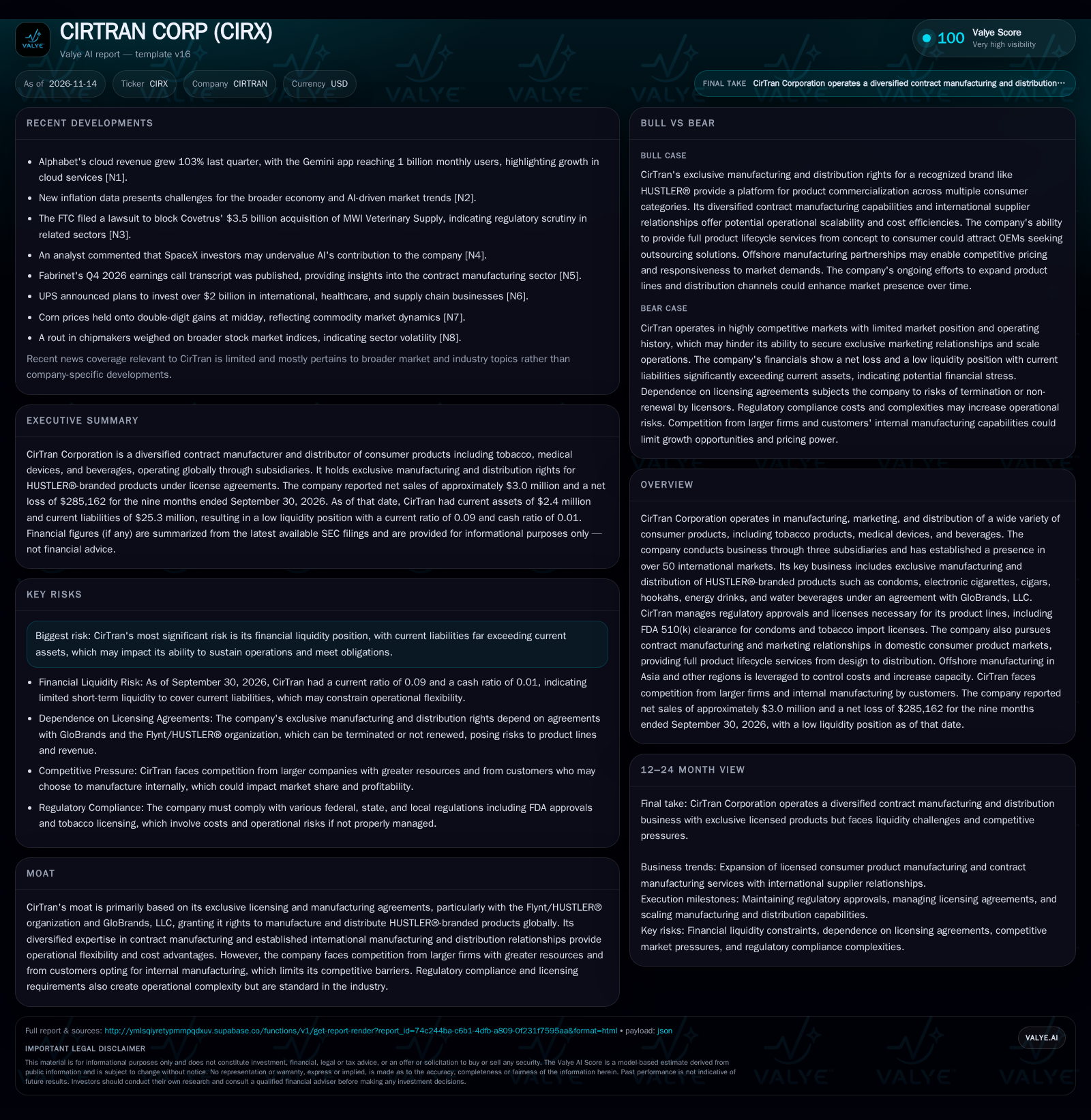
As of September 30, 2026, CirTran reported current assets of approximately $2.4 million versus current liabilities of $25.3 million, resulting in a current ratio of 0.09 and a cash ratio of 0.01. This acute short-term liquidity constraint places the company at risk of being unable to meet near-term obligations without outside capital or dramatic operational improvement. Net sales for the first nine months of 2026 totaled $3.0 million, generating a gross profit of $1.3 million but still resulting in a net loss of $285,162. Against this backdrop, CirTran’s exclusive manufacturing and distribution rights for HUSTLER®-branded products—including condoms, electronic cigarettes, and beverages—remain its most differentiated asset, but the company’s ability to exploit these rights is now tightly coupled to its financial runway. [S2]
The interplay between CirTran’s liquidity position and its licensing assets underscores a critical operational tension. This dynamic creates a scenario where the theoretical value of licensing is contingent not only on market demand but also on the company’s capacity to sustain operational momentum during periods of financial stress. Consequently, liquidity challenges may amplify the risk of underutilizing licensing assets, reducing the practical differentiation that these rights confer.
How CirTran’s Asset-Light Model Could Unlock Margin—If Scale Arrives
CirTran’s business model is structured around contract manufacturing and exclusive licensing, both of which are intended to minimize fixed costs and maximize variable-margin flexibility. The use of offshore manufacturing in Asia is designed to reduce per-unit costs and enable the company to flex capacity as customer demand fluctuates. By relying heavily on part-time contractors (23 contract workers versus just 4 full-time employees as of the latest report), CirTran seeks to keep overhead low—a strategy that theoretically delivers operating leverage if meaningful volume materializes. Revenue streams include direct product sales (notably HUSTLER®-branded items) and turnkey B2B manufacturing contracts, with the potential for higher-margin, value-added services such as design, prototyping, and distribution.
However, the company’s limited scale—$3.0 million in nine-month sales—means fixed costs, regulatory compliance, and licensing fees may still consume a disproportionate share of gross profit. The key economic test is whether CirTran can achieve sufficient volume, either through organic growth of its branded products or by winning larger contract manufacturing deals, to cover these overheads and reverse its current net loss trajectory.
The asset-light model’s reliance on offshore manufacturing introduces both cost advantages and operational risks that merit deeper consideration. While offshore production can lower unit costs, it also exposes CirTran to supply chain disruptions, quality control challenges, and longer lead times, which may impact responsiveness to customer demands or regulatory changes. Additionally, the heavy use of part-time contractors, while beneficial for cost flexibility, may limit the company’s ability to cultivate specialized expertise or institutional knowledge critical for complex manufacturing processes or rapid innovation. Therefore, the scalability and margin improvement promised by the model depend heavily on effective supply chain management and the ability to transition from low-touch contract work to higher-margin, value-added services.
Brand Licensing as Differentiation—But Scale, Not Uniqueness, Drives Survival
CirTran’s exclusive global rights to manufacture and distribute HUSTLER®-branded products provide a rare licensing moat in its markets. This differentiates its offering in categories like condoms, tobacco alternatives, and energy beverages, where generic contract manufacturers often compete on price alone. The full-cycle manufacturing and distribution solution is designed to appeal to both established licensors and OEMs seeking to outsource production complexity.
Yet, CirTran faces formidable competition from larger contract manufacturers with greater scale, automation, and pricing power. Customers with sufficient internal resources may also choose to bring manufacturing in-house, eroding CirTran’s value proposition. The company’s relatively small size and thin balance sheet could hinder its ability to absorb regulatory shocks, invest in automation, or fund the working capital needed to win larger contracts. In this context, the durability of CirTran’s competitive position will likely depend on its ability to leverage its licensing relationships into recurring, higher-margin business—before larger players replicate or outcompete its offering.
CirTran’s licensing moat provides a unique entry point, but sustaining competitive advantage requires translating brand exclusivity into consistent revenue streams that justify the associated fixed costs and compliance burdens. The company’s smaller scale relative to competitors means it must carefully prioritize investments to avoid dilution of focus or capital. For instance, selective targeting of niche markets or product categories where HUSTLER® brand equity is strongest could yield higher returns than attempting broad-based expansion. Moreover, the company’s vulnerability to regulatory shifts necessitates a proactive compliance strategy, as failure to anticipate or swiftly adapt to regulatory changes could erode licensing value and customer trust more rapidly than competitive pressures alone.
If Licensing and Outsourcing Trends Align, CirTran Could Achieve Escape Velocity
A favorable scenario would see CirTran leveraging its HUSTLER®-brand exclusivity and full-cycle manufacturing services to capture a greater share of both branded product markets and third-party contract manufacturing. If consumer demand for licensed products grows and more OEMs seek to outsource manufacturing to flexible, cost-efficient partners, CirTran could see rapid revenue scaling with incremental margin expansion due to its variable-cost structure.
Confirmation of this scenario would require evidence of accelerating sales growth, improving gross margins, and the signing of new, larger manufacturing contracts. Renewed or expanded licensing agreements, especially with the Flynt/HUSTLER® organization, would also support this trajectory. Falsification would occur if branded product volumes stagnate, major licensing agreements are lost, or if the company is unable to raise capital to support growth and working capital needs.
Incremental Progress, Ongoing Losses: The Most Probable Near-Term Outlook
The most plausible scenario for CirTran in the next 12-24 months is incremental revenue growth from both licensed products and contract manufacturing, but not at a scale sufficient to overcome its net losses or resolve its liquidity shortfall. While the company’s cost structure allows for flexibility, persistent underutilization of capacity and ongoing regulatory and licensing costs may keep the company in a cycle of marginal improvement but ongoing financial strain.
Falsification would require either a clear move to sustainable profitability and positive cash flow, or a pronounced deterioration in operations leading to insolvency or forced restructuring.
Liquidity Crisis or Contract Loss Could Force Restructuring or Asset Sales
In a negative scenario, CirTran’s acute liquidity shortfall could trigger a cash crunch, forcing it to delay payments, lose supplier or customer relationships, or even default on obligations. Loss or non-renewal of key licensing agreements—particularly those tied to the HUSTLER® brand—would remove its main commercial differentiator, likely resulting in further revenue declines and loss of negotiating leverage with both customers and suppliers.
Downside confirmation would include signs of covenant breaches, public disclosure of going-concern doubts, layoffs or headcount reductions, or the sale of core assets and intellectual property. Severe regulatory setbacks could also trigger this scenario, especially if the company is unable to maintain FDA or tobacco import licenses for its key product lines.
Milestones That Will Determine Whether CirTran’s Platform Can Outrun Its Balance Sheet
Net sales growth rate in both branded (HUSTLER®) and contract manufacturing segments—if disclosed, a useful metric would be the split by product line and customer concentration.
Gross margin trend and the degree to which incremental sales convert to operating profit, signaling scalability of the model.
Renewal, expansion, or loss of key licensing agreements with GloBrands or the Flynt/HUSTLER® organization, as these directly impact the company’s differentiator and revenue base.
Liquidity developments: new debt or equity financing, renegotiation of payables, or disclosure of going-concern language.
Customer win announcements, especially with larger OEMs or recurring, multi-year manufacturing contracts—if disclosed.
Regulatory milestones: maintenance or loss of FDA 510(k) clearance for condoms, tobacco import licenses, or other compliance statuses.
Changes in headcount or contractor utilization that signal operational scaling or retrenchment.
Disclaimer: This is research-only, informational analysis and not investment advice. It may include AI-generated interpretation and general industry context. Always verify important details using primary sources.

Comments