
Broadway Financial’s Mission-Driven Banking: Navigating Margin Pressures and Community Impact Ambitions
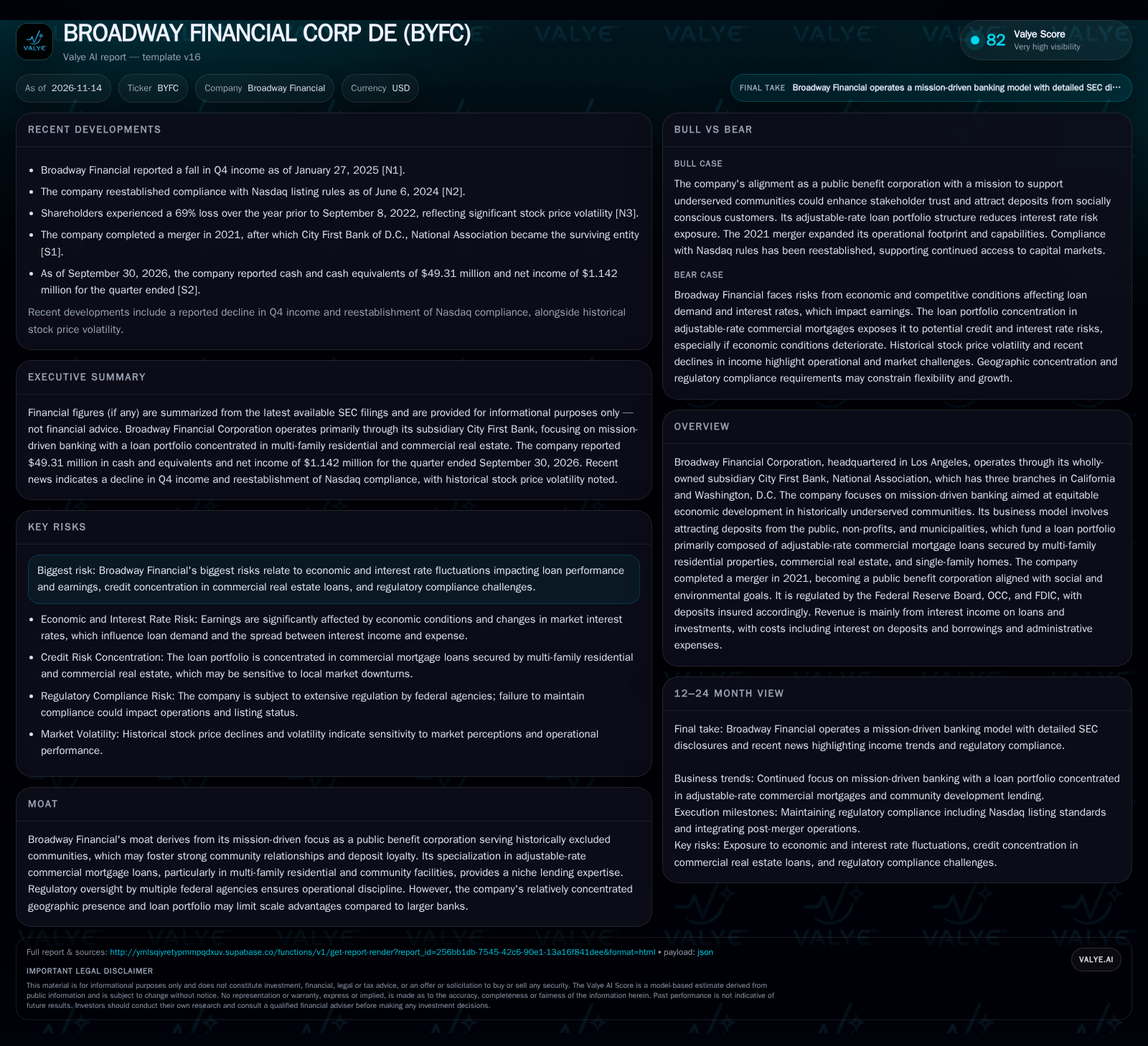
Broadway Financial, operating as a public benefit corporation through City First Bank, is balancing its mission to serve historically excluded communities with the realities of margin compression, credit concentration, and regulatory scrutiny. While recent income declines and past stock volatility highlight ongoing challenges, the company’s niche focus and adjustable-rate loan portfolio may offer resilience if market and community dynamics align.
The mission-driven model and public benefit corporation status could attract stable deposits and competitive differentiation in community development finance, yet execution risk and market volatility remain acute.
Broadway Financial Corporation, through its subsidiary City First Bank, stands at the intersection of community impact and commercial banking. While its public benefit corporation status and mission-driven approach distinguish it in the financial sector, recent results reveal the persistent tension between social purpose and financial sustainability. With a loan book heavily concentrated in adjustable-rate commercial mortgages and a geographic focus on California and Washington, D.C., Broadway faces both unique opportunities in community development and heightened exposure to credit, interest rate, and local economic risks. The company’s ability to maintain profitability, regulatory compliance, and its mission will define its future trajectory in a competitive and volatile environment.
Recent Results Underscore Profitability and Risk Concentration
As of September 30, 2026, Broadway Financial reported $49.31 million in cash and equivalents and net income of $1.142 million for the quarter, with basic and diluted EPS of $0.04 [S2]. While this signals ongoing operations and a positive bottom line, a reported decline in Q4 income as of January 2025 points to earnings volatility [N1]. The loan portfolio stands at approximately $1.0 billion, representing 75.5% of total assets, and is heavily skewed toward adjustable-rate loans (over 82%), with a primary focus on multi-family residential (58.41%) and commercial real estate (16.01%) [S1]. This credit concentration and rate sensitivity heighten the firm’s exposure to both local economic cycles and interest rate movements. The company’s reestablishment of Nasdaq compliance as of June 2024 is crucial for continued access to public capital markets [N2], but historical stock price losses (69% decline prior to September 2022) underscore persistent market skepticism and volatility [N3].
How Broadway Financial’s Community Lending Model Drives Its Economics
Broadway Financial’s core business model centers on attracting deposits from individuals, non-profits, municipalities, and mission-aligned depositors, which are then deployed as loans—primarily adjustable-rate mortgages secured by multi-family and commercial properties. Revenue is predominantly derived from interest income on these loans and investments, while principal costs include interest paid on deposits and borrowings, as well as administrative expenses [S1]. Given the adjustable-rate structure, net interest margin could benefit from rising rate environments, but also exposes the bank to repricing risk and borrower stress in downturns.
The relatively high proportion of fixed costs—branch infrastructure, compliance, and staffing—means Broadway’s operating leverage is limited unless it can grow its loan book or deposit base materially. Its public benefit corporation status may help attract low-cost, sticky deposits from value-oriented customers, but this advantage is counterbalanced by higher compliance costs and deliberate lending in lower-income areas, where credit risk is structurally higher. Capital needs are ongoing, as regulatory requirements and the risk profile of the loan book necessitate prudent provisioning and capital buffers, especially given the concentration in commercial real estate and the potential for localized downturns.
Mission-Driven Niche Versus Scale-Driven Competitors
Broadway Financial’s competitive position hinges on its status as a public benefit corporation and its established relationships in historically underserved communities. This mission-driven approach can foster deposit loyalty, community goodwill, and access to mission-aligned capital. However, the company operates in highly competitive markets—California and Washington, D.C.—where large national and regional banks, as well as fintechs and mortgage specialists, offer broader product suites, greater resources, and superior technology. These larger institutions may be able to offer more competitive rates or digital experiences, potentially eroding Broadway’s share among non-mission-aligned customers.
The company’s specialization in adjustable-rate lending for multi-family and community development properties provides expertise and local knowledge, but also makes it vulnerable to sector- and geography-specific shocks. Substitution risk is high in deposit gathering and lending, as customers may be drawn to higher yields, digital convenience, or broader service offerings from larger players. Broadway’s differentiation depends on its ability to deliver measurable community impact, favorable customer experiences, and prudent credit management—none of which guarantee financial outperformance without scale or unique underwriting capabilities.
If Mission Alignment Drives Sustainable Deposit Growth and Stable Margins
A favorable trajectory for Broadway Financial would involve leveraging its public benefit status to attract stable, low-cost deposits from socially conscious individuals, non-profits, and institutional partners. This could allow the bank to fund loan growth at attractive costs, expand its community development lending, and enhance its reputation as a trusted partner in underserved markets. If local economic conditions remain stable and adjustable-rate borrowers continue to perform, Broadway could see steady net interest income and modest operating leverage as the loan book grows.
Confirmation of this scenario would involve sustained growth in deposit balances from mission-aligned sources, stable or improving net interest margin, and nonperforming loan ratios remaining low despite macroeconomic volatility. Evidence of new partnerships with philanthropic or government agencies, or winning high-visibility community development projects, would further validate this upside path.
Navigating Credit Concentration and Margin Pressures Amid Modest Growth
The most plausible scenario for Broadway Financial is continued modest profitability, with periodic earnings volatility driven by interest rate and credit cycles. The adjustable-rate loan portfolio may provide some protection against interest rate shocks, but also exposes the company to borrower stress if rates rise too quickly or if local real estate markets deteriorate. Deposit growth is likely to be incremental, reflecting the bank’s mission-driven but limited geographic footprint.
In this scenario, Broadway maintains regulatory compliance and Nasdaq listing, but faces ongoing pressure from larger competitors and technology-driven entrants. Loan performance remains generally stable, but any significant uptick in delinquencies or charge-offs in the multi-family or commercial portfolios could quickly erode profitability. Confirmation would come from stable quarterly net income, controlled loan loss provisions, and consistent regulatory filings indicating no material compliance issues.
Local Economic Shocks or Asset Quality Deterioration Trigger Losses
A negative outcome could unfold if local economic conditions in Broadway’s core markets deteriorate—due to recession, real estate downturns, or exogenous shocks such as natural disasters. Given the loan book’s concentration in multi-family and commercial real estate, even moderate declines in property values or increases in local unemployment could drive up delinquencies and loan losses, especially among borrowers with adjustable-rate obligations. Rising rates could also strain borrowers’ ability to service debt, leading to higher provisions and write-downs.
This scenario would be confirmed by a spike in nonperforming assets, rising charge-offs, and a material decline in net interest income due to narrowing spreads or declining loan demand. Regulatory scrutiny could intensify, and the company could face renewed threats to its Nasdaq listing if losses persist or capital ratios fall below thresholds. Negative headlines regarding asset quality, compliance lapses, or loss of key deposit relationships would further reinforce downside risk.
Milestones and Metrics That Will Shape Broadway Financial’s Strategic Outcome
Quarterly net interest margin trends: A sustained decline would signal margin compression or asset quality deterioration.
Nonperforming loan and charge-off ratios, especially in the multi-family and commercial real estate segments, as early warning signs of credit stress.
Growth rate and composition of deposits, with particular focus on mission-aligned and low-cost funding sources.
Regulatory capital ratios and any material changes in risk-weighted assets reported in SEC filings.
Evidence of new community development partnerships or government grant awards, which would indicate strategic execution on the public benefit mission.
Changes in operating expense levels, as efficiency gains or losses could impact profitability given the fixed-cost structure.
Any material changes in Nasdaq listing status, as a proxy for ongoing regulatory compliance and market confidence.
If disclosed, customer retention rates and digital adoption metrics, to assess competitiveness versus larger and tech-enabled banks.
Disclaimer: This is research-only, informational analysis and not investment advice. It may include AI-generated interpretation and general industry context. Always verify important details using primary sources.

Comments