
Piermont Valley Acquisition Corp: SPAC Mechanics, Liquidity Strain, and the Uncertainty of the De-SPAC Pivot
Piermont Valley Acquisition Corp remains a pre-combination SPAC with minimal cash outside its trust account, material internal control weaknesses, and a single executive managing all board functions.
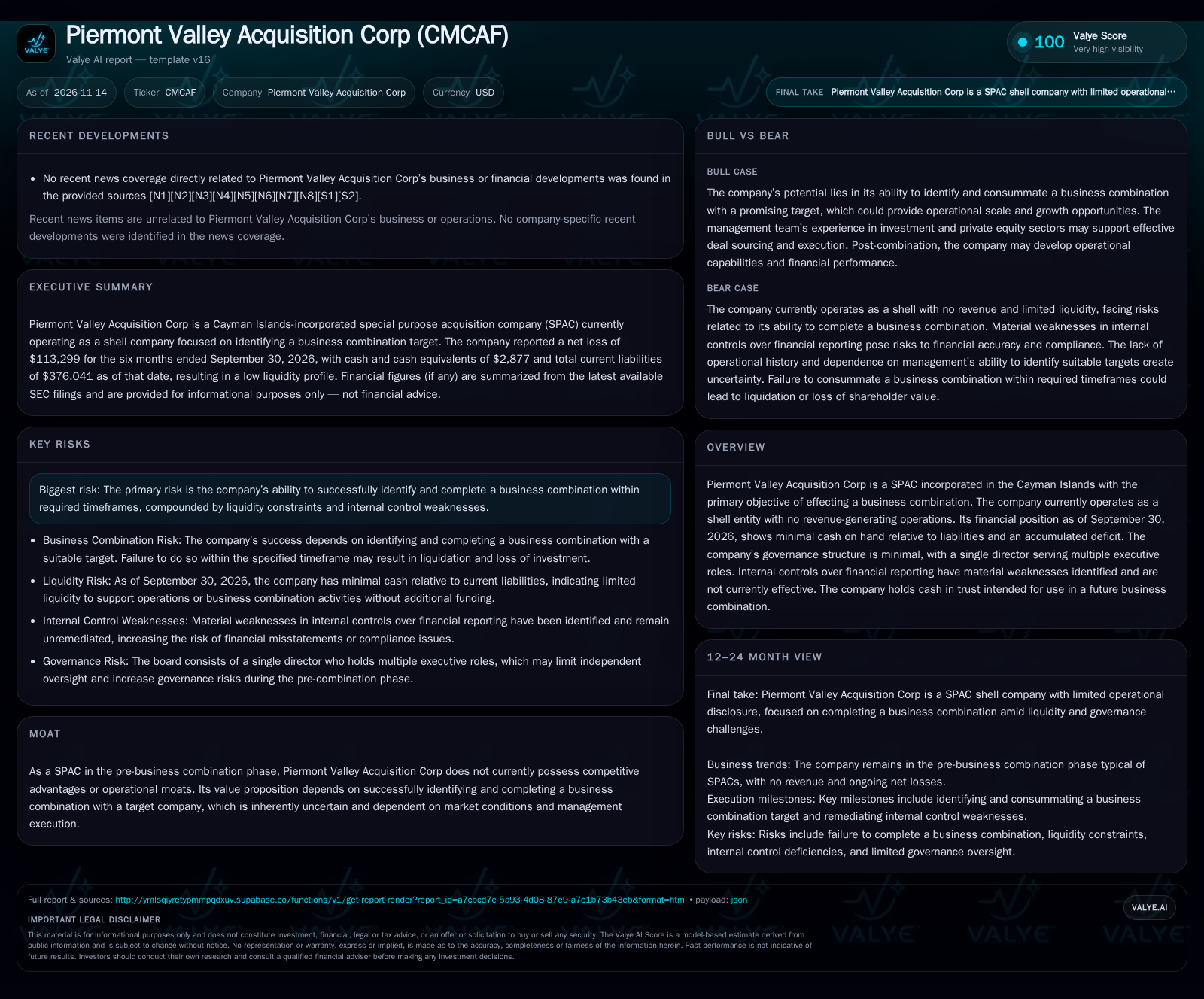
Piermont Valley Acquisition Corp is a Cayman Islands-incorporated SPAC with no revenue and an accumulated deficit of $1.6 million as of September 30, 2026. The company holds about $2.5 million in trust for a potential business combination, but has only $2,877 in operating cash versus $376,041 in current liabilities. With material weaknesses in internal controls and a one-person board, the company's future depends entirely on closing a merger within regulatory deadlines, or else facing liquidation. [S1] [S2]
Piermont Valley Acquisition Corp exemplifies the challenges faced by SPACs nearing the end of their pre-combination runway. With virtually no operating cash and a governance structure concentrated in a single executive, the company’s only tangible asset is approximately $2.5 million in trust earmarked for a future merger. The next chapter for Piermont Valley will be defined by its ability—or inability—to pivot from shell status to operating company through a timely and credible acquisition. [S1] [S2]
Piermont Valley’s Precarious Position: Cash, Controls, and the Single-Director Dilemma
As of September 30, 2026, Piermont Valley Acquisition Corp reported only $2,877 in cash and cash equivalents against $376,041 in current liabilities, resulting in a current ratio of just 0.01—a severe liquidity mismatch that leaves virtually no margin for ongoing operating costs. The company’s only substantial asset is approximately $2.5 million held in trust, which is strictly reserved for a future business combination and cannot be used to fund daily operations or resolve current liabilities. Governance is concentrated entirely in Wei Qian, who serves as Chairman, CEO, and CFO—the sole member of the board. Compounding these structural weaknesses, the company’s internal controls over financial reporting were found to be ineffective, with material weaknesses in accounting for complex financial instruments and journal entry adjustments. These issues collectively heighten operational and compliance risks, and leave Piermont Valley highly exposed to adverse outcomes if a business combination is not secured soon. [S1] [S2]
How the SPAC Model Works—and Where the Economic Tension Sits
As a SPAC, Piermont Valley’s sole economic pathway is to identify and close a business combination with a private company, effectively serving as a shell for a reverse merger into the public markets. Until that transaction occurs, the company generates no operating revenue, and its only income comes from interest on funds held in trust. The capital structure is typical: public investors hold Class A shares and redeemable warrants, while the sponsor retains founder shares acquired at nominal cost. Proceeds from the IPO are placed in trust and are generally restricted for use in the combination or redemption, not for corporate overhead.
Operating leverage is negative in the pre-combination phase: fixed costs (legal, accounting, listing fees, minimal payroll) persist while no revenues are generated, so net losses accumulate quarter by quarter. The economics hinge on the ability to close a deal before the trust account is depleted by redemptions or by the expiration of the SPAC’s lifecycle. If a merger is consummated, the combined entity may gain access to the trust funds (net of redemptions) and potentially additional PIPE financing, but Piermont Valley’s acute lack of operating cash means that even routine expenses may require further sponsor loans or advances.
The capital needs are binary: either a successful business combination brings fresh assets, growth prospects, and public market access—or, failing that, the SPAC must liquidate and return the trust funds to public shareholders, leaving the sponsor’s investment at risk and wiping out any equity value for non-redeeming holders.
SPAC Market Realities: Sponsor Quality, Target Scarcity, and Structural Headwinds
Piermont Valley’s competitive position is defined almost entirely by the skill, network, and credibility of its sponsor and management. In a saturated SPAC market, with hundreds of blank-check companies chasing a shrinking pool of attractive targets, differentiation is challenging. The company does not currently possess any operational moat or sector specialization that would make it a preferred merger partner over other SPACs.
The single-director structure and material control weaknesses may further deter high-quality targets, which often seek a sponsor with both capital and robust governance. In addition, Piermont Valley’s minimal operating cash and accumulated deficit could signal to potential targets that the SPAC is under-resourced to support a complex transaction or fund post-merger operations.
Competition comes not only from other SPACs but also from direct listings, traditional IPOs, and private equity funds. Attractive private companies have multiple avenues to access capital and the public markets—limiting Piermont Valley’s leverage in negotiating favorable deal terms or securing exclusivity with a target.
Unlocking Value Through a Successful Merger: What Would Need to Go Right
The most favorable outcome for Piermont Valley is the identification and timely completion of a business combination with a credible, growth-oriented private company. This would allow the SPAC to deploy its trust assets, potentially attract PIPE financing, and transition to an operating entity with a compelling growth narrative. For this scenario to materialize, several things must happen:
- The company must secure a merger target willing to accept the terms offered and able to clear regulatory, shareholder, and listing hurdles. 2. Shareholder redemptions must be limited, preserving enough trust capital to make the transaction meaningful and to support the combined entity’s initial liquidity needs. 3. Governance and internal control issues must be remediated to meet public company standards and satisfy auditors and institutional investors.
Confirmation would come from the announcement of a binding merger agreement with a credible target, low redemption rates at the shareholder vote, successful regulatory clearance, and evidence of post-close capital adequacy. A falsification of this scenario would be the absence of a deal announcement as deadlines approach, high redemption rates, or a failed shareholder vote.
The Most Likely Outcome: Prolonged Search, Rising Costs, and the Liquidation Cliff
Given Piermont Valley’s current liquidity pinch, internal control gaps, and lack of operational board oversight, the most plausible scenario is a protracted search for a suitable target, with mounting operating losses and increasing risk of forced liquidation. In this path, sponsor loans or advances may be required to cover basic expenses, but unless a high-quality target is secured quickly, trust assets will be depleted by redemptions or regulatory deadlines may trigger a wind-down.
Confirmation of this scenario would be continued reporting of net losses, no substantive merger progress, and further warnings in filings about going concern risk and liquidation timelines. A falsifying signal would be an announced, market-credible business combination with evidence of sufficient capital to close and operate post-merger.
The Liquidation Spiral: When No Target Emerges and Time Runs Out
The adverse outcome is straightforward: Piermont Valley fails to secure a business combination within required regulatory timeframes, triggering liquidation. In this scenario, the trust account is returned to public shareholders (minus allowable expenses), founder shares and warrants become worthless, and any sponsor loans may not be fully recoverable. The accumulated deficit and lack of operating cash mean that even an orderly wind-down could be operationally challenging.
Signs that this scenario is playing out would include the explicit acknowledgment of impending deadlines without deal progress, a lack of merger announcements, or the withdrawal of any previously announced prospective transaction. High rates of shareholder redemption and further deterioration in internal controls would further validate the downside thesis.
Testing the SPAC Thesis: What Will Define Piermont Valley’s Next Phase
Announcement and terms of any business combination agreement, including target identity, valuation, and expected post-merger capital structure.
Trends in shareholder redemption rates at any merger vote—low redemptions would signal confidence and maximize trust capital for the target.
Remediation or further deterioration of internal control weaknesses, as disclosed in future filings or auditor reports.
Any changes in board composition, including the addition of independent directors or audit committee formation, which would indicate governance improvement.
Updates on sponsor loans, advances, or other interim funding arrangements to bridge operating expenses before a business combination.
Explicit disclosure of regulatory or listing deadline extensions, or warnings regarding approaching liquidation triggers.
Evidence of PIPE financing commitments or other capital sources supporting the prospective merger, if disclosed.
Disclaimer: This is research-only, informational analysis and not investment advice. It may include AI-generated interpretation and general industry context. Always verify important details using primary sources.

Comments