
Golden Minerals: Exploration Pivot, Asset Sales, and the Countdown to Funding or Exit
Golden Minerals has shed its mining operations to focus exclusively on early-stage gold-silver-copper exploration in Argentina and Nevada. With cash likely depleted by mid-2026, the company’s future now hinges on asset sales, external financing, or a transformative joint venture—while legacy liabilities and the inherent uncertainties of exploration loom large.
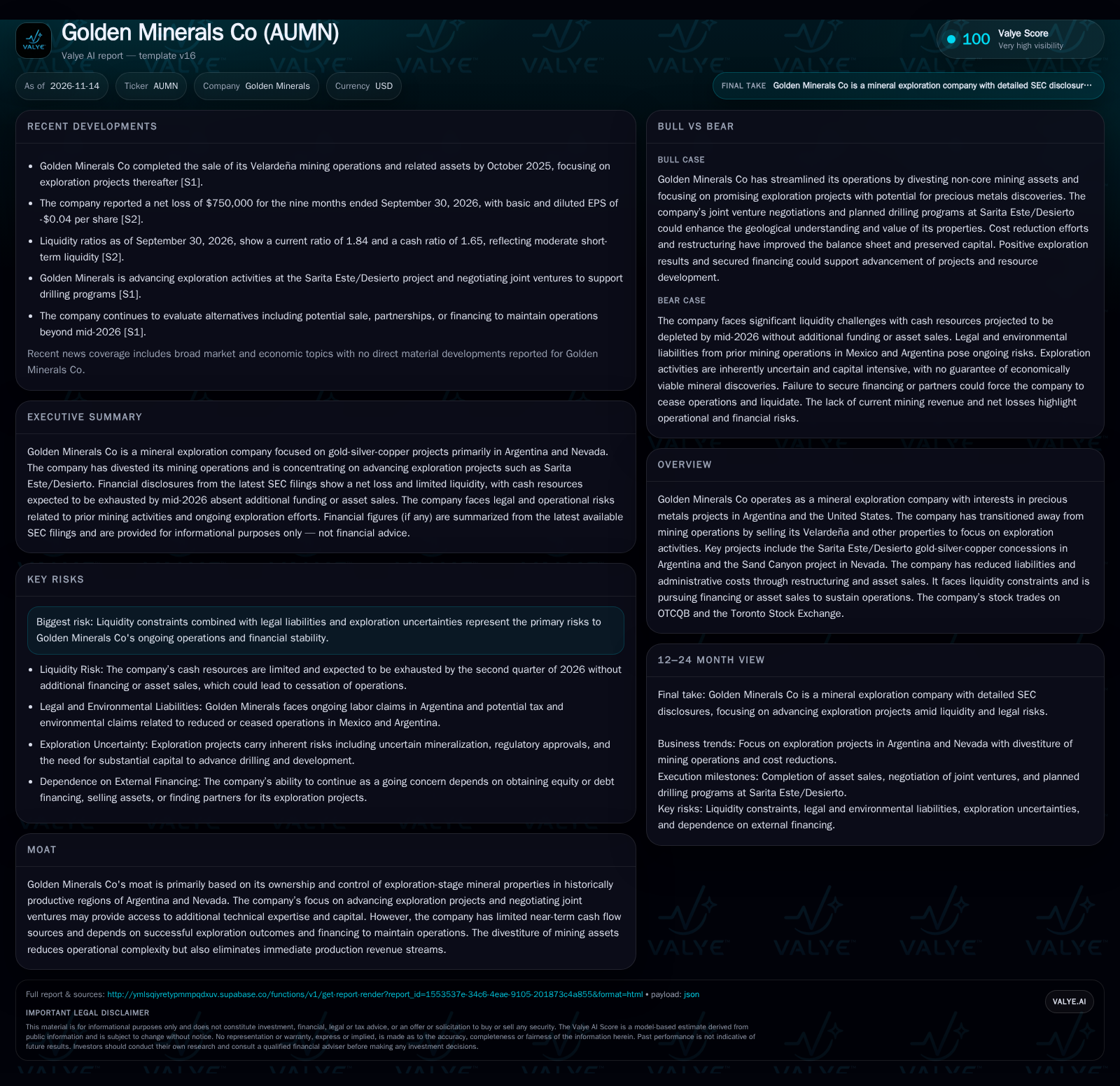
Golden Minerals has transitioned from mining to pure exploration, with its financial survival beyond mid-2026 dependent on successful asset sales, new partnerships, or fresh funding. The company’s focus is now on advancing the Sarita Este/Desierto and Sand Canyon projects, but ongoing legal risks and the absence of cash-generative operations create a precarious situation. The critical question: Can Golden Minerals unlock value via discovery or dealmaking before liquidity runs out? [S1] [S2]
Golden Minerals has undergone a fundamental transformation: it is no longer a mining company, but an exploration pure-play with a shrinking liquidity window. After divesting its Velardeña and other producing assets, the company is now betting on its ability to generate value from early-stage gold-silver-copper projects in Argentina and Nevada. The transition reduces operational complexity but amplifies funding risk, as the company’s limited cash could run out by mid-2026 without a material asset sale or new partnership. This leaves Golden Minerals at a crossroads, where the next 6–12 months will determine whether it secures the capital and technical resources needed to survive—or is forced into liquidation. [S1] [S2]
A Company Transformed: Asset Sales, Exploration Focus, and a Liquidity Cliff
Golden Minerals completed the sale of its Velardeña mining operations and other subsidiaries by October 2025, marking its exit from direct mining to focus solely on exploration [S1]. The company now holds majority interests in the Sarita Este/Desierto gold-silver-copper concessions in Argentina and a 60% stake in the Sand Canyon project in Nevada. This pivot is paired with cost reductions and administrative downsizing.
As of September 30, 2026, the company reported current assets of $1.9 million against current liabilities of $1.4 million, for a current ratio of 1.84 and a cash ratio of 1.65 [S2]. Despite these nominally reported liquidity position, Golden Minerals anticipates exhausting its cash resources by Q2 2026 without additional funding or asset sales [S2].
The company is advancing exploration at Sarita Este/Desierto and negotiating joint venture agreements to support drilling. However, it continues to face unresolved labor, legal, and environmental liabilities stemming from its former operations in Argentina and Mexico [S1] [S2].
Exploration Model Economics: Value Creation Hinges on Discovery and Dealmaking
Golden Minerals now operates as an early-stage mineral explorer rather than a producer. Its business model is fundamentally speculative: value is created by discovering economically viable mineral deposits, which can then be monetized by selling project interests, entering into joint ventures, or eventually developing mines (with or without a partner).
Unlike mining, exploration does not generate operating revenue and is inherently cash-consuming. The company’s primary cash inflows must now come from asset sales, option payments from partners, or new equity/debt financings. These are episodic and highly uncertain.
Cost structure is mostly variable—driven by exploration expenditures (drilling, sampling, geological work) and, to a lesser extent, G&A. Recent administrative cost reductions following divestitures have lowered the fixed cost base [S2]. However, exploration budgets have increased due to option payments and contingent liabilities, raising the burn rate [S2].
Operating leverage is limited: unless a significant discovery is made or a lucrative deal struck, incremental exploration spending does not guarantee future returns. This makes funding needs acute. The company’s ability to sustain operations, or create value, depends on timely access to external capital or the successful monetization of its exploration assets.
Asset Quality, Location, and Partnerships Define Competitive Standing in a Crowded Field
Golden Minerals’ competitive position depends almost entirely on the perceived geological potential of its Sarita Este/Desierto and Sand Canyon projects. The company’s assets are located in geologically prospective regions—northwest Salta Province in Argentina and northwestern Nevada—both of which have histories of significant gold and silver discoveries.
However, as an exploration pure-play with limited cash and no current mining operations, Golden Minerals faces intense competition from other junior explorers and larger mining companies seeking similar discoveries. Access to capital, technical expertise, and credible joint venture partners are critical differentiators.
The company’s efforts to negotiate joint ventures could help offset funding and technical risks, but may also dilute its economic interest in any eventual discovery. In this environment, smaller players like Golden Minerals often succeed by securing early-stage partnerships with majors or mid-tiers, or by making a discovery significant enough to attract a strategic buyout.
Potential substitutes for investors include other gold-silver-copper exploration juniors, as well as established producers with active exploration programs. The lack of current production or cash flow at Golden Minerals means it must offer either compelling asset quality or a favorable risk/reward profile to compete for capital and partners.
Breakthrough Discovery or Transformative Deal Unlocks Value Before Cash Runs Out
The most favorable scenario for Golden Minerals is that exploration at Sarita Este/Desierto or Sand Canyon yields strong drill results, demonstrating robust mineralization and compelling resource potential. This could catalyze a partnership with a major mining company or enable the company to sell a project interest at a premium.
A successful joint venture agreement—especially one that provides upfront cash, milestone payments, and partner-funded exploration—would extend the company’s runway and validate the geological potential of its assets. Alternatively, a full company sale to a larger peer seeking exploration pipeline exposure is plausible if the assets attract sufficient interest.
Confirmation of this upside would come from: (1) announced high-grade drill intercepts or positive resource estimates; (2) a binding joint venture or farm-in agreement with a credible partner; (3) a significant asset sale or acquisition offer; or (4) successful closing of a large, non-dilutive financing tied to exploration progress.
Sustained Asset Monetization Efforts Amid Ongoing Cash Burn and Uncertainty
The most likely path is that Golden Minerals continues its efforts to monetize assets and secure partnerships while advancing exploration at a measured pace. Exploration results may be mixed, and while negotiations for joint ventures or asset sales progress, they may not materialize quickly enough to fully resolve liquidity pressures.
In this scenario, the company may succeed in closing modest asset sales or option agreements that provide incremental funding, but these may only extend operations by a few quarters. Exploration spending remains tightly controlled, and administrative costs stay low due to prior restructuring.
The company continues to face legacy legal and environmental claims, which could create episodic cash outflows or distract management. Confirmation of this scenario would include ongoing announcements of small asset sales, option payments, or bridge financings—without a transformative discovery or major partnership.
Liquidity Exhaustion Triggers Cessation of Operations and Potential Liquidation
If Golden Minerals fails to secure additional capital or monetize its assets before cash is exhausted (projected by Q2 2026), the company could be forced to cease operations and enter liquidation. This outcome could be accelerated by adverse legal judgments, environmental claims, or cost overruns related to exploration or legacy liabilities.
In this scenario, the value of remaining exploration properties may be realized only through distressed sales, likely at a significant discount. Creditors and claimants from prior operations in Argentina and Mexico could take priority over equity holders in any liquidation process.
Evidence for this downside would include: (1) failure to announce any joint venture, asset sale, or financing by early 2026; (2) abrupt cessation of exploration activity; (3) public disclosure of going concern warnings and preparations for winding up the company; or (4) legal or regulatory actions that further constrain the company’s cash position.
Milestones That Will Determine Golden Minerals’ Fate in the Next Year
Announcement of a binding joint venture or farm-in agreement for Sarita Este/Desierto or Sand Canyon, including upfront cash or committed partner funding.
Release of substantive drill results or technical reports indicating significant mineralization at the company’s key projects.
Disclosure of completed asset sales or option agreements that materially extend the company’s funding runway.
Updates on legal, labor, or environmental claims—especially any settlements, adverse judgments, or new liabilities that could impact cash resources.
Progress reports on negotiations for the potential sale of the company or its remaining exploration assets.
Changes in exploration spending levels—an increase could signal optimism and new funding, while a reduction may indicate cash preservation or lack of progress.
If disclosed, the company’s monthly or quarterly cash burn rate, to assess how quickly liquidity is being consumed and whether the timeline to potential funding or dealmaking is shrinking.
Disclaimer: This is research-only, informational analysis and not investment advice. It may include AI-generated interpretation and general industry context. Always verify important details using primary sources.

Comments