
Oaktree Acquisition Corp. III Life Sciences: Redemption-Driven Extension Puts SPAC Clock and Liquidity in the Spotlight
Oaktree Acquisition Corp. III Life Sciences faces a narrowing window to secure a life sciences target after major redemptions and an extension of its business combination deadline.
Oaktree Acquisition Corp. The next several months will be critical for execution, as further delays or failure to consummate a transaction could result in liquidation and loss of shareholder value. [S2]
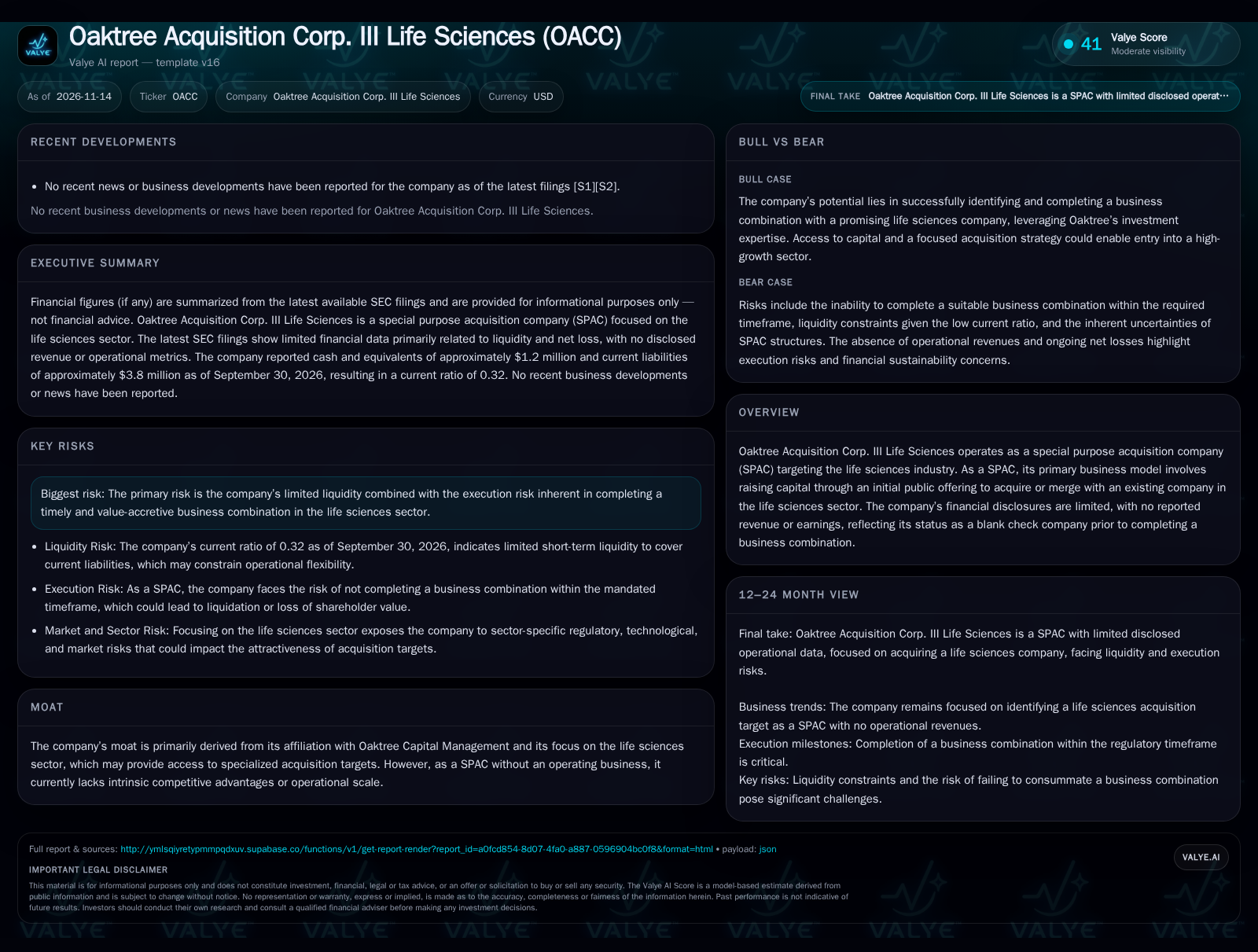
Oaktree Acquisition Corp. III Life Sciences, a SPAC targeting the life sciences sector, is at a pivotal juncture after extending its business combination deadline and experiencing substantial shareholder redemptions. With $85 million remaining in trust but limited cash outside of it, the company faces a compressed timeline and heightened execution risk. Its future now depends on the ability to identify and close a value-accretive transaction in a complex and competitive sector before further extensions expire or liquidation becomes inevitable. [S2]
Extension, Redemptions, and the Ticking SPAC Clock
On October 23, 2026, Oaktree Acquisition Corp. III Life Sciences secured shareholder approval to extend its business combination deadline from October 25, 2026, to November 25, 2026, with the possibility of monthly extensions through May 25, 2027, at the sponsor’s discretion. This move is critical, as it provides a brief window to finalize a merger or acquisition before facing forced liquidation. The extension, however, triggered significant shareholder redemptions: 11.33 million shares were redeemed at $10.81 per share, totaling approximately $122.4 million and leaving $85 million in trust. No business combination target has been announced, and the company continues to incur net losses without generating revenue. These dynamics sharply focus attention on Oaktree’s ability to execute a deal under time and capital pressure. [S2]
SPAC Economics: Trust Account Constraints and the Cost of Delay
As a SPAC, Oaktree Acquisition Corp. III Life Sciences’ economics are defined by the capital raised in its IPO, now primarily held in trust, and the race to identify and close a target before liquidation deadlines. The $85 million remaining in trust post-redemptions is earmarked for a business combination or to be returned to shareholders if no deal materializes. Cash outside the trust—just $1.2 million as of September 30, 2026—must fund search, legal, and administrative costs, creating real operational strain. The fixed costs of the SPAC structure (deal diligence, regulatory filings, sponsor expenses) persist regardless of deal progress, while the absence of revenue generation means losses continue to accumulate. If a combination is found, economics will pivot to the acquired company’s profile: typically, a life sciences target may have high R&D spend, negative cash flow, and uncertain regulatory outcomes, requiring robust post-merger funding. If no deal is reached, capital is returned to remaining shareholders, and the sponsor’s investment is lost. Thus, operating leverage is negative pre-deal, with the only path to value creation coming from successfully closing and integrating a compelling acquisition.
Acquisition Target Competition and the Oaktree Brand
Oaktree’s affiliation provides a degree of brand credibility and access to deal flow in the life sciences sector, a field where industry connections and diligence expertise are vital. However, the SPAC landscape is crowded, with many vehicles chasing a limited pool of attractive targets, especially as regulatory and market scrutiny of SPAC transactions has intensified post-2022. Oaktree’s trust size, now $85 million, is at the lower end for life sciences deals, which often command higher valuations and require additional PIPE (private investment in public equity) funding to close. Other acquisition vehicles—including strategic acquirers, private equity, and rival SPACs—can often offer more certainty, faster execution, or richer terms. The company’s ability to attract a compelling target may hinge on its sponsor’s reputation, willingness to structure creative deals, and ability to raise incremental capital, but its reduced float and trust balance could be a competitive disadvantage versus larger or less redemption-impacted peers.
What Success Would Require: Rapid Target Identification and PIPE Support
A favorable outcome hinges on Oaktree Acquisition Corp. III Life Sciences quickly identifying a high-potential life sciences company willing to merge at a valuation that fits the remaining $85 million trust and can attract additional PIPE financing if needed. The most likely path to success would involve leveraging Oaktree’s network to source a late-stage private biotech, medtech, or diagnostics company with a near-term commercial or regulatory catalyst. Negotiating a deal structure that aligns incentives for both the target and remaining public shareholders—potentially including sponsor concessions or earn-outs—would help mitigate dilution and redemptions. Evidence confirming this scenario would include a definitive agreement announcement, a concurrent PIPE raise at favorable terms, and clear communication on the target’s growth prospects and post-merger funding plan. Conversely, the lack of deal announcements, inability to secure a PIPE, or continued net redemptions would undermine this upside scenario.
Most Likely Trajectory: Prolonged Search, Incremental Extensions, and Mounting Pressure
The most plausible outcome is a period of continued target search and negotiation, utilizing monthly extensions through the first half of 2027. Operational cash burn will persist, making cost management essential. The company may announce non-binding letters of intent or enter preliminary discussions, but deal closure will be challenged by the reduced trust size and market skepticism toward SPAC-sponsored life sciences listings. If a target is identified, it is likely to be a smaller or earlier-stage company, or one with limited alternative financing options, which may increase post-merger volatility. Evidence confirming this scenario would be further extension notices, incremental trust balance updates, and possibly soft deal announcements without immediate definitive agreements. Falsification would come from either a surprise, high-quality transaction or a sudden move toward liquidation if no target is found.
Liquidation Risk: No Deal, Sponsor Losses, and Shareholder Return of Trust
If Oaktree Acquisition Corp. III Life Sciences fails to secure a suitable target before the extended deadline, or cannot assemble the necessary financing to close a deal, the SPAC will enter liquidation. In this scenario, remaining trust assets (minus any allowable expenses) are returned to shareholders, while the sponsor’s at-risk capital is forfeited. This outcome is plausible if sector conditions deteriorate, regulatory hurdles tighten, or if the company’s shrinking float and trust size make it unattractive for viable life sciences targets. Confirmatory evidence would include a formal liquidation announcement, the absence of deal talks or extensions, and ongoing net losses with no progress toward a business combination. The risk of this scenario increases with each passing extension and absent a clear transaction pipeline.
Milestones That Will Define Oaktree Acquisition Corp. III Life Sciences’ Outcome
Any announcement of a definitive business combination agreement, including target identity, valuation, and deal structure.
Disclosure of PIPE financing commitments or other incremental funding to supplement the $85 million trust balance—if disclosed.
Updates to the trust account balance and public share count after further redemptions or extensions.
SEC filings or press releases detailing monthly extension elections and any changes to liquidation deadlines.
Changes in sponsor support, such as additional capital at risk, fee waivers, or warrant modifications—if disclosed.
Evidence of target company quality, such as near-term regulatory milestones, commercial traction, or differentiated technology.
Sector-wide developments in life sciences M&A, SPAC market sentiment, and regulatory guidance impacting deal feasibility.
Disclaimer: This is research-only, informational analysis and not investment advice. It may include AI-generated interpretation and general industry context. Always verify important details using primary sources.

Comments