
Moleculin Biotech: Advances in Trials, Patent Fortification, and Financing Dynamics in Oncology
Moleculin Biotech advances its lead oncology candidate Annamycin through pivotal clinical trials and patent milestones, but the company's future hinges on regulatory outcomes, sustained financing, and the ability to translate scientific promise into commercial value.
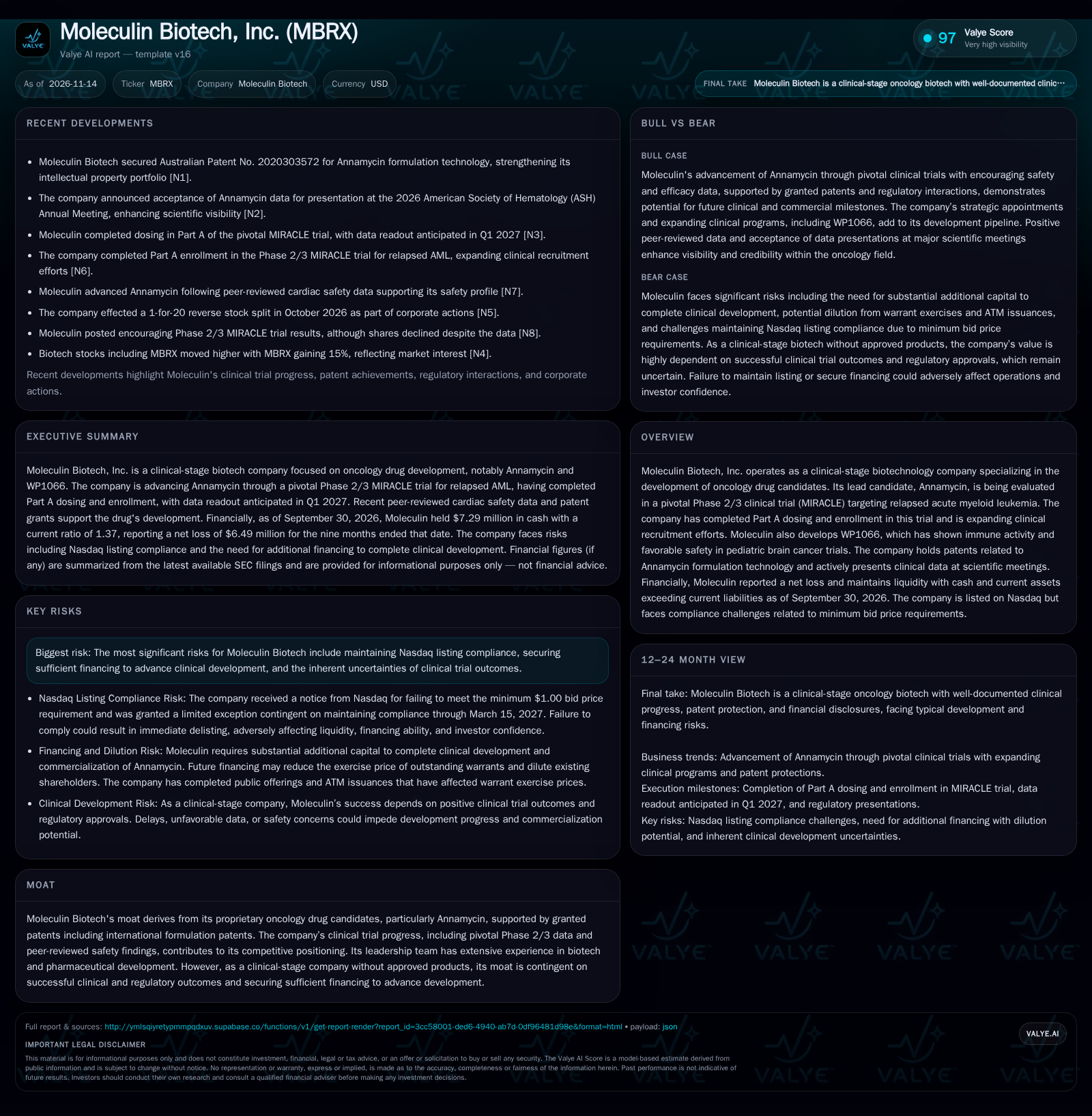
Moleculin Biotech has completed Part A enrollment and dosing in its pivotal Phase 2/3 MIRACLE trial for Annamycin in relapsed AML, with a key data readout expected in Q1 2027. The company secured new patent protection and published peer-reviewed safety data, but faces ongoing Nasdaq listing compliance issues and requires additional funding to reach commercialization. The next 12-18 months will be defined by clinical results, financing developments, and Moleculin’s ability to maintain strategic momentum in a competitive oncology landscape. [N1] [N2] [N3] [N6] [S2]
Moleculin Biotech, a clinical-stage oncology company, is at a pivotal juncture as it pushes its lead candidate, Annamycin, through late-stage clinical trials for relapsed acute myeloid leukemia (AML). With Part A of the key MIRACLE trial completed and data pending in early 2027, Moleculin’s prospects rest on translating promising clinical and safety data into regulatory approvals and commercial traction. The coming year will test Moleculin’s ability to navigate both scientific and financial hurdles as it seeks to establish a foothold in the competitive oncology therapeutics market.
Pivotal Trial Progress, Patent Milestones, and Financial Pressures Define the Current State
Moleculin Biotech has achieved several material milestones: it completed Part A enrollment and dosing in its pivotal Phase 2/3 MIRACLE trial of Annamycin for relapsed AML, positioning the company for a data readout in Q1 2027. This clinical progress is supported by a recently secured Australian patent for Annamycin’s formulation, strengthening Moleculin’s intellectual property position in key international markets. On the scientific front, peer-reviewed cardiac safety data for Annamycin has been published, addressing a critical safety concern for anthracycline-based therapies and supporting further clinical advancement. Financially, Moleculin reported $7.29 million in cash and cash equivalents as of September 30, 2026, with current assets of $8.41 million against current liabilities of $6.14 million, and a net loss of $6.49 million for the first nine months of 2026. However, the company faces continued Nasdaq listing compliance risk and a clear need for additional capital to fund ongoing clinical development and potential commercialization. [N1] [N3] [N6] [N7] [S2]
Oncology Pipeline Economics: High Fixed Costs, Uncertain Payouts, and the Financing Imperative
Moleculin’s business model is typical of clinical-stage biotech: heavy upfront investment in R&D and clinical trials, with no product revenue until regulatory approval and commercial launch. The company’s economics are dominated by the fixed costs of multi-center clinical trials, regulatory filings, and ongoing IP protection, while variable costs remain low until commercial scale-up. If Annamycin is ultimately approved, Moleculin could benefit from favorable pricing dynamics common to novel oncology therapies, which often command premium prices due to unmet medical need and limited competition in relapsed AML. However, the company currently operates at a net loss and relies on external capital, including dilutive warrant exercises and at-the-market (ATM) equity issuances, to sustain operations. Operating leverage is negative at present, as incremental spending is not offset by any product revenue, and the path to profitability is entirely contingent on successful trial outcomes and subsequent market uptake. The capital intensity of late-stage oncology development also raises the risk of dilution for current shareholders, particularly given Moleculin’s reported cash balance and ongoing cash burn. [S2]
Intellectual Property and Clinical Differentiation: Moleculin’s Position in a Crowded Oncology Field
Moleculin’s competitive position is anchored by its proprietary drug candidates—most notably Annamycin, which now benefits from an Australian patent for its formulation technology. This patent protection, along with ongoing clinical data generation and peer-reviewed safety publications, provides a barrier to generic entry and could support premium pricing if the drug reaches market. However, the broader oncology market is highly competitive, with numerous established and emerging players pursuing treatments for AML and related hematological malignancies. Moleculin’s ability to differentiate Annamycin will depend on demonstrating clear efficacy and safety advantages over existing therapies, particularly given the crowded pipeline of next-generation targeted agents and immunotherapies. The company’s strategy of enhancing visibility through scientific presentations and peer-reviewed publications may help build clinical credibility, but without near-term product revenue or commercial partnerships, Moleculin remains vulnerable to larger, better-funded competitors and to shifts in the standard of care that could erode the addressable market for its lead asset. [N1] [N2] [N7]
Clinical Success and Commercial Validation: What Would Drive a Step-Change for Moleculin
A favorable scenario would see the MIRACLE trial’s Part A and subsequent Part B data demonstrate statistically and clinically meaningful efficacy and safety for Annamycin in relapsed AML, with clear differentiation from current standards of care. If the Q1 2027 data readout is positive, Moleculin could rapidly pursue regulatory submissions in the U.S. and internationally, leveraging its patent portfolio for market exclusivity. This could attract partnerships or licensing deals with larger pharma companies, providing non-dilutive funding and commercial infrastructure. Confirmation would come from robust efficacy and safety data at major medical meetings, regulatory fast-track designations, and announced commercial or co-development partnerships. Falsification would involve trial data failing to show meaningful benefit, safety signals emerging, or the inability to secure regulatory engagement or commercial interest post-data.
Navigating Uncertainty: Incremental Progress Amid Financing and Clinical Risks
The most plausible path is one of incremental clinical progress, with Moleculin advancing Annamycin through the remaining phases of the MIRACLE trial while continuing to seek additional financing through dilutive equity or warrant issuances. The company could achieve data readouts in line with expectations but face delays in regulatory submissions or require further studies to satisfy health authorities. Cash constraints might necessitate prioritizing Annamycin over other pipeline assets, and Nasdaq compliance could remain a persistent risk until a clear inflection point is reached. This scenario would be confirmed by continued trial enrollment updates, additional capital raises, and steady but unspectacular clinical progress. Falsification would occur if the company fails to secure sufficient financing, faces major clinical setbacks, or loses Nasdaq listing status before a pivotal data readout.
Clinical Setbacks or Capital Shortfalls: How Value Could Unravel
The primary downside risk is that the MIRACLE trial produces negative or inconclusive efficacy or safety data, undermining the case for Annamycin’s approval. In this event, Moleculin would likely struggle to attract further investment, face delisting from Nasdaq, and be forced to curtail or halt clinical development. A secondary risk is that even with positive data, delays in regulatory review or commercial partnering—combined with ongoing cash burn—could result in severe shareholder dilution or the need for asset sales under distressed conditions. Confirmation of this scenario would come from adverse clinical announcements, inability to raise capital, accelerated cash usage, or formal Nasdaq delisting notices. Falsification would require clear evidence of positive data, successful financing, and regulatory momentum.
Milestones and Metrics That Will Define Moleculin’s Clinical and Financial Trajectory
Progress and data quality from the MIRACLE Phase 2/3 trial—especially the Q1 2027 data readout.
Updates on regulatory engagement, fast-track designations, or feedback from health authorities if disclosed.
Cash burn rate and timing/magnitude of future financing rounds or ATM issuances.
Nasdaq listing status and compliance with minimum bid price rules.
Announcements of new commercial, licensing, or co-development partnerships.
Expansion or contraction of the clinical pipeline beyond Annamycin if resources allow.
Patent filings, grants, and challenges in key jurisdictions.
Market reaction to clinical data presentations at major scientific meetings (e.g., ASH 2026).
Disclaimer: This is research-only, informational analysis and not investment advice. It may include AI-generated interpretation and general industry context. Always verify important details using primary sources.

Comments