
NexPoint Diversified Real Estate Trust: Governance Complexity, External Management, and the Search for Sustainable Returns
NexPoint Diversified Real Estate Trust (NXDT) faces a challenging operational landscape, reporting significant losses even as it maintains high-yielding preferred shares and ongoing insider interest. The interplay of external management incentives, governance provisions, and REIT qualification risks shapes both its upside potential and structural vulnerabilities.
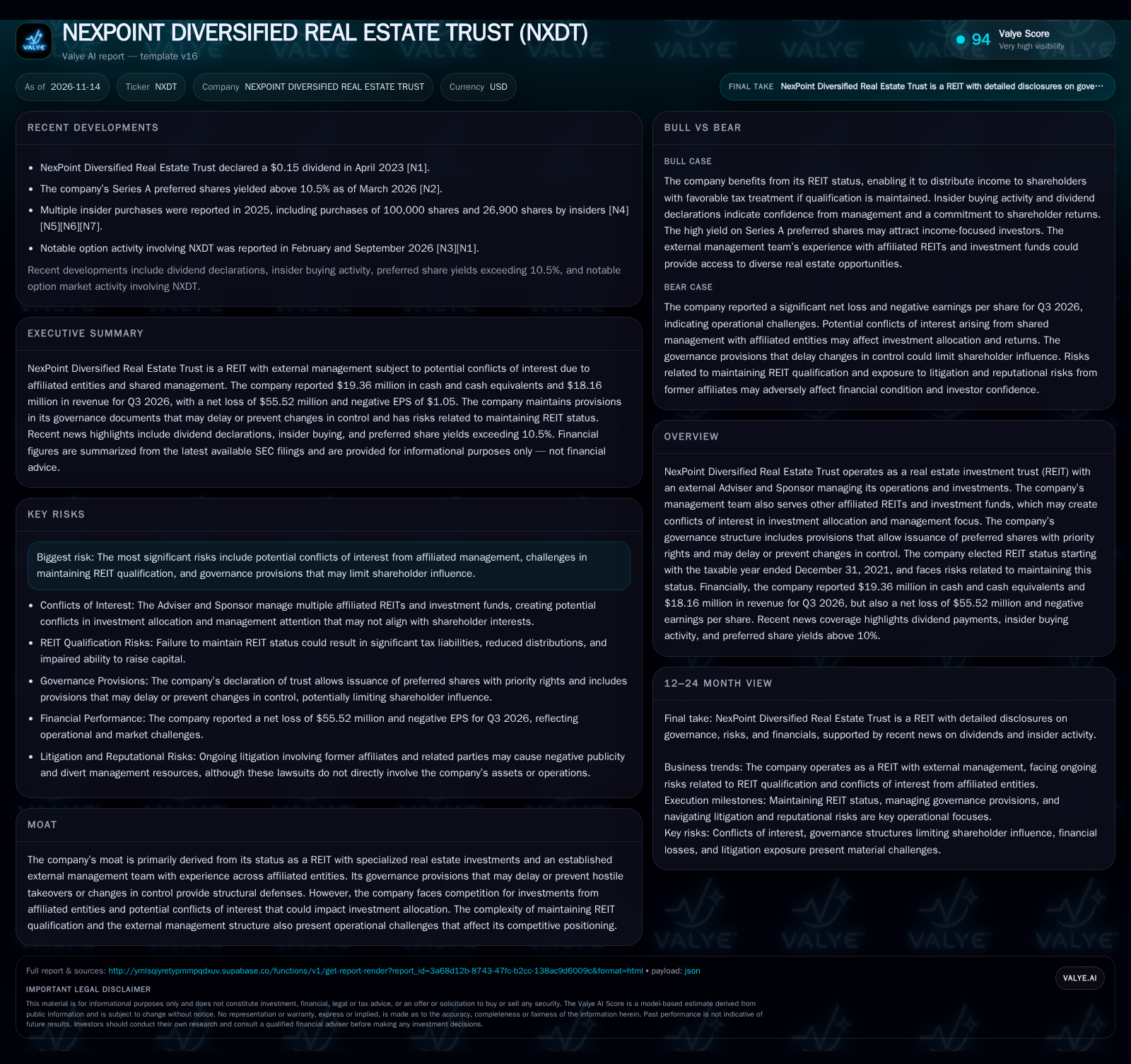
NXDT, a REIT with external management, reported a $55.5 million net loss for Q3 2026 despite generating $18.2 million in quarterly revenue. High-yield preferred shares and recent insider purchases underscore income appeal and management alignment, but governance structures and conflicts of interest raise questions about capital allocation and shareholder influence. The company's path forward hinges on its ability to sustain REIT status, manage leverage, and navigate reputational and litigation risks. [S2] [N2] [N4] [N5] [N6] [N7]
NexPoint Diversified Real Estate Trust (NXDT) exemplifies the modern externally managed REIT, combining income-oriented products with a complex governance and advisory structure. Recent financial results reveal persistent operational losses, even as the company maintains a profile of attractive preferred-share yields and visible insider buying. The real test for NXDT is whether its external management model and governance architecture can align capital allocation with shareholder value, or whether persistent conflicts and structural frictions will limit its ability to generate sustainable returns.
Recent Results Spotlight Losses, High-Yield Appeal, and Insider Activity
NXDT reported $18.16 million in revenue and a net loss of $55.52 million for the quarter ending September 30, 2026, with basic and diluted EPS of -$1.05. Cash and cash equivalents stood at $19.36 million at quarter end. These figures point to ongoing operational and perhaps asset-level challenges within the REIT’s portfolio. [S2]
The company’s Series A preferred shares yielded above 10.5% as of March 2026, a level that generally signals elevated perceived risk or market skepticism about future cash flows. [N2]
Insider buying activity was notable in 2025, with reported purchases of 100,000 shares and 26,900 shares among others, suggesting management or board members see value at current price levels despite reported losses. [N4] [N5] [N6] [N7]
The external Adviser is compensated based on managed assets, including leverage, which may influence risk posture and allocation decisions. [S1] [S2]
External Management, Leverage Incentives, and the REIT Income Model
As an externally managed REIT, NXDT’s core economic engine is the acquisition and operation of real estate assets, with income distributed to shareholders in line with REIT tax requirements. The Adviser’s compensation structure—tied to total managed assets, including leverage—creates a potential bias toward balance sheet expansion, which can amplify both returns and risks.
High preferred-share yields (exceeding 10.5% as of March 2026) reflect both the income orientation of the investor base and market perceptions of risk. While such yields can attract capital, they also raise the company’s cost of capital and may constrain flexibility if asset-level returns do not consistently exceed these thresholds.
Fixed costs tied to external management contracts and governance structures may limit operating leverage benefits, especially during periods of asset underperformance or elevated portfolio vacancy. Variable costs are largely driven by asset-level operating expenses and leverage servicing, with the Adviser’s incentives potentially misaligned with long-term common shareholder value if asset growth is prioritized over risk-adjusted returns.
Sustaining REIT qualification requires distributing most taxable income, which can restrict retained earnings for reinvestment or debt service. The cited source reports dividend-related activity; that disclosure alone does not establish dividend-policy continuity, management confidence, or a material constraint on capital flexibility.
Structural Defenses and Competitive Frictions in a Crowded REIT Landscape
NXDT’s competitive position is shaped by several structural and market forces. Governance provisions authorize the issuance of preferred shares with priority rights and impose high thresholds for changes in control, offering some defense against hostile takeovers but potentially limiting shareholder influence and capital market flexibility. [S1] [S2]
The company competes for real estate assets and capital not only with unaffiliated public REITs and private real estate funds but also with other vehicles managed by its own Adviser and Sponsor. This creates inherent conflicts of interest and could dilute the focus on maximizing NXDT’s unique portfolio value.
Externally managed REITs often face market skepticism regarding alignment of interests and cost efficiency, particularly when compared to internally managed peers. NXDT’s affiliation with an Adviser overseeing multiple funds may provide access to deal flow and asset management expertise, but also risks suboptimal asset allocation if incentives are not tightly aligned.
Specialized real estate focus and the ability to issue high-yielding preferred shares may attract a niche investor base, but the lack of clear structural moat—such as proprietary asset sourcing or irreplaceable locations—limits sustainable competitive advantage in the long term.
If Asset Performance and Capital Allocation Improve, Income Appeal Could Drive Re-Rating
The most favorable scenario for NXDT is one where asset-level returns stabilize or improve, allowing the company to cover its high preferred-share yields, reinstate or grow common dividends, and restore investor confidence. This could occur if management successfully allocates capital to higher-yielding or more resilient real estate segments, leverages Adviser expertise for superior asset selection, and manages leverage within prudent bounds.
New asset acquisitions or dispositions that demonstrably improve portfolio quality would further support bull arguments.
Falsification would be evident if net losses persist, preferred-share yields remain elevated or rise further, and common dividends are cut or suspended. Signs of asset impairment, persistent high vacancy, or deteriorating portfolio metrics would also undermine the upside case.
REIT Status Maintained, but Governance and Cost Frictions Weigh on Returns
The most plausible near-term scenario is that NXDT continues to operate as a going concern REIT, maintaining compliance with tax and distribution requirements but delivering uneven or modest returns to common shareholders. External management and governance complexities persist, with occasional portfolio turnover but no dramatic shift in performance or market perception.
This scenario would be confirmed by continued payment of preferred-share dividends, periodic insider buying, and stable but unremarkable revenue and FFO metrics. Preferred yields remain high, reflecting ongoing risk, and the company’s share price trades at a discount to net asset value, consistent with skepticism about alignment and long-term value creation.
A shift out of this scenario would require either a step-change in asset performance (positive or negative), a change in Adviser incentives or fee structure, or a governance event such as a hostile bid or activist campaign (which current provisions are designed to resist).
Persistent Losses, Governance Rigidity, and Conflict Risks Erode Value
A negative outcome for NXDT would result from sustained operational underperformance, persistent net losses, or asset impairments that force reductions in distributions or trigger breaches of REIT qualification. High preferred-share yields become unsustainable, potentially leading to payment deferrals or forced recapitalization.
If governance provisions continue to insulate external management from shareholder pressure, capital allocation may remain suboptimal, with risk-taking (via leverage) exacerbating losses rather than driving recovery. Conflicts of interest with affiliated vehicles could lead to adverse asset allocations or missed opportunities.
This scenario would be confirmed by repeated quarters of deep losses, suspension or reduction of preferred or common dividends, regulatory warnings about REIT status, or litigation that begins to affect core assets or distract management. An acceleration of insider selling would also be a strong negative signal.
Factors That Will Determine Whether NXDT Can Deliver Sustainable Shareholder Value
Preferred-share yield levels and market pricing: Declining yields would signal reduced perceived risk and improved market confidence; persistently high yields would suggest ongoing skepticism or stress.
Insider buying or selling activity: Continued insider accumulation would support management alignment, while net selling would undermine confidence.
Dividend continuity and coverage ratio: Stability or growth in common and preferred dividends, and clear coverage from operating cash flow, would evidence business model viability.
Portfolio turnover and asset acquisition/disposition quality: A useful metric would be the IRR or cash-on-cash returns of new investments, if disclosed, to test capital allocation discipline.
Leverage levels and debt service metrics: Increases in leverage not matched by asset performance could indicate rising risk, especially given Adviser compensation incentives.
Updates on litigation or reputational risks: Material developments in lawsuits involving former affiliates, or any spillover to NXDT’s assets or operations, would be important to monitor.
Governance changes or activist interest: Any movement toward internalization of management, fee renegotiation, or governance reform would be a significant signal regarding future alignment and value creation.
Disclaimer: This is research-only, informational analysis and not investment advice. It may include AI-generated interpretation and general industry context. Always verify important details using primary sources.

Comments