
Bion Environmental Technologies: Commercial-Ready Ammonia Recovery Meets Severe Funding and Execution Hurdles
Bion Environmental Technologies has optimized its ARS ammonia recovery technology and secured non-binding fertilizer offtake commitments, signaling initial market validation.
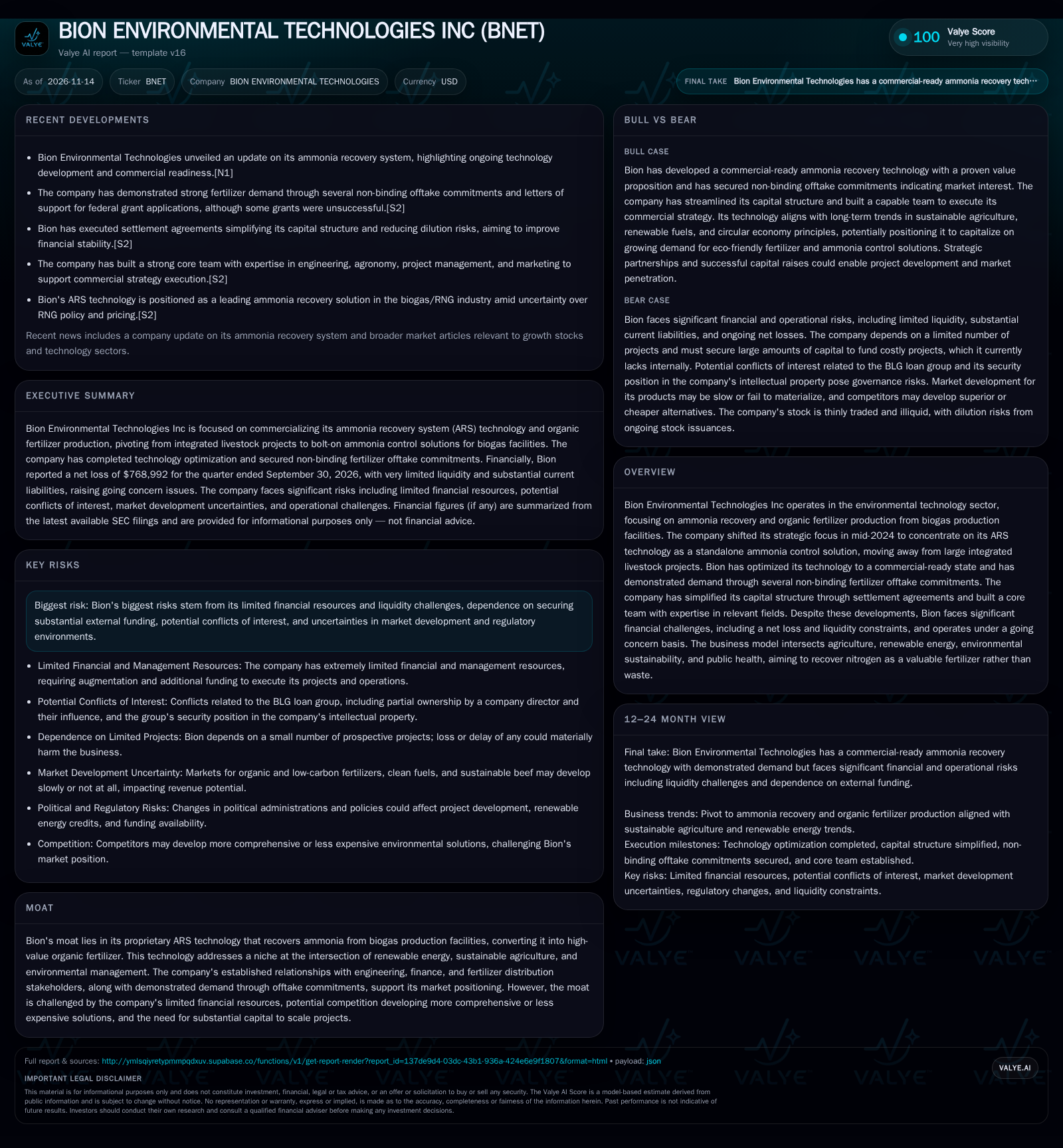
Bion Environmental Technologies has optimized its ARS ammonia recovery technology and secured non-binding fertilizer offtake commitments, signaling initial market validation. The next 12-24 months will test whether Bion can translate technology readiness and early demand into funded, revenue-generating projects before liquidity runs out. [S2]
Bion Environmental Technologies stands at a crossroads: armed with a commercial-ready ammonia recovery system and early fertilizer offtake interest, but encumbered by severe liquidity shortfalls and a history of operational and managerial instability. Its recent pivot to bolt-on ammonia control solutions for biogas producers reflects both a pragmatic market focus and an urgent need to demonstrate revenue traction. The company’s fate now depends on its ability to quickly secure substantial external funding, convert pilot interest into binding contracts, and navigate the complex, slow-moving markets for organic and low-carbon fertilizers. The next two years will determine whether Bion’s technology platform can seed a viable business—or remain a promising solution stranded by capital constraints and market inertia. [S2]
Acute Liquidity Stress and Technology Pivot Define Bion’s Current State
Bion Environmental Technologies has recently completed the optimization of its ARS ammonia recovery technology, positioning it as a standalone, commercial-ready solution for biogas facilities. Several non-binding offtake commitments for its AB10 nitrogen fertilizer have been executed, indicating demonstrated market interest but not yet translating to binding revenue. As of September 30, 2026, Bion reported a net loss of $768,992 for the quarter and held only $74,627 in cash versus $8,025,698 in current liabilities, resulting in an extremely low current and cash ratio of 0.01. These conditions prompted auditors to express substantial doubt about the company’s ability to continue as a going concern. Bion has also executed settlement agreements to simplify its capital structure, aiming to reduce dilution risk. The company’s financial fragility, pivot away from large livestock projects to bolt-on solutions, and the securing of early commercial interest define its current context and set the stage for its next strategic moves. [S2]
Economics of Ammonia Recovery: From Waste Management to Value-Added Fertilizer
Bion’s business model revolves around capturing ammonia emissions from biogas production, converting what is traditionally a costly environmental liability into a marketable organic fertilizer product. The economic thesis is that biogas operators, facing increasingly stringent ammonia emission regulations, will pay for ARS installation or share in the value of recovered fertilizer. Bion’s revenue could derive from equipment sales, licensing, ongoing service or maintenance fees, and/or direct fertilizer sales, but specific commercial mechanics remain undisclosed.
If the company can scale, a material portion of revenue would likely come from selling or licensing its technology to biogas plants and capturing a share of the premium for low-carbon organic fertilizer. Margins may be attractive if Bion can demonstrate cost-effective ammonia capture and conversion at commercial scale, especially if regulatory drivers increase demand for compliance solutions. However, the business will require significant upfront capital for project deployments, and the long project development cycles typical in environmental infrastructure could delay cash flows. The company reported cash and liquidity metrics for the period; these figures do not by themselves establish operating runway, investment capacity, financial flexibility, or financing capacity.
Niche Technology Advantage Versus Broader, Cheaper Solutions
Bion’s proprietary ARS technology is designed to address a specific pain point at the intersection of biogas production and sustainable agriculture: ammonia recovery and conversion into high-value fertilizer. This niche focus provides a technical edge if regulatory and market trends continue to prioritize nitrogen management and sustainable fertilizer sourcing. However, Bion faces competition from both conventional ammonia emission control technologies (such as scrubbers or chemical treatment systems) and more comprehensive waste-to-value platforms developed by better-resourced environmental and agricultural technology firms.
Switching costs for biogas operators may be moderate if ARS delivers measurable compliance and economic benefits, but entrenched relationships with existing technology providers and risk aversion in the biogas sector could slow adoption. The company’s lack of scale, limited financial resources, and dependence on a small number of initial projects leave it vulnerable to competitive displacement—especially if rivals offer bundled solutions, lower prices, or easier integration. Bion’s early offtake commitments and engineering/distribution relationships are positive signals, but do not yet constitute a durable moat.
Unlocking Value Through Rapid Project Execution and Market Adoption
The most favorable trajectory for Bion is contingent on securing substantial external funding, enabling the company to deploy the ARS system at several commercial biogas facilities within the next 12-24 months. Successful project execution would validate the technology at scale, convert non-binding offtake commitments into binding contracts, and generate initial revenue streams. If regulatory drivers for ammonia control tighten and the market for low-carbon, organic fertilizer accelerates, Bion could benefit from both compliance-driven demand and premium pricing for AB10 fertilizer.
Evidence that would confirm this scenario includes announcements of major funding rounds or strategic investments, conversion of pilot projects into multi-year commercial contracts, and growing backlog of binding fertilizer sales agreements. Sustained progress on permitting, construction, and commissioning of ARS installations, along with early revenue recognition and positive customer case studies, would further support the upside case.
Slow Commercialization and Ongoing Dilution as Bion Seeks Survival
The most plausible scenario is a protracted commercialization process: Bion secures small tranches of bridge funding, enabling limited project development and incremental technology validation, but struggles to achieve scale or profitability within the next two years. Non-binding offtake interest may convert slowly, with revenue generation lagging capital requirements. The company continues to issue equity or options to cover operating expenses, diluting existing shareholders and increasing volatility. Regulatory and market development for low-carbon fertilizers remain slow, and project delays or cost overruns are frequent given limited internal resources.
This scenario would be confirmed by continued low revenue, serial dilutive financings, and a lack of major commercial project wins. Persistent auditor going concern warnings and limited progress in converting offtake interest into binding, revenue-generating contracts would further support this view.
Liquidity Exhaustion and Strategic Asset Sale or Restructuring
If Bion fails to secure sufficient external capital on favorable terms, it risks running out of cash well before any meaningful revenue is generated. In this scenario, the company could default on obligations, forcing a fire sale of assets—potentially including its proprietary ARS technology, which is subject to creditor security interests—or even bankruptcy. Shareholder value would be severely impaired, and control of intellectual property could pass to creditors or competitors. Market development for low-carbon fertilizer stalls or is captured by better-capitalized rivals, leaving Bion’s platform stranded.
Evidence confirming this scenario would include default or impairment disclosures, asset sales at distressed valuations, resignation of key management, and a cessation of project development activity. An inability to raise further equity or debt, combined with rapid cash outflows and mounting payables, would also point to this outcome.
Milestones That Will Determine Bion’s Commercial and Financial Trajectory
Announcements of binding commercial contracts for ARS installations or AB10 fertilizer sales, rather than non-binding commitments, would be critical in validating market traction.
Disclosure of successful external funding rounds, strategic investments, or non-dilutive grant wins would help test whether Bion can bridge its liquidity gap.
If disclosed, revenue recognition from initial ARS project deployments or fertilizer sales would provide evidence of business model conversion.
Updates on project development timelines, including permitting, construction, and commissioning for first commercial ARS installations, would indicate execution momentum.
Material changes in the company’s current and cash ratios, or auditor commentary on going concern status, would signal improvement or deterioration in financial health.
Any new or escalated conflicts related to the BLG loan group’s security interest in Bion’s intellectual property could affect control and strategic flexibility.
Market signals such as regulatory changes favoring ammonia recovery, or evidence of accelerating demand for low-carbon fertilizers, would impact the company’s addressable opportunity.
A useful metric would be conversion rates of non-binding offtake agreements into binding, multi-year contracts, as this would test the depth of actual market demand.
Disclaimer: This is research-only, informational analysis and not investment advice. It may include AI-generated interpretation and general industry context. Always verify important details using primary sources.

Comments