
Finward Bancorp: Merger, Credit Quality, and the Search for Durable Profitability in a Regional Banking Landscape
Finward Bancorp’s pending merger with First Financial Bancorp comes amid rising non-performing loans and a heavily weighted commercial real estate portfolio. With regulatory headwinds easing, the company’s near-term outlook hinges on credit discipline, loan diversification, and its ability to extract value from scale.
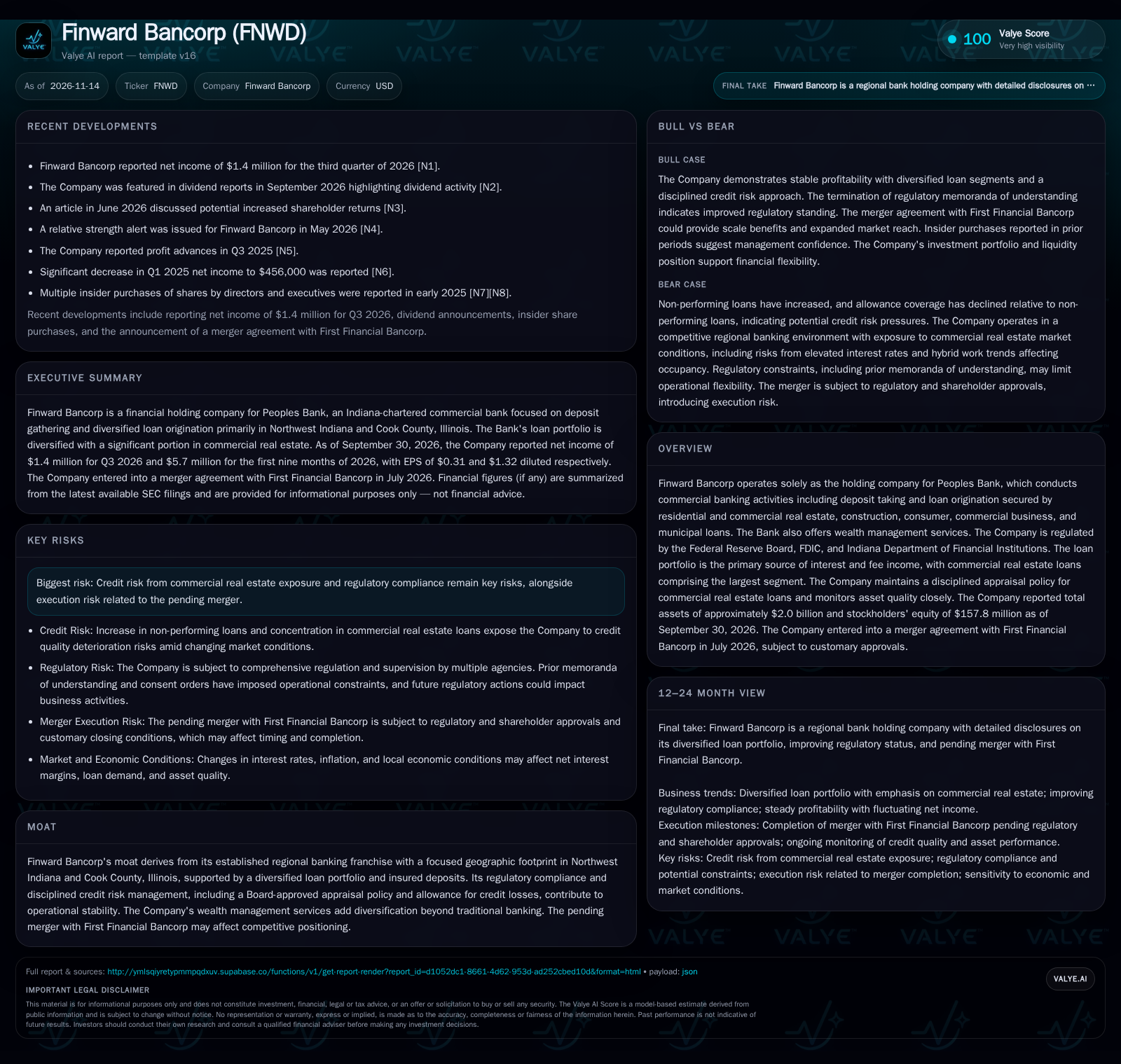
Finward Bancorp faces a pivotal period: a merger with First Financial Bancorp is pending, non-performing loans have risen to 1.12% of total loans, and commercial real estate accounts for nearly 40% of its portfolio. Regulatory scrutiny has eased, but credit risk and execution of the merger will shape the company’s trajectory over the next year [S2].
Finward Bancorp, a regional banking holding company operating through Peoples Bank, stands at a crossroads. Its Q3 2026 results reveal modest profitability but also a notable uptick in non-performing loans, particularly in its large commercial real estate portfolio. The company’s regulatory environment has improved, with supervisory restrictions recently lifted. However, the path forward is dominated by the execution risks and strategic opportunities of its planned merger with First Financial Bancorp, which could reshape its market position and operational scale. The interplay of credit quality, regional economics, and merger integration will determine whether Finward can build lasting value or face further headwinds.
Merger, Rising Credit Risk, and Regulatory Reset: Where Finward Bancorp Stands
As of September 30, 2026, Finward Bancorp reported total assets of approximately $2.0 billion, with net loans of $1.5 billion and deposits totaling $1.8 billion [S2]. Commercial real estate loans make up 39.8% of the loan portfolio, while residential real estate accounts for 30.3% [S2]. Non-performing loans increased to $16.8 million (1.12% of total loans), a material rise from $11.2 million (0.77%) at year-end 2025, signaling pressure on asset quality [S2]. The allowance for credit losses stood at $17.5 million, covering 104.5% of non-performing loans [S2]. The company’s regulatory standing improved following the termination of a supervisory memorandum of understanding in June 2026 [S2]. Most strategically, Finward entered a merger agreement with First Financial Bancorp in July 2026, subject to regulatory and shareholder approvals [S2]. These developments set the stage for a period of transition, with asset quality, merger execution, and market integration as primary variables.
Interest Margin, Loan Mix, and the Economics of a Regional Bank
Finward Bancorp’s core profitability is driven by the spread between interest earned on loans and investments and interest paid on deposits—the classic net interest margin model of community banking. The loan book is diversified, but heavily weighted toward commercial real estate, which typically offers higher yields but also greater cyclical risk. Fee income from wealth management provides some non-interest revenue, but is likely a minority of total income given the company’s scale and focus [S1] [S2].
Operating leverage is moderate: much of the cost base (branches, personnel, regulatory compliance) is fixed or semi-fixed, so incremental loan growth can improve margins if asset quality holds. However, rising non-performing loans can quickly erode those gains through higher provisions and potential charge-offs. Funding is primarily via local core deposits, which tend to be less expensive and more stable than wholesale funding, but in a rising rate environment, deposit costs and competition can increase. The investment portfolio ($279.9 million as of Q3 2026, primarily in municipal, MBS, and agency securities) serves as a liquidity buffer and earnings driver, but also exposes the bank to interest rate risk. Capitalization remains adequate, with equity at 7.8% of assets and book value per share at $36.45 [S2]. Absent a merger, growth is likely constrained by local market demographics and competition; the merger could provide scale, cost synergies, and product expansion opportunities if integration is well executed.
Regional Franchise Strengths Meet Sector Headwinds
Finward Bancorp’s competitive positioning is rooted in its established regional franchise—a 26-branch footprint in Northwest Indiana and Cook County, Illinois, markets where relationship banking, local knowledge, and brand familiarity help retain customers [S1]. The bank’s diversified loan book and insured deposit base provide some defense against shocks. However, the heavy commercial real estate exposure magnifies vulnerability to sector downturns, particularly as higher interest rates and hybrid work trends pressure property values and occupancy.
Competition is intense: community banks, credit unions, and larger regional/national banks all vie for the same customers. Digital-first and fintech entrants further compress margins and raise customer expectations for convenience and pricing. The terminated regulatory memorandum suggests prior operational or capital challenges, though the recent improvement may restore some strategic flexibility. The merger with First Financial Bancorp, if completed, may enhance competitive position by expanding geographic reach and potentially enabling technology upgrades and product innovation. However, integration risk and potential cultural mismatches are real, and customer attrition is always a threat in bank mergers.
Unlocking Value Through Merger Synergies and Asset Quality Stabilization
The most favorable outcome for Finward Bancorp combines successful merger execution with stabilization—or improvement—in credit quality. If the merger with First Financial Bancorp closes smoothly, the combined entity could realize cost synergies through branch consolidation, shared technology platforms, and streamlined back-office functions. Enhanced scale may enable better pricing power in both lending and deposit gathering, while a larger balance sheet could support more robust investment in digital banking and product innovation.
A benign credit environment, or effective risk management that keeps non-performing loans in check, would allow provision expenses to normalize and support improved profitability. Confirmation would come from post-merger financials showing expense reductions, stable or declining non-performing loan ratios, and positive operating leverage. Further, successful customer retention and cross-selling of wealth management and commercial services would indicate merger integration is adding value rather than destroying it. Evidence to watch for: closing of the merger, publicized post-deal cost saves, and a reversal in the upward trend of non-performing loans.
Stable Operations Amid Integration and Credit Discipline Challenges
The most plausible near-term scenario is one of operational continuity with moderate headwinds. The merger process may extend into 2027, with incremental integration steps and lingering uncertainty for customers and employees. Asset quality pressures—particularly in commercial real estate—may persist, leading to elevated provision expenses and limiting earnings growth even if net interest margins remain stable. The allowance for credit losses is currently sufficient to cover non-performing loans, but further deterioration would require additional provisioning.
Deposit competition and local economic trends are likely to keep growth muted. The bank’s core franchise is likely to remain intact, but significant margin expansion or loan growth is unlikely absent a major change in regional economic conditions or a successful, swift merger integration. Evidence supporting this scenario would include continued moderate profitability, stable but elevated non-performing loan ratios, and regular merger progress updates without major disruptions or integration failures.
Merger Stumbles and CRE Weakness Drive Asset Quality Deterioration
The most adverse scenario involves further deterioration in credit quality, especially within the commercial real estate portfolio, combined with a failed or significantly delayed merger. A surge in non-performing loans could trigger higher provision expenses, erode profitability, and potentially lead to regulatory scrutiny if capital ratios are threatened. If local economic conditions weaken—such as a commercial real estate downturn or spike in unemployment—Finward’s balance sheet could come under strain.
A failed merger, or one that results in significant customer attrition and operational disruption, would not only forfeit anticipated scale benefits but could also saddle the bank with integration costs and lost market share. Confirmation of this scenario would be sustained increases in non-performing loans, declines in capital ratios, negative surprises in merger process updates, or renewed regulatory interventions.
Factors That Will Determine Finward Bancorp’s Value Creation Post-Merger
Quarterly trend in non-performing loans as a percentage of total loans—continued increases would signal rising credit stress [S2].
Allowance for credit losses relative to non-performing loans—whether coverage remains above 100% or begins to erode [S2].
Progress and timeline updates on the merger with First Financial Bancorp, including regulatory and shareholder approvals [S2].
Post-merger expense synergies: disclosures on branch consolidation, technology integration, or back-office cost reductions (if disclosed).
Net interest margin trends—evidence of pressure from funding costs or competitive loan pricing (if disclosed).
Deposit growth or retention in the face of rising competition and rate pressure (if disclosed).
Commercial real estate portfolio performance, including delinquency and charge-off rates (if disclosed).
Retention of key commercial and wealth management client relationships post-merger (would help test the thesis).
Disclaimer: This is research-only, informational analysis and not investment advice. It may include AI-generated interpretation and general industry context. Always verify important details using primary sources.

Comments