
Northwest Biotherapeutics: Financing Lifelines and Regulatory Milestones Amid Severe Liquidity Strain
Northwest Biotherapeutics is advancing its immunotherapy pipeline with recent regulatory achievements and new financing arrangements, but faces acute liquidity pressures, persistent net losses, and reliance on external capital. The next phase hinges on successful clinical outcomes and the company's ability to convert scientific progress into commercial momentum.
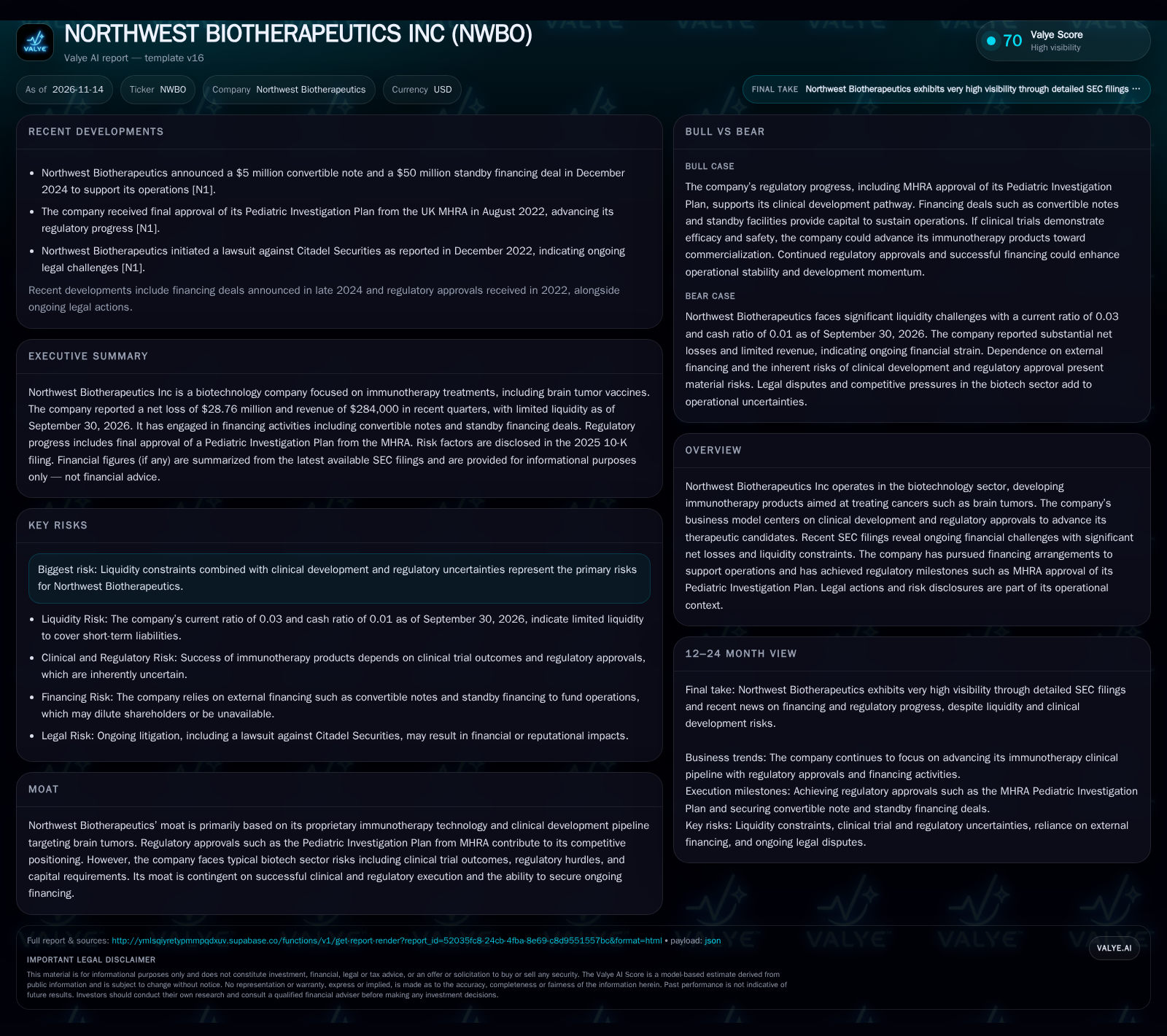
Northwest Biotherapeutics reported a net loss of $28.76 million for the quarter ended September 30, 2026, with minimal revenue and a critically reported current ratio of 0.03. The company has secured a $5 million convertible note and a $50 million standby financing facility, while achieving regulatory progress with MHRA approval of its Pediatric Investigation Plan. The sustainability of operations depends on further financing, successful clinical trials, and eventual regulatory approvals for its brain tumor immunotherapy candidates. [S2]
Northwest Biotherapeutics stands at a crossroads between scientific promise and financial peril. With a net loss of nearly $29 million in the latest quarter, cash on hand of just $725,000, and current liabilities exceeding $90 million, the company’s liquidity position is critical. Recent moves to secure a $5 million convertible note and a $50 million standby facility have bought time, but Northwest’s future now hinges on the successful advancement of its immunotherapy candidates through clinical trials and regulatory review. Regulatory wins, such as the MHRA Pediatric Investigation Plan approval, signal progress—yet the true test will be converting clinical milestones into durable commercial value. [S2]
Liquidity Crisis Meets Regulatory Progress: Northwest’s Present Reality
As of September 30, 2026, Northwest Biotherapeutics reported $725,000 in cash and cash equivalents against $90.9 million in current liabilities, yielding a current ratio of just 0.03 and a cash ratio of 0.01. This signals severe short-term liquidity strain, with the company’s ability to meet obligations dependent on external financing. [S2]
To support ongoing operations, management secured a $5 million convertible note and a $50 million standby financing facility in December 2024. These arrangements are vital for funding clinical trials and covering operating expenses, but they also underscore the company’s reliance on capital markets. [S1]
Despite these financial pressures, Northwest continues to make regulatory headway. The final approval of its Pediatric Investigation Plan by the UK MHRA in August 2022 is a critical step toward potential pediatric indications for its brain tumor immunotherapy candidates. [S1]
The reliance on external financing to bridge liquidity gaps introduces both operational and strategic risks. Should capital markets tighten or investor appetite wane, Northwest could face delays in trial progression or even forced pauses in development activities. This dynamic underscores the importance of not only securing financing but also managing cash flow prudently to extend runway. Furthermore, regulatory progress, while encouraging, does not guarantee expedited commercialization timelines; regulatory agencies may impose additional requirements or requests for data, potentially increasing costs and timelines. The interplay between financing availability and regulatory milestones will be critical in shaping the company’s near-term viability.
How Northwest Biotherapeutics’ Model Could Generate Value—If Clinical Milestones Are Achieved
Northwest Biotherapeutics’ business model is predicated on developing proprietary immunotherapy treatments for cancers, with a focus on brain tumors. The company currently generates minimal revenue ($284,000 for Q1 2024) and incurs substantial R&D and operating expenses, resulting in persistent net losses. Fixed costs remain high due to ongoing clinical development and regulatory compliance demands. [S2]
Revenue potential is contingent on successful clinical outcomes and subsequent regulatory approvals. If approved, pricing for advanced immunotherapies in oncology can be substantial, often reflecting the high unmet need and limited competition. However, volumes are likely to be constrained by indications (e.g., glioblastoma), and initial adoption may be gated by clinical guidelines, reimbursement hurdles, and physician acceptance.
The company’s capital requirements are significant: bridging the gap from late-stage trials to commercialization typically demands tens of millions in additional funding. Without positive clinical data and clear regulatory pathways, Northwest will remain dependent on dilutive financings or costly debt, which could further erode shareholder value. Operating leverage is theoretically possible if a product reaches market, but until then, losses are likely to persist.
The business model’s sensitivity to clinical outcomes creates a high binary risk profile. Positive trial results could rapidly shift the company’s valuation and funding prospects, while negative or ambiguous data might lead to capital scarcity and operational retrenchment. Additionally, reimbursement landscapes for novel immunotherapies remain complex and variable across geographies, necessitating strategic engagement with payers and health technology assessment bodies early in development. The ability to demonstrate not only clinical efficacy but also cost-effectiveness will influence market access and pricing power. Moreover, the scalability of manufacturing and supply chain considerations for cell-based therapies could materially impact gross margins and operational leverage once commercialized.
Battling for Relevance in Immuno-Oncology: Northwest’s Place in a Crowded Field
Northwest’s competitive positioning relies on the novelty and clinical efficacy of its immunotherapy platform for brain tumors. The company faces entrenched competition from large, well-capitalized oncology players, academic spinouts, and other emerging biotechs developing cell therapies, vaccines, and checkpoint inhibitors.
Advantages could stem from proprietary technology or strong clinical data, but these have yet to be validated in pivotal trials. The field is characterized by rapid innovation, high attrition rates, and frequent shifts in standard of care driven by new trial results. Substitutes include existing chemotherapy, radiation, surgical approaches, as well as other experimental immunotherapies.
Switching costs for payers and providers are low unless Northwest’s therapies demonstrate clear survival or quality-of-life benefits. Intellectual property and regulatory exclusivity would be vital moats if the products succeed, but until then, the company’s differentiation rests on unproven claims.
In a rapidly evolving immuno-oncology ecosystem, differentiation hinges on both scientific innovation and strategic execution. The presence of multiple competing modalities—such as CAR-T therapies, checkpoint inhibitors, and oncolytic viruses—means Northwest must establish a clear clinical niche supported by robust data. Moreover, partnerships with academic institutions or larger pharmaceutical companies could provide critical resources and validation, but may also dilute control or future economics. Intellectual property protection is necessary but insufficient alone; the company must also navigate patent challenges and biosimilar competition over time. Market dynamics, including physician prescribing habits and treatment guidelines, will further influence uptake and competitive positioning.
Clinical Trial Success and Regulatory Approvals Could Transform the Outlook
If Northwest’s lead immunotherapy candidates demonstrate compelling efficacy and safety in late-stage trials, the company could secure regulatory approvals in key markets. This would unlock commercial partnerships, licensing deals, or direct market entry, potentially yielding substantial revenue given the high value placed on novel oncology treatments.
Confirmation would come from positive pivotal trial data releases, regulatory filings and approvals (e.g., FDA, EMA), and evidence of commercial traction such as distribution agreements or initial sales. Additional upside could emerge if the platform technology is validated for other cancer indications.
Falsification would come from failed or inconclusive trial results, regulatory setbacks, or inability to raise sufficient capital to complete development.
Sustained Losses and Ongoing Dilution as the Default Trajectory
The most plausible scenario is continued operating losses and reliance on external capital. The company will likely need to raise additional funds before the next significant clinical milestone, resulting in further dilution or unfavorable financing terms. [S2]
Clinical progress may be incremental, with regulatory submissions taking longer than expected and no near-term revenue inflection. The business could remain in a pre-commercial state for several more years, with sporadic regulatory wins offset by persistent cash burn.
This scenario would be confirmed by continued net losses, repeated financing announcements, and a lack of transformative clinical or commercial developments.
Failure to Secure Capital or Clinical Progress Could Lead to Restructuring or Asset Sales
If Northwest is unable to raise sufficient capital or if clinical trials fail to demonstrate efficacy, the company may be forced to restructure, sell assets, or pursue bankruptcy protection. Its acute liquidity constraints make it especially vulnerable to adverse events, delays, or negative trial outcomes. [S2]
This scenario would be confirmed by missed payroll or debt payments, abrupt operational cutbacks, or disclosures of going-concern uncertainty. Asset sales or licensing of intellectual property at distressed valuations could follow if no partners or acquirers emerge.
What Will Prove Northwest’s Immunotherapy Thesis—And What Could Break It?
Disclosure of pivotal clinical trial results for lead immunotherapy candidates—positive or negative outcomes would dramatically shift the outlook.
Updates on regulatory submissions and approvals (e.g., FDA, EMA) beyond the Pediatric Investigation Plan—progress would validate the development pathway.
Announcements of new financing deals, equity offerings, or debt arrangements—frequency and terms will indicate the company’s funding runway.
Net cash flow and quarterly cash burn rates—if disclosed, these would clarify the urgency of additional capital needs.
Any changes in current liabilities or evidence of renegotiating debt—would signal flexibility or distress in managing obligations.
Commercialization or partnership announcements (e.g., licensing deals with larger pharma companies)—would mark a shift from pre-revenue to revenue-generating operations.
Resolution or escalation of litigation (such as the Citadel Securities lawsuit)—could have material financial or reputational consequences.
Disclaimer: This is research-only, informational analysis and not investment advice. It may include AI-generated interpretation and general industry context. Always verify important details using primary sources.

Comments