
zSpace’s AR/VR Education Bet: Proprietary Platform Meets Severe Financial Headwinds
zSpace, Inc. built a differentiated AR/VR learning platform for K-12 and CTE classrooms, blending proprietary hardware and software. But as government education budgets tightened, revenue collapsed, liquidity evaporated, and strategic alternatives became a necessity. What would it take for zSpace to stabilize or recover—and what could force a terminal outcome?
zSpace, Inc. delivers AR/VR educational solutions via proprietary hardware and software, targeting K-12 and CTE markets. Its future depends on accessing capital, resolving debt and legal overhangs, and shifting its business mix toward higher-margin software, but execution risks are acute and downside scenarios are prominent. [S1] [S2]
zSpace, Inc. once stood out for its immersive AR/VR learning platform, offering interactive 3D experiences without the need for goggles—a compelling value proposition for K-12 and career technical education. But a sharp pullback in public education spending triggered a collapse in hardware revenues, leaving the company with a mounting deficit, delisting from Nasdaq, and acute liquidity distress. Now in default on senior debt, facing a major lawsuit, and unable to fund inventory, zSpace’s survival hinges on securing new capital or a strategic transaction. The question is whether its proprietary platform and content library are enough to attract a lifeline, or whether operational and financial pressures will force a restructuring or wind-down.
Liquidity Crisis, Debt Default, and Revenue Contraction Define the Present
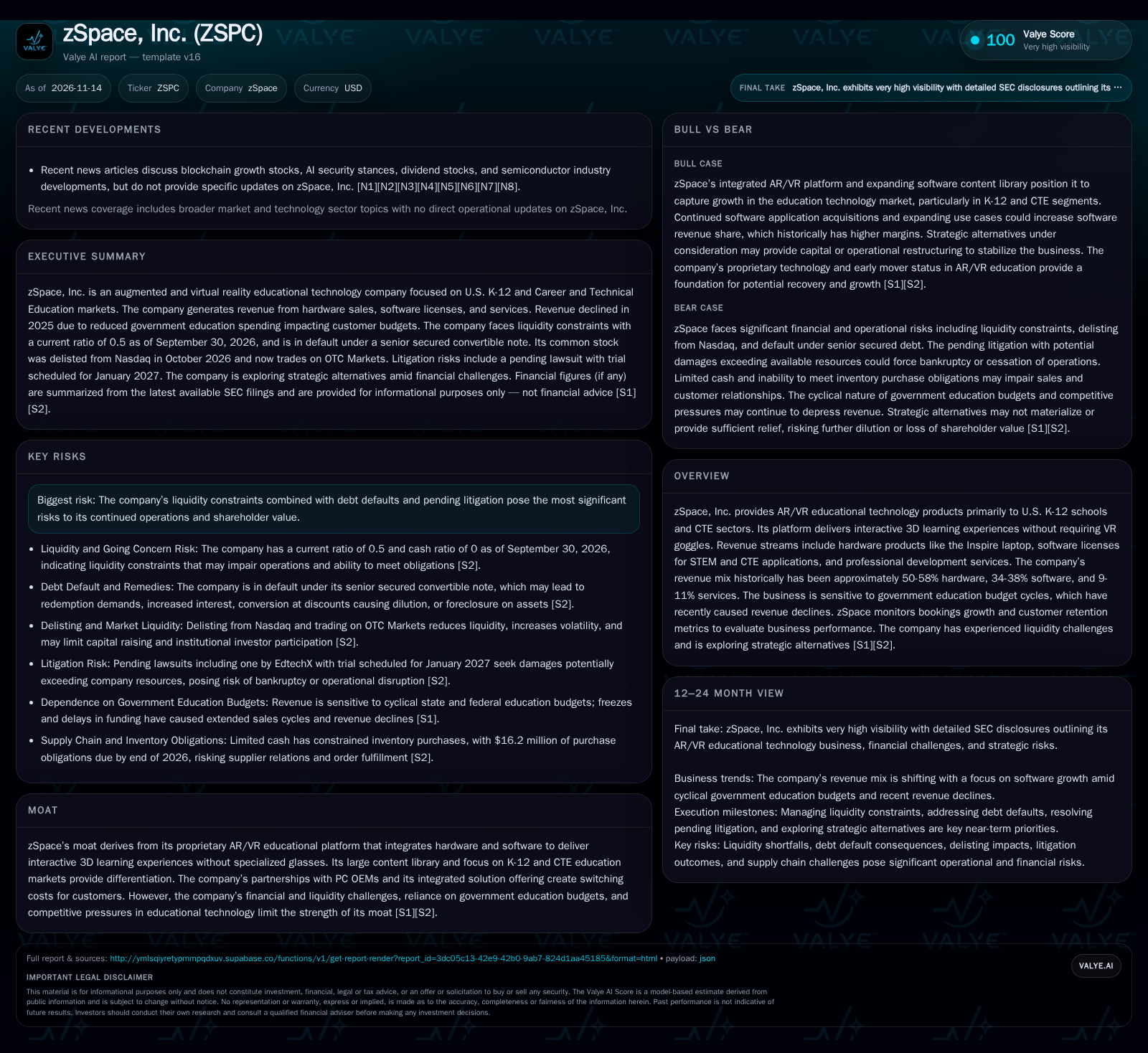
Four facts define zSpace’s current predicament. First, in 2025, total revenue plunged 27% to $27.9 million, driven mainly by a drop in hardware sales as public school district customers delayed purchases amid government funding freezes [S1]. Second, as of September 30, 2026, the company’s current assets ($6.1 million) were dwarfed by current liabilities ($12.2 million), resulting in a current ratio of 0.5 and a cash ratio of zero—direct evidence of severe liquidity strain [S2]. Third, zSpace is in default on a $4.3 million senior secured convertible note held by 3i, LP, and the noteholder has broad rights to demand repayment or initiate foreclosure [S2]. Fourth, the company has been delisted from Nasdaq and now trades on the OTC Markets, which typically reduces share liquidity and limits access to institutional capital [S2]. Together, these facts suggest that without immediate new funding or a successful strategic transaction, zSpace may not be able to meet its obligations or continue operations in its current form.
How AR/VR Education Economics Break Down—and Where Leverage Could Emerge
zSpace’s business model blends hardware sales (51–58% of revenue in recent years), software licensing (34–38%), and services (9–11%) [S1]. Hardware—primarily proprietary laptops and styluses—has historically been the main revenue driver, but is capital intensive, margin-compressed, and highly sensitive to education funding cycles. Software, in contrast, is priced per device/user and contract length, and likely carries higher gross margins, especially as content libraries grow and incremental distribution costs fall. Services such as installation and professional development generate additional revenue but are less scalable.
The economics of the model suggest that operating leverage would improve if software and recurring license revenue grew to a larger share of the mix. However, scaling software in the K-12 sector depends on installed hardware, school district procurement cycles, and budget stability—factors outside zSpace’s control. The capital required to fund hardware inventory and development is substantial, and with the company unable to meet $16.2 million in inventory purchase obligations due by year-end 2026, its ability to fulfill orders and support software adoption is impaired [S2]. This creates a negative feedback loop: liquidity shortfalls limit hardware shipments, which in turn constrain software growth and recurring revenue potential.
Differentiation Through Immersive Platform—But Moat Erodes Amid Financial Stress
zSpace’s core differentiator is its proprietary AR/VR platform, which delivers interactive 3D educational content without requiring VR goggles or specialty glasses—a clear usability advantage for classroom environments [S1]. Its large content library and focus on K-12 and CTE applications provide further differentiation. In theory, integration of hardware and software could increase switching costs for school districts, as does the need for teacher training and curriculum alignment.
However, the strength of this moat is compromised by the company’s financial distress. Liquidity constraints can undermine customer confidence, delay implementation, and disrupt service/support, making it easier for competitors—ranging from other AR/VR providers to traditional EdTech platforms with 3D content—to win share. Hardware-centric models are also vulnerable to rapid technological change and the risk that general-purpose devices (e.g., tablets with AR capabilities) could substitute for proprietary systems if software is not sufficiently differentiated. As a result, while zSpace’s platform offers real advantages, its competitive position is precarious without the resources to invest in content, support, and customer acquisition.
Strategic Transaction or Recapitalization as a Catalyst for Recovery
A plausible upside chain begins with zSpace securing a strategic investor, acquirer, or rescue financing that provides sufficient runway to address immediate obligations—paying down senior debt, funding inventory, and stabilizing operations. This could enable the company to fulfill backlog, restore customer confidence, and resume hardware shipments, which in turn would support software adoption and recurring revenue growth.
If a strategic partner recognizes unique value in zSpace’s proprietary platform, content library, or installed base, the company could command a premium for its technology or intellectual property. Evidence that would confirm this scenario includes a definitive agreement for a sale or recapitalization, new capital infusion sufficient to cure debt default and fund operations, and announcements of renewed or expanded contracts with school districts. Falsification would occur if no transaction materializes and liquidity continues to deteriorate, resulting in further operational disruptions or bankruptcy filings.
Protracted Uncertainty as zSpace Seeks Lifeline Amid Structural Constraints
The most likely scenario is a period of extended uncertainty, with zSpace continuing to operate under acute financial strain while actively seeking strategic alternatives. Hardware shipments may remain constrained by lack of inventory funding, leading to further booking declines and customer cancellations. Litigation risk, particularly from the EdtechX lawsuit, looms large, and the outcome is unpredictable but could be catastrophic if damages are awarded at the claimed scale.
Revenue is likely to remain depressed as government education budgets recover slowly and procurement cycles remain elongated. The company may pursue incremental cost reductions or attempt to monetize non-core assets, but these actions are unlikely to resolve the structural funding gap. Confirmation of this scenario would be ongoing delays in strategic transactions, continued defaults or forbearance agreements with lenders, and limited new contract wins. Falsification would require either a major capital infusion or a sudden positive legal outcome.
Default Cascades and Operational Paralysis Could Precipitate a Forced Liquidation
Absent a strategic transaction or new funding, zSpace faces a cascading series of adverse outcomes. In default on senior debt, the company could see foreclosure on assets, forced liquidation, or a bankruptcy filing. Insufficient cash to meet $16.2 million in inventory obligations could lead to supplier lawsuits, inability to fulfill orders, and rapid erosion of customer trust. The pending EdtechX litigation, with potential damages exceeding $60 million, could trigger insolvency if an adverse verdict is rendered [S2].
In this scenario, value for common shareholders would likely be extinguished, and customers could be left with unsupported hardware/software. Evidence confirming this trajectory would include acceleration of creditor remedies, bankruptcy filings, and loss of key personnel or customers. Falsification would require an unexpected capital injection or favorable settlement of major liabilities.
Milestones That Will Determine Whether zSpace Can Survive or Restructure
Resolution (or lack thereof) of the senior secured note default, including whether the lender exercises foreclosure or agrees to forbearance.
Progress or definitive announcements on strategic alternatives—such as a sale, recapitalization, or major investment—that would address liquidity needs.
Ability to secure funding or renegotiate terms to meet $16.2 million in inventory purchase obligations by year-end 2026.
Outcome of the EdtechX lawsuit, including any settlements, trial delays, or adverse verdicts, and the magnitude of potential damages.
Trends in new bookings and customer retention rates, if disclosed, as a proxy for ongoing demand and market confidence.
Shifts in revenue mix, particularly evidence that software and services are becoming a larger share of total revenue.
Announcements of major customer wins, renewals, or cancellations, which would signal either momentum or further erosion.
Changes in leadership or board composition, which could indicate a shift in strategic direction or response to distress.
Disclaimer: This is research-only, informational analysis and not investment advice. It may include AI-generated interpretation and general industry context. Always verify important details using primary sources.

Comments