
Eva Live Inc: AI Advertising Innovation Meets Financial Volatility and Execution Risk
Eva Live’s rapid expansion into AI-powered marketing platforms and recent Nasdaq uplisting highlight its ambition, but volatile profitability and significant note obligations underscore the need for disciplined execution and market validation.
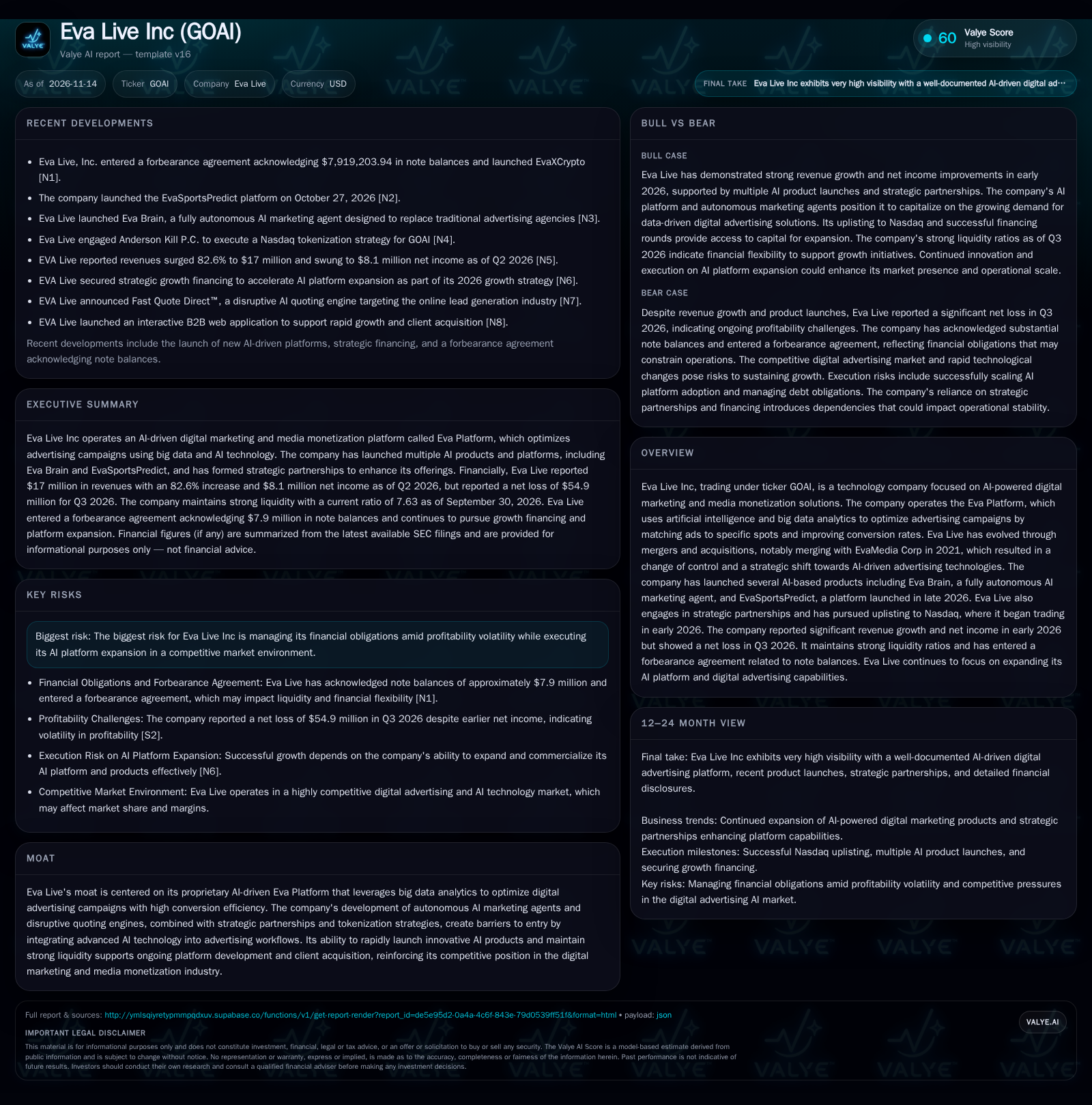
Eva Live Inc (GOAI) is a technology company specializing in AI-driven digital marketing and media monetization. The firm has launched multiple AI products—including Eva Brain and EvaSportsPredict—while reporting significant revenue growth and a Nasdaq uplisting in 2026. However, a sharp swing from early-year net income to a substantial Q3 net loss and the entrance into a forbearance agreement over $7.9 million in notes raise questions about sustainable profitability and balance-sheet flexibility. The next phase hinges on Eva Live’s ability to scale its AI platform, manage financial obligations, and demonstrate durable adoption in a fiercely competitive ad-tech landscape. [S2] [N1] [N5]
Eva Live Inc’s aggressive push into AI-driven digital advertising and recent Nasdaq uplisting signal both ambition and rapid operational evolution. With multiple new platforms launched in 2026 and an 82.6% revenue increase in early-year results, the company is positioning itself at the intersection of AI, ad-tech, and data analytics. Yet, a sudden pivot from profitability to a $54.9 million Q3 net loss and the need for a forbearance agreement on $7.9 million in notes reveal substantial risks. The company’s future will rest on whether its AI products can deliver sustainable adoption and margin, and if management can balance innovation with financial discipline in a crowded, fast-changing market. [S2] [N1] [N5]
Major Revenue Volatility, Product Launch Cadence, and Debt Forbearance Define the Current Landscape
Eva Live Inc reported $17 million in revenues and $8.1 million in net income as of Q2 2026, representing an 82.6% year-over-year surge. However, the company posted a sharp $54.9 million net loss in Q3 2026, signaling significant volatility in operating performance [S2] [N5].
In parallel, Eva Live launched several new AI-driven platforms—including Eva Brain, EvaSportsPredict, and Fast Quote Direct—in 2026, indicating a rapid product development pace and a focus on expanding its digital marketing footprint [N2] [N3] [N7].
The company entered a forbearance agreement on $7.9 million in note balances, a move that highlights both near-term debt pressures and management’s willingness to negotiate for runway [N1].
Eva Live’s successful Nasdaq uplisting and new growth financing provide access to capital markets and support for its expansion strategy, but do not by themselves guarantee operational or financial stability [N6].
AI Monetization, Platform Leverage, and the Challenge of Scaling Profitable Growth
Eva Live’s business model centers on monetizing digital advertising through its proprietary AI-driven Eva Platform, which uses big data analytics to optimize campaign performance. Theoretically, this should allow for higher conversion rates, better ad placement, and improved return on advertising spend for clients.
The company has not disclosed precise commercial mechanics such as the structure of its revenue streams, pricing models, or contract terms. As such, it is unclear whether revenue is primarily generated through campaign-based fees, recurring subscriptions, performance-based arrangements, or a mix of these. If Eva Brain and similar offerings function as autonomous marketing agents, they could potentially replace traditional agency functions and drive higher margins at scale—provided that customer acquisition and retention costs do not offset these gains.
Eva Live’s rapid product expansion—including the launch of Fast Quote Direct, targeting the online lead-generation industry—suggests a strategy to address multiple advertising market segments. However, the fixed costs associated with R&D, platform development, and ongoing AI model training could create substantial operating leverage: profitability may be highly sensitive to top-line growth and client retention.
The strong reported current ratio (7.63 as of September 2026) indicates a reported liquidity position on paper, but the forbearance agreement and recent net loss signal that cash burn and debt service may consume resources quickly if revenue momentum stalls [S2] [N1].
AI Differentiation Versus Intense Digital Ad-Tech Competition
Eva Live’s competitive pitch rests on the automation and efficiency of its AI-driven platform, positioning itself as a replacement for traditional advertising agencies and as a disruptor in online lead generation and campaign optimization.
The market for AI-powered advertising is highly competitive and rapidly evolving. Major digital ad-tech platforms, marketing clouds, and AI-enabled agencies all vie for share, often with deeper balance sheets, entrenched client relationships, and robust data access.
Eva Live’s moat is based on proprietary technology, the integration of autonomous AI agents, and rapid product rollout. However, these advantages are vulnerable to commoditization as AI tools become more widely available and as larger competitors incorporate similar automation into their offerings.
Switching costs for advertising clients may be low unless Eva Platform demonstrates sustained, measurable improvements in conversion or ROI. The company’s ability to establish recurring revenue streams or long-term contracts—if achieved—would be an important marker of competitive durability, but such arrangements have not been disclosed.
If AI Product Adoption Accelerates and Monetization Deepens, Margin Expansion Could Follow
The most favorable scenario is that Eva Live’s new AI products—especially Eva Brain and Fast Quote Direct—achieve widespread adoption, attracting both direct advertisers and marketing agencies seeking automation and measurable ROI improvements.
If the Eva Platform’s AI-driven optimization consistently delivers superior conversion rates and cost savings, Eva Live could secure multi-year client relationships, driving recurring revenue and enabling operating leverage as fixed costs are spread over a larger client base. However, the existence and structure of such client relationships or recurring revenue streams have not been disclosed.
Strategic partnerships, effective use of new growth financing, and successful navigation of the forbearance period would allow the company to continue investing in product innovation and go-to-market expansion.
Evidence supporting this scenario would include: accelerating customer acquisition and retention metrics (if disclosed), rising gross margin, reduced quarterly net losses or a return to net income, and tangible case studies of campaign performance improvements relative to industry benchmarks.
Balanced Growth Offset by Execution Risks and Capital Constraints
The most plausible trajectory is that Eva Live achieves continued, but uneven, growth in its AI-driven digital marketing platform, with new product launches supporting customer pipeline expansion but also creating operational complexity and lumpy financial performance.
Profitability may remain volatile as the company balances aggressive R&D and sales investment with the need to manage debt service and cash burn. The forbearance agreement provides temporary relief, but underlying note obligations could resurface as a constraint if top-line growth decelerates.
Competitive pressure from established ad-tech players and emerging AI startups will likely limit Eva Live’s ability to command premium pricing or lock in long-term contracts unless it can clearly demonstrate superior outcomes. The company has not disclosed details on contract duration or recurring revenue.
Confirmation would come from stabilization in quarterly net income/loss, evidence of recurring revenue streams (if disclosed), and ongoing product development cadence. Falsification would include further sharp net losses, rising debt balances, or signs of customer churn.
Product Monetization Falls Short, Debt Burden Intensifies, and Competitive Pressures Erode Share
In a negative scenario, Eva Live’s AI platforms fail to achieve meaningful market traction—either due to insufficient differentiation, weak client outcomes, or rapid competitive response from larger incumbents.
If customer acquisition slows and churn rises, revenue growth would stall, leaving the company unable to cover high fixed costs and debt service. The forbearance agreement could lapse into default or force unfavorable restructuring if new financing or operational cash flow is not secured.
Aggressive R&D and product launch spending without corresponding revenue could accelerate cash burn, leading to further dilution, asset sales, or a strategic pivot.
Evidence for this scenario would include declining or plateauing revenues, persistent or widening net losses, inability to refinance or reduce note balances, and a slowdown in product launches or customer wins.
What Will Determine Whether Eva Live’s AI Ambitions Translate to Durable Value?
Quarterly revenue and net income/loss trends: sustained growth and margin improvement (or lack thereof) will be the clearest signal of business momentum [S2].
Updates on note balances and forbearance terms: any changes in debt obligations or refinancing activity will impact potential financial flexibility [N1].
Adoption rates for new AI products—Eva Brain, EvaSportsPredict, Fast Quote Direct—if disclosed, would help assess product-market fit and client demand.
Gross margin and operating leverage: improvement would suggest successful scaling; deterioration would point to cost or pricing pressure.
Client concentration and retention metrics, if disclosed: high dependency on a few clients or weak retention would increase risk.
Evidence of recurring revenue streams, contract duration, or multi-year customer relationships—would help test the thesis of competitive durability.
Competitive responses from larger ad-tech players or AI marketing platforms: new product launches or pricing moves could challenge Eva Live’s positioning.
Disclaimer: This is research-only, informational analysis and not investment advice. It may include AI-generated interpretation and general industry context. Always verify important details using primary sources.

Comments