
XMax Inc.: Furniture Distribution Roots Meet High-Stakes AI Diversification
XMax Inc.
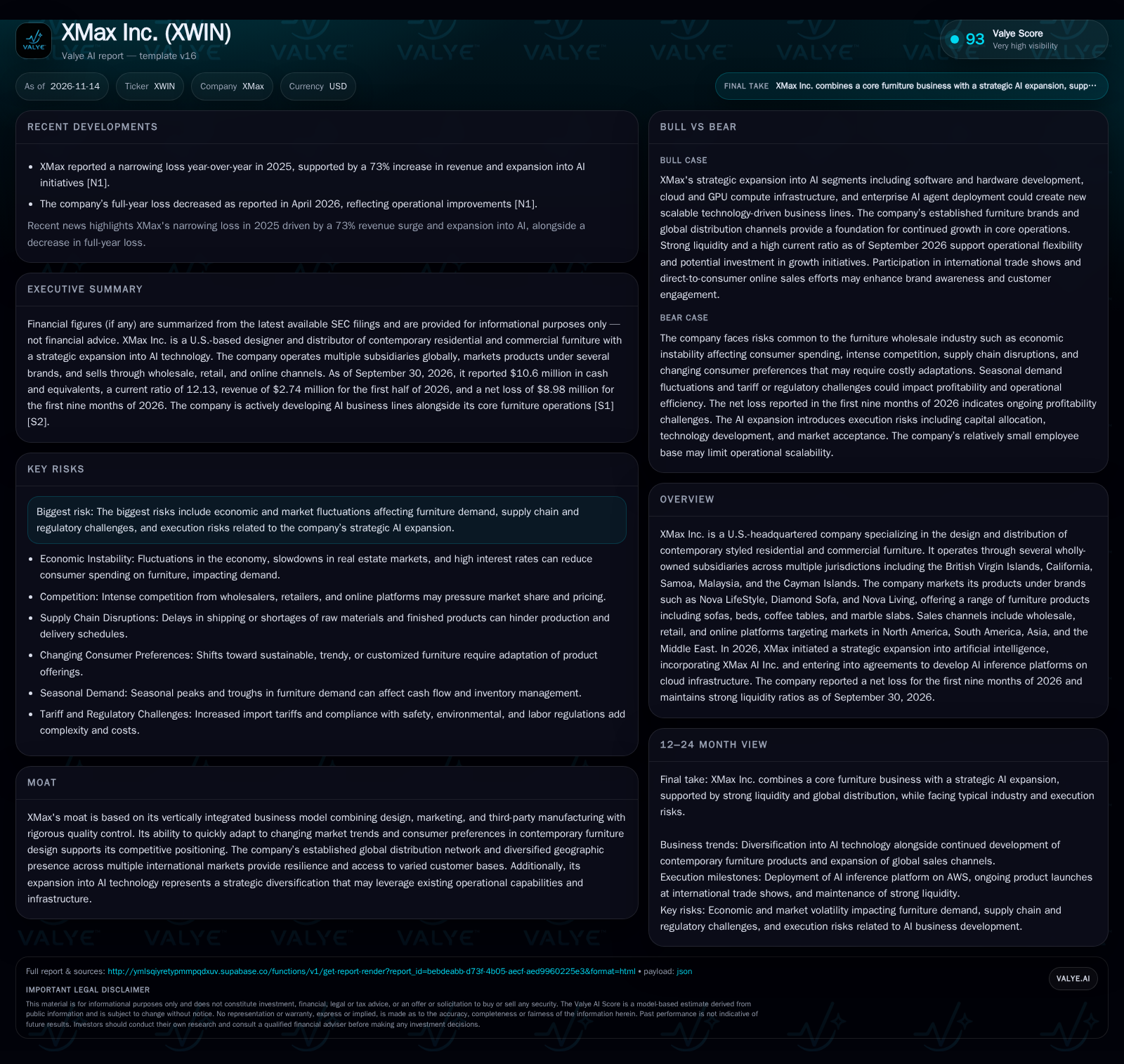
XMax Inc. is a global designer and distributor of contemporary furniture with a recent push into artificial intelligence. As of September 2026, the company reports strong cash reserves but continues to operate at a loss. The new AI initiative represents a significant diversification, with execution risk heightened by the company’s small workforce and ongoing challenges in its core furniture segment. Success will depend on XMax’s ability to generate scalable revenue from AI while stabilizing or growing its legacy operations. [S1] [S2]
XMax Inc. stands at a critical juncture, blending its legacy as a global contemporary furniture designer and distributor with a bold expansion into artificial intelligence. XMax’s ability to leverage its distribution infrastructure and brand equity while creating scalable value from AI will determine whether this pivot yields renewed growth or compounds risk.
Liquidity, Losses, and a Strategic AI Bet: Where XMax Stands Now
As of September 30, 2026, XMax Inc. reported $10.6 million in cash and equivalents, with current assets totaling $23.9 million and current liabilities of $1.97 million. This results in a notably reported current ratio of 12.13 and a cash ratio of 5.39, indicating significant short-term liquidity on the balance sheet. Despite this, the company generated only $2.74 million in revenue for the first half of 2026 and posted a net loss of $8.98 million for the nine months ended September 2026, with basic and diluted EPS of -$0.14 per share. [S2]
In March 2026, XMax’s board approved a strategic expansion into artificial intelligence, subsequently incorporating XMax AI Inc. and entering a $400,000 agreement to deploy an AI inference platform on AWS infrastructure. This marks a major diversification from its core business of designing and distributing contemporary furniture under brands such as Nova LifeStyle and Diamond Sofa. [S2]
The company’s principal sales markets remain North America (52.1% of 2025 sales) and Hong Kong (47.4%), reflecting both geographic diversification and exposure to global economic trends. [S1]
How XMax’s Revenue Model Faces Pressure and Opportunity
XMax’s traditional revenue model is anchored in the design, marketing, and distribution of contemporary furniture, with manufacturing outsourced to third parties. Sales flow through wholesale, retail, and online channels, supporting international reach but exposing the business to industry-standard risks: thin margins, inventory and logistics complexity, and sensitivity to economic cycles. The company’s OEM relationships and brand portfolio provide some pricing flexibility, but the fragmented nature of the furniture market limits sustained pricing power.
Operating leverage is currently unfavorable: persistent net losses suggest that fixed costs—such as salaries, marketing, and logistics—outpace gross profit from relatively modest sales volumes. The company’s exit from the jade mats business and closure of Nova Malaysia signal a willingness to prune underperforming segments, but also reflect the challenge of scaling profitably in a highly competitive sector.
The AI initiative, if commercialized, could dramatically alter XMax’s economics. AI platforms can offer high-margin, recurring-revenue streams if sold as SaaS or managed services, especially if the company leverages cloud infrastructure efficiently. However, the up-front investment in development, cloud deployment, and customer acquisition is significant, and there is little evidence yet of revenue contribution from this segment. The small workforce (22 employees as of year-end 2025) may constrain both operational execution and the pace of innovation.
Competitive Dynamics: From Furniture Fragmentation to AI Ambitions
In the furniture sector, XMax faces intense competition from established wholesalers, direct-to-consumer brands, and online platforms. The company’s differentiation is rooted in rapid product design cycles, brand recognition across Nova LifeStyle and Diamond Sofa, and a multi-channel distribution approach. However, barriers to entry are low, and consumer preferences shift rapidly, requiring continuous innovation and marketing investment.
The AI expansion opens a new competitive arena. Here, XMax will contend with both incumbent software vendors and cloud-native AI startups—many of whom have deeper technical talent, more established platforms, and greater brand credibility in enterprise AI. Without a clear statement of target verticals, customer segments, or proprietary technology, it is unclear whether XMax can carve out a durable niche. The company’s global distribution infrastructure could provide cross-selling opportunities if AI solutions are tailored to existing B2B relationships, but this remains speculative until customer traction is disclosed.
What Success Would Look Like: AI Monetization and Furniture Stabilization
A favorable outcome for XMax would see its AI division successfully deploying inference platforms that win early enterprise customers, generating recurring SaaS or service revenue and leveraging the company’s global B2B network. If the AI platform addresses tangible industry pain points—such as supply chain optimization, demand forecasting, or product personalization for furniture and adjacent sectors—XMax could create a defensible, higher-margin business line.
Core furniture operations would need to stabilize, with new product launches and improved online sales efficiency stemming further losses. A positive sign would be evidence of AI-driven operational improvements within the legacy business, creating a virtuous cycle of cost reduction and customer engagement.
Confirmation would come from disclosed initial AI contracts, growing monthly recurring revenue from the new segment, and reduced operating losses or a clear path to profitability in furniture. Falsification would be the absence of AI revenue after several quarters or continued net losses with no improvement in sales volumes or gross margins.
Dual-Track Uncertainty: Furniture Treadmill and AI Learning Curve
The most plausible near-term scenario is that XMax continues to generate modest furniture sales in its core markets while the AI venture remains in early-stage development, with limited immediate revenue impact.
Furniture revenue may fluctuate with macroeconomic conditions and competitive intensity, while the AI business—despite initial deployment on AWS—will need to establish product-market fit and secure reference customers before contributing materially.
Evidence for this scenario would be continued quarterly losses, stable or declining furniture sales, and limited or no AI segment revenue in the next several filings. Upside or downside deviation will depend on the speed and success of AI commercialization and any unexpected shifts in furniture demand.
Stalled Diversification and Persistent Losses: Risks of Strategic Overreach
The adverse scenario unfolds if XMax’s core furniture business continues to contract due to economic headwinds, supply chain disruptions, or intensifying competition—shrinking gross profit and forcing further cost cuts. If the AI initiative fails to deliver a viable product or gain customer adoption, the capital invested in cloud infrastructure and development may not be recoverable.
A sustained lack of revenue growth, mounting operating losses, and depletion of cash reserves could force XMax to scale back or abandon its AI efforts and potentially restructure or divest parts of its legacy business. The small size of the workforce and lack of demonstrated AI commercialization raise the risk that the pivot becomes a cash drain rather than a growth engine.
Falsification would come from new customer wins, positive AI pilot outcomes, or a return to cash flow breakeven in furniture. Confirmation would be continued net losses, declining cash balance, and no material AI revenue as disclosed in future filings.
Milestones That Will Clarify XMax’s Strategic Payout
Disclosed revenue and customer wins from the AI segment—if and when reported—would indicate early traction and validate the new business model.
Gross margin trends in the furniture business: improvement would suggest better pricing or cost discipline, while further compression would flag competitive or supply chain pressures.
Quarterly cash burn and changes in cash or equivalents: a rapid drawdown would increase pressure to deliver on AI or cut costs in legacy operations.
Any updates on the number of full-time employees, especially in AI roles, would signal investment in technical capacity and execution bandwidth.
Evidence of cross-selling AI solutions to existing furniture B2B customers—if disclosed—would support the thesis of leveraging existing relationships.
Participation in major technology or AI industry events, as opposed to only furniture trade shows, would indicate serious commitment to the new vertical.
New product launches or partnerships in the AI domain, including reference customers or pilot projects, would help test the commercial relevance of the platform.
Geographic sales mix changes in furniture (e.g., further concentration or new regions) could indicate shifting market strategy or risk exposure.
Disclaimer: This is research-only, informational analysis and not investment advice. It may include AI-generated interpretation and general industry context. Always verify important details using primary sources.

Comments