
LFTD Partners: Regulatory Disruption, Brand Adaptation, and the Search for a Post-Hemp Growth Model
LFTD Partners faces a fundamental business model inflection point as the impending federal ban on intoxicating hemp-derived consumables threatens its core revenue stream. While recent expansions into the marijuana sector and operational restructuring offer potential offsets, the company’s ability to adapt its portfolio, manage financial volatility, and establish resilient customer relationships will determine its post-ban trajectory.
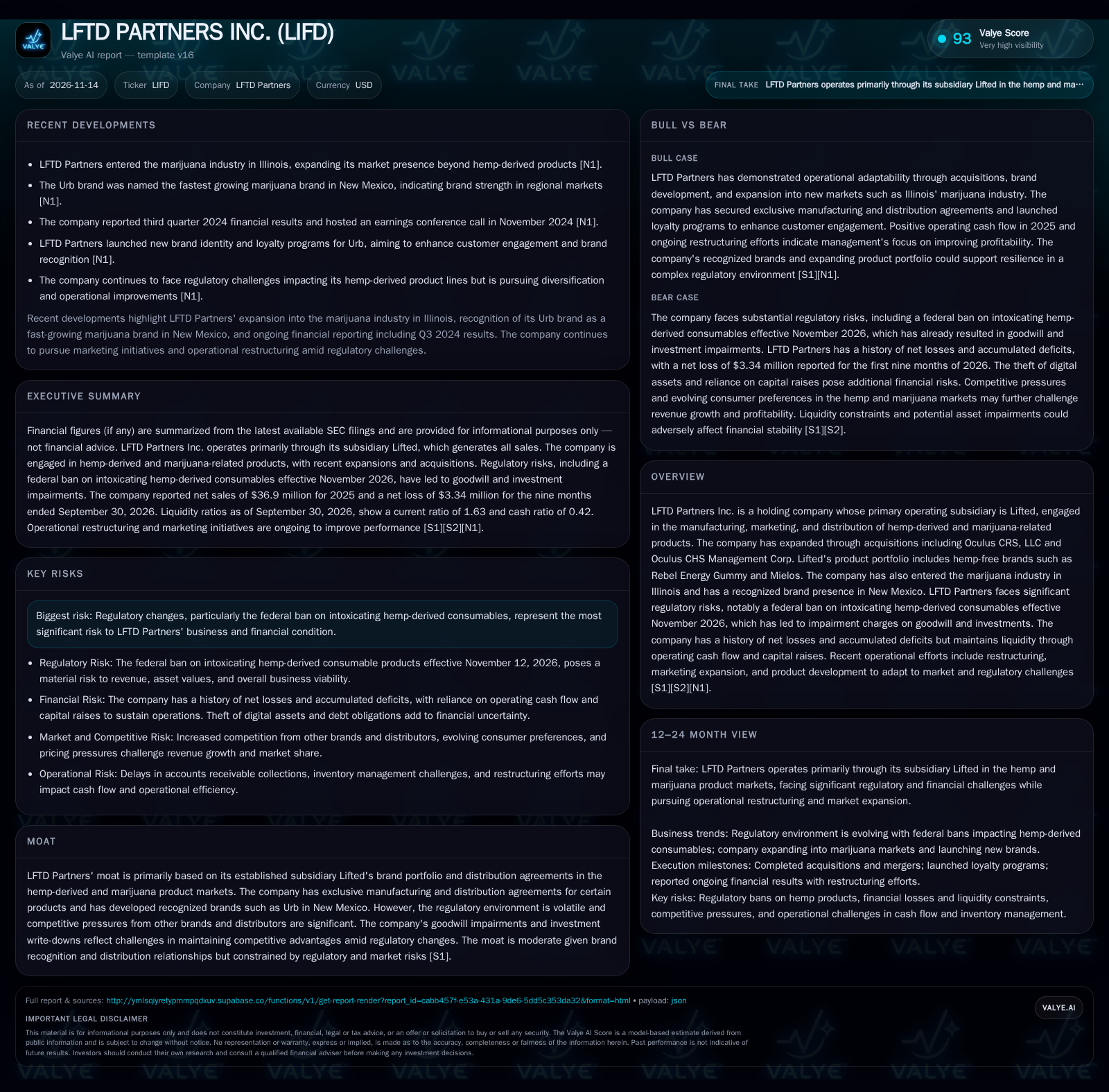
LFTD Partners’ core business—hemp-derived consumables sold via its Lifted subsidiary—faces existential risk from a federal ban taking effect in November 2026. Recent years brought declining sales, substantial asset impairments, and ongoing net losses, though 2025 saw a brief return to positive operating cash flow. Management is pivoting to marijuana markets and new product launches, but regulatory, competitive, and financial headwinds remain severe. The company’s future viability hinges on replacing lost hemp revenue, managing liquidity, and building defensible brands in more stable segments. [S1] [S2]
LFTD Partners stands at a critical crossroads as impending federal regulation threatens to upend its primary business: the manufacture and distribution of intoxicating hemp-derived consumables. Years of declining revenue, significant goodwill and investment impairments, and ongoing losses have put pressure on management to rapidly pivot. The company’s response—a mix of product innovation, geographic expansion into legal marijuana markets, and restructuring—reflects both the urgency and uncertainty of the situation. The next year will test whether LFTD Partners can build a sustainable business model beyond hemp, or if regulatory disruption will overwhelm its remaining competitive assets.
Federal Ban Forces a Strategic Pivot in LFTD Partners’ Core Business
The most consequential current development for LFTD Partners is the impending federal ban on intoxicating hemp-derived consumable products, which takes effect in November 2026. This regulatory change is expected to materially reduce the company’s revenue and asset base, as virtually all sales have historically flowed through its Lifted subsidiary in this segment. In anticipation, the company has already recognized substantial impairment charges, reducing the carrying value of goodwill for Lifted and Oculus to zero, and fully writing down its investment in Ablis. [S1]
Operationally, net sales have declined from $51.6 million in 2023 to $36.9 million in 2025, reflecting both escalating regulatory pressure and intensifying competition. The company reported a net loss of $3.34 million for the nine months ended September 30, 2026, despite positive operating cash flow in 2025. [S1] [S2]
LFTD Partners has responded by restructuring its operations, consolidating sales teams, and expanding into the marijuana sector in Illinois, while launching new brands and loyalty programs to diversify its revenue base. The effectiveness of these adaptations remains unproven, and the company continues to face liquidity and profitability challenges. [S1]
Revenue Concentration, Margin Volatility, and the Economics of Regulatory Uncertainty
LFTD Partners’ historical economics have been dominated by hemp-derived consumables, a category that has offered high top-line growth but exposed the company to pronounced regulatory and pricing volatility. Gross margins in this business can be attractive when regulatory arbitrage exists, but are quickly eroded by legal crackdowns, competitive commoditization, and rapid shifts in consumer preferences.
With the federal ban imminent, the company faces a forced contraction in its highest-volume segment. The economic challenge is twofold: to replace lost volume with new products (such as marijuana-derived offerings in legal markets) and to restore margin structure in categories that may have higher compliance costs and different competitive dynamics. The company has attempted to offset fixed-cost deleverage with restructuring—layoffs, sales team consolidation, and new marketing initiatives—but such moves have yet to produce durable profitability. [S1]
The capital needs of this pivot are significant. The company reported cash and liquidity metrics for the period; these figures do not by themselves establish operating runway, investment capacity, financial flexibility, or financing capacity. While 2025 saw a return to positive operating cash flow, persistent net losses, asset impairments, and a history of deficits ($28.8 million as of December 2025) signal a need for either substantial external funding or rapid improvement in underlying business economics. [S1] [S2]
Brand Recognition Versus Regulatory and Commodity Pressures
LFTD Partners’ competitive position has rested on a portfolio of recognized brands (notably Urb in New Mexico) and a network of distribution agreements, particularly in the hemp-derived and emerging marijuana product markets. Exclusive manufacturing and distribution contracts for certain product lines provide some channel security, but are vulnerable to both regulatory shifts and aggressive competition from legacy cannabis operators, new market entrants, and illicit suppliers.
The moat is moderate: brand equity and distribution relationships offer some insulation, but product substitutability is high and switching costs for retailers and consumers remain low. The company’s recent asset impairments and declining revenues underscore the fragility of these advantages in the face of regulatory disruption. Expansion into legal marijuana markets could provide a new competitive footing, but these segments are themselves crowded, compliance-intensive, and subject to shifting state and federal policies.
A further complication is the fragmented nature of the U.S. cannabis market, which limits the scale and efficiency benefits available to multi-state operators and increases the risk that LFTD’s new initiatives will not replicate the economics of its former hemp business.
If Brand Migration and Product Innovation Outpace Regulatory Losses
The most favorable scenario for LFTD Partners is one where its pivot to marijuana markets and new product development successfully replaces most of the lost hemp-derived revenue. This would require rapid regulatory approvals, effective brand migration (transferring customer loyalty from hemp to marijuana SKUs), and the ability to secure or expand exclusive distribution relationships in high-growth legal markets.
Evidence supporting this scenario would include: measurable revenue growth from Illinois and other legal marijuana initiatives; successful launches of new brands and loyalty programs with demonstrable customer retention; and a return to positive operating margins as fixed costs are leveraged by new volume. Ongoing positive operating cash flow and a stabilization or reduction in net losses would further confirm the upside case. [S1]
This scenario would likely be aided by further state-level cannabis legalization, favorable regulatory interpretations, or the ability to leverage existing retail relationships to cross-sell new products. It would be falsified by continued revenue declines, loss of distribution partners, or regulatory barriers that prevent meaningful marijuana segment growth.
Navigating Regulatory Losses with Partial Offsets and Ongoing Strain
The most plausible scenario is that LFTD Partners experiences a sharp decline in revenue and gross profit following the federal hemp-derived consumable ban, partially offset by incremental gains in marijuana markets and new product categories. Operational restructuring may help contain losses, but the company is likely to face persistent profitability and liquidity pressures.
Confirmation of this scenario would include continued negative or near-breakeven net income, flat or declining sales in the post-ban period, and ongoing asset write-downs or restructuring charges. Modest improvements in cash flow could occur if working capital management and cost controls are successful, but meaningful recovery would require a faster-than-expected ramp in marijuana or alternative product sales. [S1] [S2]
A partial falsification would be observed if the company manages to accelerate revenue growth in marijuana or other segments, or if regulatory timelines shift to allow a slower decline in hemp-derived sales.
If Regulatory and Competitive Shocks Trigger Liquidity or Solvency Crisis
In the adverse scenario, the loss of hemp-derived sales is not replaced, cost cuts are insufficient, and attempts to pivot to marijuana markets falter due to competitive or regulatory obstacles. This could lead to sustained negative cash flow, further asset impairments, and potential breaches of debt covenants or inability to raise fresh capital.
Evidence confirming this scenario would include steep post-ban sales declines, accelerating net losses, deteriorating liquidity ratios, and negative operating cash flow. Loss of key distribution agreements or failure to achieve meaningful market share in new segments would reinforce the downside case. [S1] [S2]
If the company is unable to secure external financing or monetize remaining assets, the risk of restructuring, asset sales, or even bankruptcy would rise. This scenario would be partially falsified by any signs of regulatory relief, successful brand migration, or new capital infusions that extend the company’s runway.
Testing the Pivot: What Will Prove or Disprove LFTD Partners’ Post-Ban Viability?
Monthly or quarterly revenue contributions from new marijuana markets—especially Illinois—would help gauge whether the company’s pivot is gaining traction. If disclosed, segment-level revenue would be particularly informative.
Gross margin trends following the November 2026 hemp-derived ban: improvement would signal successful product and cost realignment; further compression may indicate unsustainable mix or pricing pressure.
Operating cash flow by quarter, especially after the onset of the ban, is a critical indicator of underlying business resilience.
Updates on exclusive manufacturing and distribution agreements: new signings, renewals, or cancellations would directly impact revenue visibility.
Customer retention and loyalty program engagement metrics—if disclosed—would help assess brand stickiness as the portfolio shifts.
Inventory turnover and accounts receivable days: improvements would suggest operational discipline and reduced working capital risk.
Regulatory developments at the state and federal level, including any delays, exceptions, or expansions of the hemp-derived product ban, could materially affect the company’s addressable market.
Disclosures of additional asset impairments, restructuring charges, or capital raises would signal ongoing financial strain and may foreshadow further strategic shifts.
Disclaimer: This is research-only, informational analysis and not investment advice. It may include AI-generated interpretation and general industry context. Always verify important details using primary sources.

Comments