
Axiom Intelligence Acquisition Corp 1: SPAC Leverage and Risk in the European Infrastructure Opportunity Set
AXIN has until June 2027 to consummate a business combination or liquidate, with $200 million in trust and a target focus on European infrastructure.
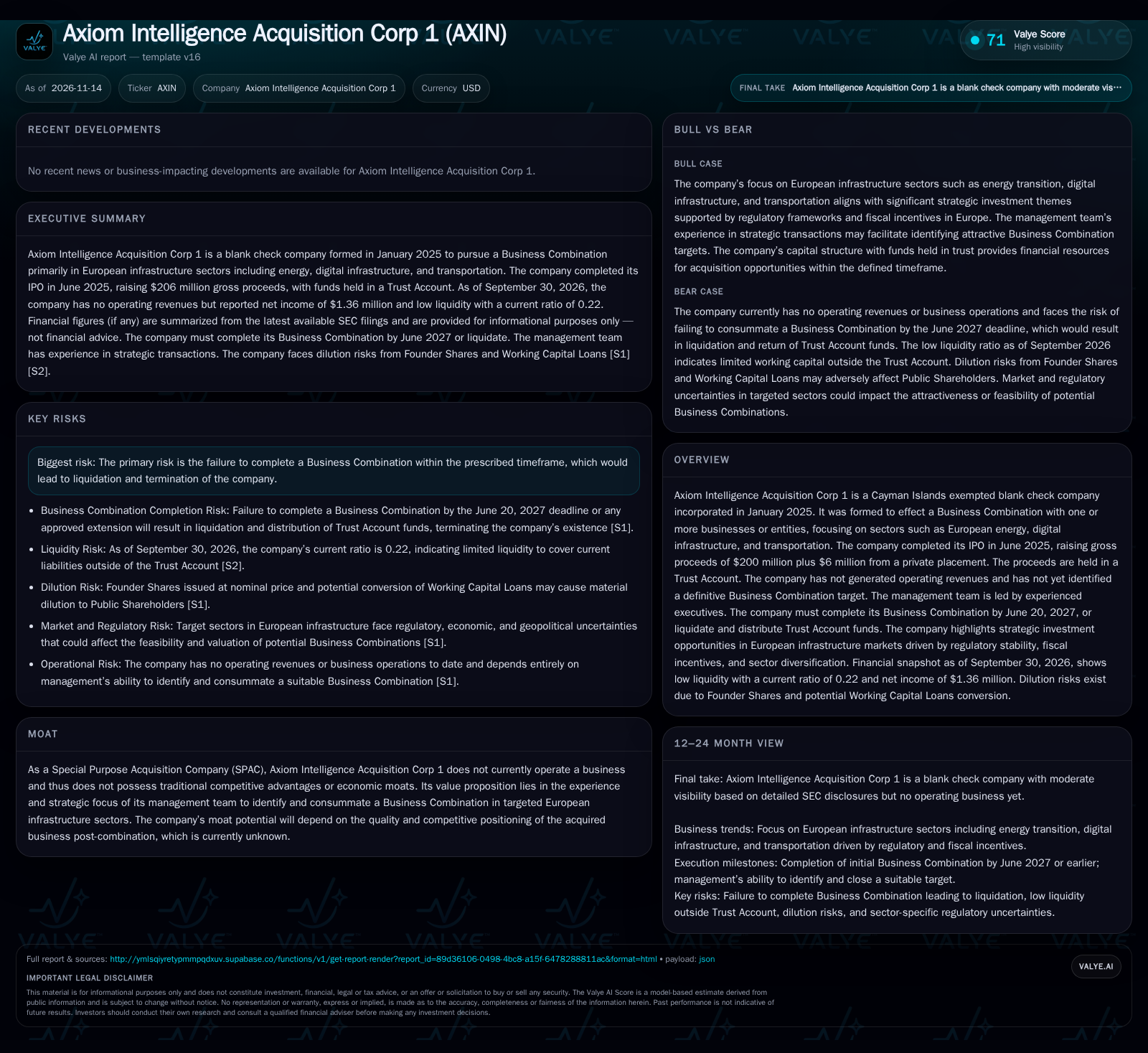
AXIN has until June 2027 to consummate a business combination or liquidate, with $200 million in trust and a target focus on European infrastructure. The management team brings sector and transaction experience, but the company faces acute working capital constraints outside its trust, and public shareholders are exposed to dilution from founder shares and potential loan conversions. The outcome and ultimate value proposition will hinge almost entirely on the quality, terms, and timing of its inaugural deal — if one is secured at all. [S1] [S2]
Axiom Intelligence Acquisition Corp 1 (AXIN) exemplifies the SPAC model at its most binary: the company exists solely to find, negotiate, and close a business combination — in this case, with a stated focus on European infrastructure sectors such as energy transition, digital infrastructure, and transportation. With $200 million in trust from its 2025 IPO and a two-year deadline to deploy, AXIN’s fate will be determined by whether it can secure a compelling target before June 2027. However, acute working capital limitations outside the trust and dilution mechanics built into the capital structure add layers of risk for public shareholders. The company’s ultimate value creation will depend on the timing, quality, and terms of any deal it can secure in a competitive European landscape.
SPAC Mechanics, Timeline, and Liquidity Constraints Define Current State
Axiom Intelligence Acquisition Corp 1 is a blank check company formed in January 2025, raising $200 million from its June 2025 IPO and an additional $6 million from a simultaneous private placement. All IPO and private placement proceeds are held in a trust account, restricted for use in a future business combination. The company reported cash and liquidity metrics for the period; these figures do not by themselves establish operating runway, investment capacity, financial flexibility, or financing capacity. AXIN has not generated operating revenues and must complete a business combination by June 20, 2027, or liquidate and return trust funds to public shareholders. Founder shares and potential working capital loan conversions create further dilution risk for public investors. [S1] [S2]
How the SPAC Model Shapes Economics and Shareholder Outcomes
AXIN’s economics are typical of a SPAC: it currently generates no operating revenue or cash flow and incurs modest operating expenses, with all substantive value resting on the successful completion of a business combination. The $200 million trust account, invested in short-term government securities or money-market funds, is essentially ring-fenced and cannot be used for day-to-day operations. Any acquisition must be structured to deliver post-deal value to public shareholders after accounting for sponsor promote (founder shares issued at nominal cost), underwriting fees, potential working capital loans, and redemptions.
The economics post-combination will depend heavily on the acquired company’s business model — which is currently unknown. If AXIN acquires a European infrastructure asset with stable, contracted cash flows (such as regulated utility assets or data centers), the resulting entity could benefit from high operating leverage and low variable cost. Conversely, if the acquisition involves a growth-stage or capital-intensive asset, substantial further capital may be required, complicating the economics for legacy SPAC shareholders.
Dilution is a structural feature: founder shares (typically 20% of post-IPO equity) and any conversion of working capital loans can materially reduce public shareholder ownership. The redemption feature allows public shareholders to exit at trust value, but this can drain cash available for the deal and potentially undermine the post-combination capital structure.
European Infrastructure SPACs Face Crowded Field and Regulatory Complexity
AXIN’s stated focus on European infrastructure — including energy transition, digital networks, and transport — aligns with secular investment themes, as Europe seeks to modernize infrastructure, accelerate renewables, and upgrade digital capacity. Regulatory stability and fiscal incentives in the region are supportive, but these sectors are already targeted by private equity, pension funds, and sovereign wealth funds, as well as competing SPACs and listed infrastructure platforms.
AXIN’s competitive edge, if any, would derive from its management team’s transaction experience, speed to close, and ability to offer a public listing to a target seeking capital and liquidity. However, the absence of a defined target means AXIN is competing in a crowded and increasingly discerning market, where attractive assets often command premium valuations and sellers can choose from multiple suitors. Regulatory approval hurdles, especially for critical infrastructure or cross-border acquisitions, add further layers of complexity.
In the SPAC arena, time pressure, trust redemptions, and dilution mechanisms can put SPACs at a disadvantage relative to traditional acquirers, unless they can offer compelling deal terms or a unique public market path.
Breakthrough Combination with a High-Quality Asset Could Unlock Significant Value
The most favorable outcome for AXIN would be the identification and successful acquisition of a high-quality European infrastructure asset — such as a fast-growing renewables platform, a digital infrastructure operator with strong recurring cash flows, or a transportation asset benefiting from secular growth and regulatory tailwinds. If AXIN can negotiate a deal at an attractive valuation, minimize redemptions, and secure a target with clear public market appeal, the post-combination entity could command a premium valuation and deliver meaningful returns to public shareholders.
Confirmation of this scenario would include a definitive merger agreement with a credible operating business, robust financial disclosures, a clear path to regulatory approvals, and limited public redemptions. Additional evidence would come from positive market reception, minimal dilution beyond the standard SPAC promote, and early operational or financial outperformance by the combined entity.
Most Plausible Outcome: Extended Search, Dilution, and Median-Quality Target
The most likely scenario is that AXIN continues its search for a suitable target into 2027, potentially seeking shareholder approval for a deadline extension. The eventual target may be a mid-sized infrastructure asset or platform that fits the SPAC’s capital base but does not offer transformational upside. Redemptions could be substantial, reducing cash delivered to the target and increasing leverage or reliance on PIPE (private investment in public equity) financing.
Dilution to public shareholders is likely, both from founder shares and possible loan conversions needed to cover operating expenses. The post-combination company may trade at or near trust value, reflecting modest excitement and limited upside. Evidence supporting this scenario would be the announcement of a deal with a relatively modest growth profile, significant redemptions at the merger vote, and a post-close share price that tracks redemption value.
Deal Failure, Liquidation, and Shareholder Return of Trust Funds
The adverse scenario is that AXIN fails to secure a business combination by the June 2027 deadline (or any extended period), triggering liquidation. In this case, public shareholders receive their pro rata share of the trust account, minus any permitted expenses, but forfeit any upside potential. Founder shares and warrants become worthless, and the sponsors lose their capital at risk.
This scenario could be confirmed by repeated extension votes, lack of credible target announcements, mounting operating expense disclosures, or shareholder resistance to further extensions or dilution. Regulatory or sector shocks in the target markets could also derail potential deals or reduce the pool of attractive targets.
Milestones and External Triggers That Will Determine AXIN’s Outcome
Announcement of a definitive merger agreement with a named target, including financial and operational disclosures.
Level of public shareholder redemptions at the time of the merger vote — a high redemption rate would drain deal proceeds and signal weak confidence.
Any PIPE (private investment in public equity) commitment or backstop arrangements to supplement the trust proceeds, if disclosed.
Material changes in European infrastructure deal flow, valuations, or regulatory landscape that could affect the pool of available targets.
Updates on working capital loans or additional financing outside the trust account, indicating reliance on sponsor funding or increasing dilution risk.
Shareholder votes on deadline extensions and related proxy materials, including any changes to sponsor economics or dilution terms.
Changes in Nasdaq listing status or compliance, which could affect deal certainty and post-merger trading dynamics.
If disclosed, specifics on sponsor promote structure, lock-up terms, and any waivers or modifications to standard SPAC economics.
Disclaimer: This is research-only, informational analysis and not investment advice. It may include AI-generated interpretation and general industry context. Always verify important details using primary sources.

Comments