
Bain Capital GSS Investment Corp.: Profitability Amid Liquidity Constraints and Disclosure Gaps
Bain Capital GSS Investment Corp.
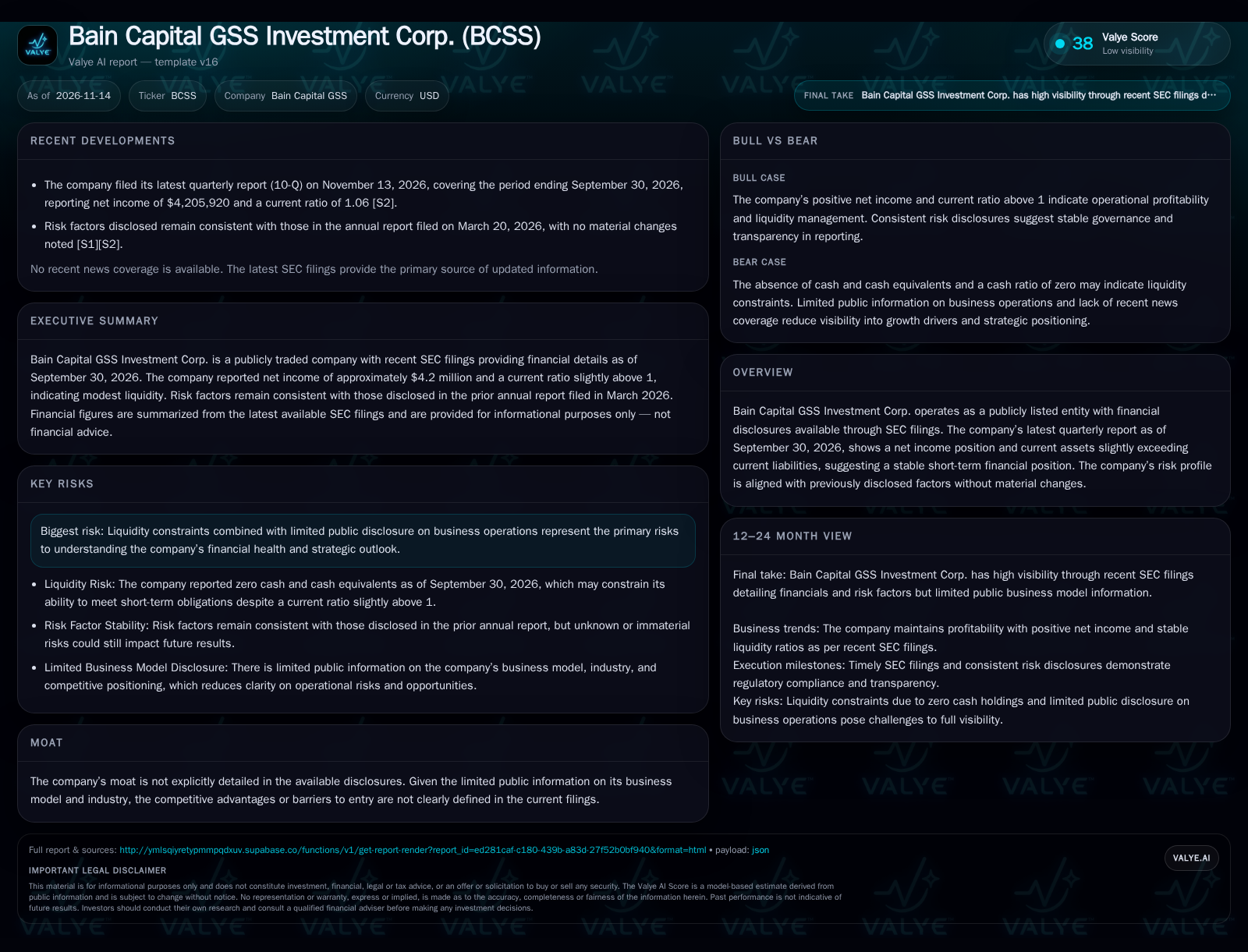
Bain Capital GSS Investment Corp. reported $4.2 million in net income for the quarter ending September 30, 2026, and current assets just above current liabilities, but held no cash or cash equivalents and offered little public detail about its business model or competitive position [S2].
Bain Capital GSS Investment Corp. presents a unique case of financial opacity: the company is publicly traded, posts positive net income, and reported liquidity-ratio trends slightly above 1, yet holds no cash on its balance sheet. The core questions are how this profitability is sustained, what underlying business economics drive results, and whether the company’s low transparency masks resilience or exposes vulnerabilities.
Financial Snapshot: Profit, Tight Liquidity, and Transparency Gaps
Bain Capital GSS Investment Corp. reported net income of $4,205,920 for the quarter ending September 30, 2026, reflecting operational profitability [S2]. The company reported cash and liquidity metrics for the period; these figures do not by themselves establish operating runway, investment capacity, financial flexibility, or financing capacity. [S2] This means that while the company covers its short-term obligations on paper, it has no immediate reported cash balance. Risk disclosures remain unchanged from the previous annual report, and there is no new public information regarding the company's business model, sector focus, or revenue sources [S1] [S2]. The lack of operational transparency and the absence of cash are the two most material watchpoints for the company's near-term stability and longer-term outlook.
How Does Profitability Persist Without Cash? Exploring the Underlying Mechanics
The combination of positive net income and a zero cash balance is atypical and raises questions about the company's business economics. Several scenarios could explain this: the company may earn income from non-cash sources (such as unrealized investment gains, accrual-based interest, or non-cash mark-to-market adjustments), or it may have significant receivables or illiquid assets classified within current assets but not as cash. Without specific disclosure, the company could be functioning as an investment vehicle or specialty finance entity, where earnings are often realized on an accrual basis and actual cash inflows are lumpy or delayed.
If the company operates as a business development company (BDC) or similar investment platform, revenue may derive from investment income, fees, or asset management rather than traditional product sales. This structure typically features high asset turnover, but can also result in periods where cash is fully deployed, with short-term liquidity provided by lines of credit or offset by incoming repayments. In such models, operating leverage is often high—incremental income can fall quickly to the bottom line when assets perform, but liquidity management becomes critical, as the absence of cash leaves the company vulnerable to mismatches between income recognition and actual cash receipts.
Capital needs in such businesses are episodic: funding new investments, servicing debt, or meeting redemption requests can require liquidity that is not always visible in the current asset mix. If the company relies on investment returns, the mix of realized versus unrealized gains, and the timing of distributions or repayments, will drive both profitability and actual cash flow.
Opaque Positioning: Competitive Advantages and Risks in a Low-Disclosure Environment
With limited public information on Bain Capital GSS Investment Corp.'s business model, it is difficult to pinpoint specific competitive advantages or threats. If the company is an investment vehicle or BDC, its competitive position would depend on access to proprietary deal flow, investment selection skill, cost of capital, and the ability to originate or manage assets at attractive yields. In this category, competitors include other BDCs, private credit funds, and specialty finance companies, all of whom compete for a finite universe of attractive lending and investment opportunities.
Barriers to entry in investment management can be high for new entrants lacking track record or sponsor backing, but established players often compete primarily on reputation, performance, and client relationships. Bain Capital’s brand could confer institutional credibility, but this is not explicitly detailed in current filings.
Substitution risk is also relevant: institutional and retail investors can readily switch between BDCs and other yield vehicles if returns, risk, or transparency are perceived as unfavorable. In the absence of disclosed switching costs or proprietary investment channels, the company’s ability to retain capital and attract new assets could be vulnerable if performance or disclosure lags peers.
If Non-Cash Earnings Convert to Cash Flow: Pathways to Sustainable Growth
The most favorable scenario for Bain Capital GSS Investment Corp. is that reported net income reflects high-quality, recurring investment returns, and the current absence of cash is a temporary artifact of timing. If, for example, the company’s portfolio includes maturing investments or receivables that will soon be converted into cash, liquidity could quickly improve without the need for external financing. In this scenario, the company could deploy new capital into higher-yielding opportunities, further expanding net income and potentially supporting dividends or share repurchases.
Confirmation of this scenario would come from subsequent filings showing a rebound in cash balances, evidence of realized gains or repayments, and continued profitability without reliance on asset sales or mark-to-market gains. Additional public disclosure clarifying the nature of income (realized vs. unrealized), the duration and quality of assets, and the source of operational cash flows would further support the sustainability of the current earnings profile.
Falsification would occur if future filings show persistent zero or negative cash balances, growing payables, or the need to raise external capital simply to meet basic obligations. Signs that earnings are driven by one-time events, accounting adjustments, or unsustainable investment gains would also undermine the bull case.
Profitability Maintained, But Liquidity and Transparency Remain Ongoing Concerns
The most plausible near-term scenario is that Bain Capital GSS Investment Corp. continues to report modest profitability and maintains a slender margin of current assets over current liabilities, but does not resolve its liquidity or disclosure challenges. In this outcome, the company may be able to operate without immediate distress, especially if it can roll over liabilities, collect receivables, or access short-term credit. However, the lack of cash and limited public detail about its operations and risk exposures mean that each quarter’s results will be scrutinized for signs of stress or hidden risk.
However, the persistence of a zero cash balance and unchanged disclosure practices would indicate that management is either comfortable operating with minimal liquidity or is unable to improve its position. Falsification would occur if the company either dramatically improves liquidity and transparency, or conversely, if it discloses a material risk event, negative cash flow, or a need for emergency financing.
Liquidity Erodes or Hidden Risks Emerge: How a Paper-Profitable Model Could Unravel
The primary risk is that the company’s reported net income is not translating into operational cash flow, and that the lack of liquidity will eventually force asset sales, dilutive financing, or even default on obligations. If the company's income is largely non-cash or dependent on asset valuations that may not be realized, a market downturn, credit event, or failed investment could quickly expose the fragility of its model. In such a scenario, counterparties or creditors could lose confidence, potentially triggering a credit squeeze or higher borrowing costs.
This scenario would be confirmed by filings showing growing current liabilities, negative operating cash flows, asset write-downs, or the announcement of emergency capital raises. Additional red flags would include changes in auditor language, restatements of past results, or the disclosure of previously undisclosed risks. If the company is forced to sell assets at a loss or suspend distributions, the downside case would be in full effect.
What Could Clarify Bain Capital GSS’s True Resilience or Vulnerability?
Quarterly changes in cash and cash equivalents: A positive swing would indicate that net income is being realized as cash, while a persistent zero balance would heighten liquidity concerns.
Breakdown of current assets: Additional disclosure on the composition (e.g., receivables, investments, prepaid expenses) would clarify the actual liquidity profile.
Nature of net income: Distinguishing between realized returns, unrealized gains, and non-cash accounting items would help test the sustainability of reported profits.
Disclosure of business model and revenue sources: Greater clarity on how the company generates income would illuminate competitive positioning and risk.
Changes in risk factors or new risk disclosures: Any update here could indicate emerging operational or market threats.
Evidence of external financing: New debt or equity raises could signal underlying stress or strategic repositioning.
Portfolio turnover or asset sales (if disclosed): High turnover or forced sales could indicate liquidity pressure or strategic shifts.
Disclaimer: This is research-only, informational analysis and not investment advice. It may include AI-generated interpretation and general industry context. Always verify important details using primary sources.

Comments