
HCM IV Acquisition Corp.: SPAC Structure, Capital Position, and the Search for a Viable Business Combination
HCM IV Acquisition Corp. enters its post-IPO phase with $287.5 million in trust and no operating business, facing a SPAC landscape tightened by new 2024 SEC rules and investor skepticism. The company's outcome now hinges on management's ability to source and execute a value-creating acquisition amid mounting time and regulatory pressures.
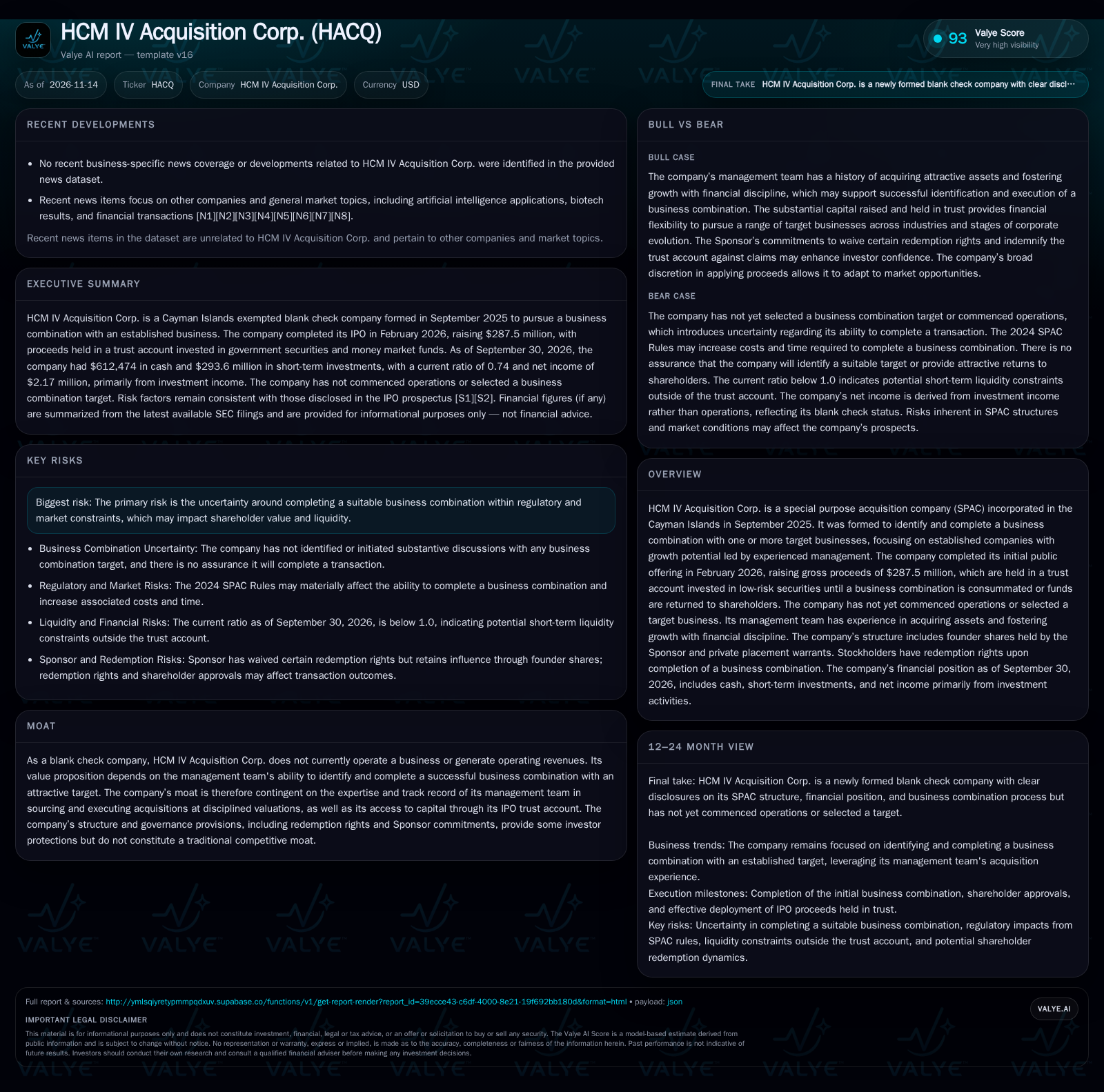
HCM IV Acquisition Corp. (HACQ) is a newly listed SPAC with $287.5 million in trust, no selected target, and no operating business. Its fate depends on management’s ability to identify and acquire a compelling company—within regulatory deadlines and before investor redemptions erode capital. [S1] [S2]
HCM IV Acquisition Corp. stands at the crossroads typical for a post-IPO SPAC: flush with capital, but operating as a shell with no identified acquisition target. The company’s $287.5 million trust account is both its main asset and its primary risk—capital that remains idle until a suitable business combination is found, but also vulnerable to shareholder redemptions and regulatory deadlines. Management’s experience in disciplined acquisitions is a positive, yet the 2024 SPAC rules and a sub-1.0 current ratio outside the trust add urgency. Whether HCM IV can convert its blank-check promise into a value-creating deal will define its trajectory in a crowded and increasingly regulated SPAC market. [S1] [S2]
Post-IPO Snapshot: Capital Structure and SPAC Status
HCM IV Acquisition Corp. completed its IPO in February 2026, raising $287.5 million by issuing 28.75 million units at $10 each, including the full exercise of the underwriters' over-allotment. In parallel, 4.67 million private placement warrants were sold for $7 million, also placed in trust. As of September 30, 2026, the company had $612,474 in cash, $293.6 million in short-term investments, and a current ratio of 0.74—reflecting that almost all liquidity is locked in the trust account, per standard SPAC mechanics. HCM IV has not commenced operations, selected a target, or initiated substantive deal discussions. Net income of $2.17 million in the period derives solely from investment income on trust assets. The company's risk profile is typical for a SPAC at this stage: high capital, no operating business, and significant time and regulatory pressure to identify a suitable acquisition before the capital is diminished by redemptions or regulatory deadlines. [S2]
How Value Might Be Created or Lost: SPAC Economics in Action
HCM IV's economic model is a binary one: the company either completes a business combination that creates value for shareholders, or it fails to do so and returns trust capital (minus costs and redemptions) to investors. Until an acquisition is closed, the only income is from low-risk investments (mostly government securities), as required by SPAC rules. The primary costs are administrative, legal, compliance, and diligence expenses, which are funded from non-trust cash and sponsor capital.
The economics after a business combination are highly sensitive to several factors: the quality and valuation of the target, the level of redemptions (which reduce available cash and post-merger float), and the ability to secure any necessary PIPE (private investment in public equity) financing. If redemptions are high or the trust is eroded by expenses, the resulting company may be undercapitalized. Sponsor incentives are aligned to close a deal, as their founder shares and private placement warrants become valuable only if a merger is consummated. However, the structure can also lead to rushed or suboptimal deals as the SPAC nears its deadline. The cost of capital is effectively the dilution borne by public shareholders from sponsor shares and warrants, which can be significant if the post-merger valuation does not appreciate.
SPAC Competition: Sourcing, Selection, and Sponsor Differentiation
HCM IV operates in a crowded SPAC market where hundreds of blank-check companies compete for a finite pool of attractive targets. The core competitive differentiator is the management team's track record in sourcing, valuing, and executing acquisitions—specifically, their ability to convince a quality private company to go public via SPAC rather than traditional IPO or private equity sale. The company's stated focus is on established businesses of scale with growth potential and experienced management, but it retains broad flexibility across sectors.
Key counterforces include the 2024 SEC rules (which impose stricter disclosure and liability standards), heightened investor skepticism after a wave of disappointing de-SPAC outcomes, and the growing preference among quality targets for direct listings or sponsorless IPOs. HCM IV does have standard investor protections—such as redemption rights and sponsor indemnities—but these are now common across the SPAC landscape. The company’s ability to differentiate may hinge on sponsor reputation, willingness to price deals attractively for both target and shareholders, and the speed of execution in a tightening regulatory environment.
What a Value-Creating Deal Might Look Like—and How to Spot It Early
The favorable scenario is that HCM IV leverages its management's acquisition expertise to source a high-quality, scalable target at a disciplined valuation—ideally in a sector with secular tailwinds and limited public comparables. The deal would need to be structured to minimize redemptions, perhaps by securing strong PIPE financing or pre-committing key investors. If the transaction closes with most trust capital intact, the combined entity could have the resources to pursue growth, and public shareholders could see meaningful upside if the post-merger company executes well and trades at a premium to the acquisition price.
Early evidence of this scenario would include a merger announcement with a credible, growth-oriented target; low redemption rates at the shareholder vote; successful PIPE commitments; and positive market reaction to the deal terms. Additional confirmation would come from the combined company’s ability to attract institutional coverage and deliver on near-term revenue or margin milestones post-close.
Most Likely Trajectory: Deal Completion Under Pressure, with High Redemptions
The most plausible path, given current SPAC market conditions and regulatory headwinds, is that HCM IV eventually announces a business combination—likely after a protracted search and negotiation phase. The target may be solid but not exceptional, and the deal could face significant redemptions, reducing the net cash delivered to the operating company. PIPE financing may be necessary to shore up the capital structure, but could come at a discount or with dilutive terms.
Confirmation of this scenario would be a merger with a credible but not top-tier target, above-average redemption rates, and potentially tepid market response. The post-merger company might trade near or below the $10 trust value for an extended period unless it demonstrates rapid operational traction. Falsification would require evidence of either an outstanding, oversubscribed deal or an inability to announce a transaction at all within the allotted timeframe.
Failure to Complete a Business Combination: Redemption and Liquidation Risk
The adverse scenario is that HCM IV fails to identify or close a business combination within the required timeframe—due to deal sourcing challenges, regulatory delays, or lack of target interest. In this case, the trust is liquidated and funds are returned to shareholders (minus expenses and taxes), with sponsor capital and warrants rendered worthless.
Warning signs for this scenario include repeated deadline extensions, lack of substantive deal announcements, or the withdrawal of previously announced targets. Regulatory changes or market shocks that further deter private companies from going public via SPAC would amplify this risk. Falsification would require clear evidence of a definitive agreement with a credible target and forward momentum toward completion.
Milestones That Will Determine HCM IV’s SPAC Outcome
Announcement of a definitive business combination agreement, including details on target sector, valuation, and management’s rationale.
Level of shareholder redemptions at the time of the merger vote—a high redemption rate would erode the cash delivered to the combined company.
PIPE financing commitments or other alternative capital sources to supplement the trust account, if disclosed.
Regulatory or legal delays stemming from the 2024 SPAC rules or other SEC interventions.
Sponsor willingness to amend deal terms, inject additional capital, or forfeit founder shares to reduce dilution and secure deal approval, if disclosed.
Market reaction (stock price, trading volume, analyst commentary) following deal announcement and at deal close.
Operational milestones or forward guidance provided by the post-merger company in the first quarters after closing, if disclosed.
Any deadline extensions or amendments to the SPAC’s charter to allow more time for deal completion.
Disclaimer: This is research-only, informational analysis and not investment advice. It may include AI-generated interpretation and general industry context. Always verify important details using primary sources.

Comments