
Vistagen Therapeutics: Navigating Clinical Setbacks, Regulatory Engagement, and Financing Hurdles in Social Anxiety Drug Development
Vistagen Therapeutics faces a critical juncture: its lead candidate, fasedienol, is in Phase 3 trials for social anxiety disorder after multiple trial failures, with ongoing FDA engagement but persistent financial strain and no approved products. The company's future hinges on clinical success, regulatory clarity, and urgently needed capital.
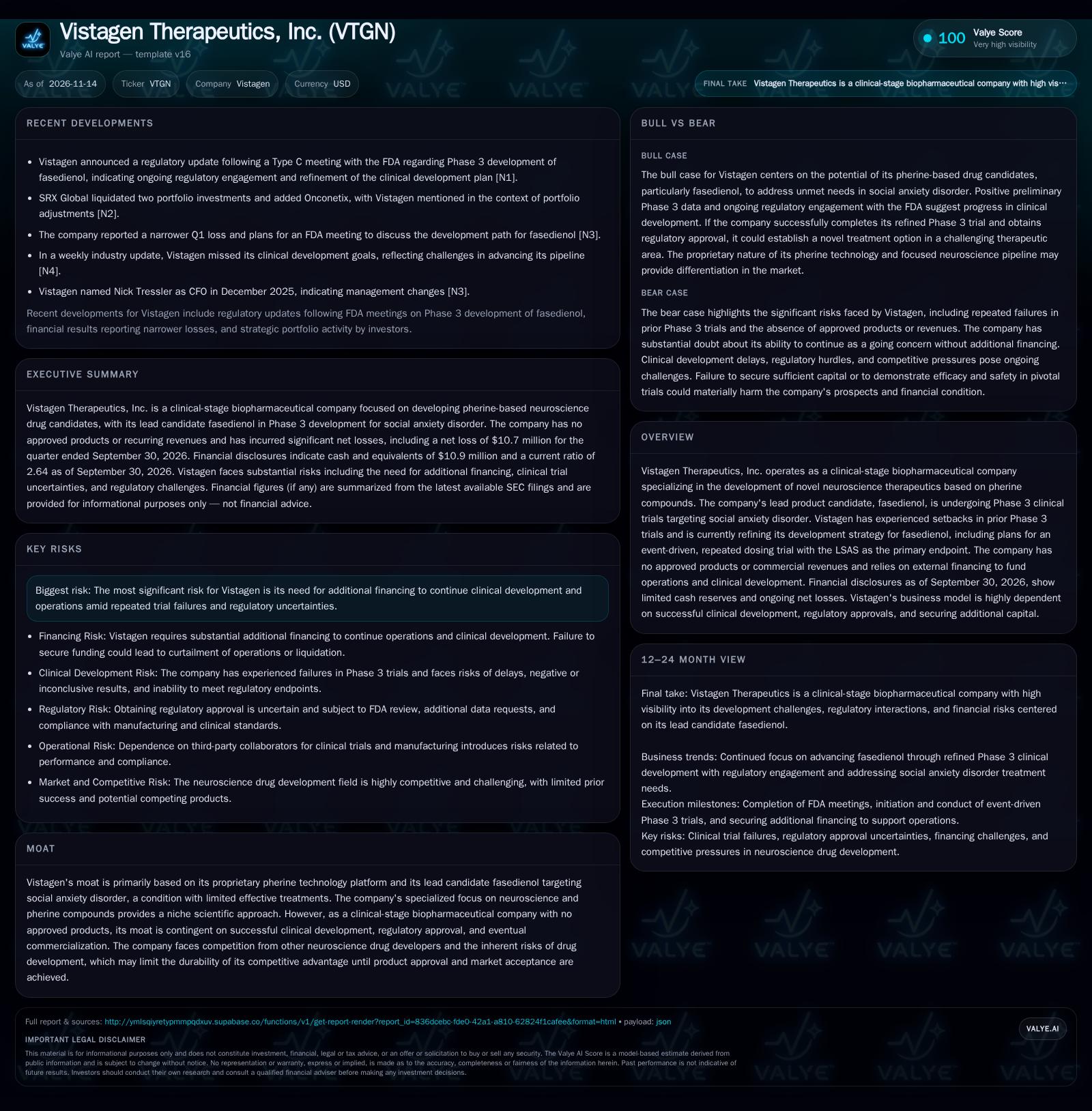
Vistagen Therapeutics is a clinical-stage biotech focused on pherine-based neuroscience drugs, with lead candidate fasedienol in Phase 3 for social anxiety disorder. Despite ongoing regulatory engagement and some positive preliminary data, repeated Phase 3 failures, no product revenues, and a precarious financial position create substantial uncertainty. The company’s prospects depend on successful trial outcomes, FDA approval, and securing additional financing to avoid operational disruption or liquidation. [S2] [N1] [N3]
Vistagen Therapeutics stands at a make-or-break moment in its quest to bring a novel treatment for social anxiety disorder to market. Despite years of development and a proprietary neuroscience platform centered on pherine compounds, the company has yet to produce an approved product or generate recurring revenues. With its lead candidate fasedienol undergoing a refined Phase 3 trial design after several high-profile failures, and with cash resources dwindling, Vistagen’s near-term viability hinges on navigating regulatory scrutiny, achieving clinical success, and securing critical financing. How the company handles these interlocking challenges will determine whether it can emerge as a differentiated player in the high-risk, high-reward landscape of neuropsychiatric drug development.
Refined Clinical Strategy and Financial Pressures Shape the Current Moment
Vistagen’s present situation is defined by three critical facts: (1) its lead program, fasedienol for social anxiety disorder (SAD), is in Phase 3 clinical development with a revised trial design targeting event-driven, repeated as-needed dosing and the LSAS as the primary endpoint; (2) the company has experienced repeated failures in its previous Phase 3 and extension studies, failing to meet primary efficacy endpoints; and (3) as of September 30, 2026, Vistagen reported $10.9 million in cash and equivalents, a $10.7 million quarterly net loss, and an explicit statement of substantial doubt about its ability to continue as a going concern without new funding. [S2] [N1] [N3]
Recent news highlights ongoing regulatory engagement, including a Type C FDA meeting to discuss the clinical development path for fasedienol, and the company’s continued efforts to refine its approach following missed clinical goals earlier in 2026. These facts underscore that Vistagen’s prospects rest almost entirely on the outcome of its lead program and its ability to raise additional capital in the near term. [N1] [N3] [N4]
Economic Realities of a Single-Asset, Pre-Revenue Biotech Model
Vistagen’s business model is typical of clinical-stage biopharma: it incurs significant R&D and G&A expenses to advance a proprietary drug candidate through lengthy, expensive clinical trials, with no product revenues or recurring income until (and unless) regulatory approval is achieved. All funding to date has come from external sources—primarily equity raises—resulting in cumulative losses and shareholder dilution. [S2]
The economics of this model are binary and high-risk. If fasedienol succeeds in Phase 3 and gains FDA approval, Vistagen could transition to a commercial stage, potentially unlocking revenue through direct sales, out-licensing, or partnership deals. However, the cost structure is heavily front-loaded and largely fixed in the near term, driven by clinical trial execution, regulatory compliance, and overhead. Margins and cash flow would only materialize if the drug reaches market and achieves commercial uptake, which remains highly uncertain. The need to fund ongoing operations and future trials—likely requiring tens of millions of dollars—means that capital raises (and their terms) are a pivotal variable.
The company reported cash and liquidity metrics for the period; these figures do not by themselves establish operating runway, investment capacity, financial flexibility, or financing capacity. [S2]
Scientific Differentiation Versus Commercial and Clinical Headwinds
Vistagen’s proprietary platform centers on pherine compounds for neuropsychiatric disorders, with fasedienol targeting the large but underserved market for social anxiety disorder. The company’s scientific differentiation lies in its non-systemic, intranasal mechanism and the novelty of its molecular approach, which may offer advantages in side-effect profile and onset of action compared to traditional SSRIs or benzodiazepines.
However, these advantages are theoretical until proven in pivotal trials. The competitive landscape for SAD remains challenging: while there are few specifically approved therapies, off-label use of existing antidepressants and anxiolytics is common, and new entrants face high regulatory and reimbursement hurdles. Larger pharmaceutical companies and other neuroscience-focused biotechs may have greater resources, diversified pipelines, and established commercial infrastructure.
Repeated clinical failures have eroded Vistagen’s perceived credibility, increasing skepticism among investors, potential partners, and the scientific community. Without compelling late-stage data and regulatory progress, Vistagen’s scientific differentiation may not translate into a durable commercial or competitive advantage.
Clinical Validation and Regulatory Success as the Pathway to Transformation
The most favorable outcome for Vistagen would involve successful completion of the refined Phase 3 trial, demonstrating statistically significant improvement on the LSAS endpoint in SAD patients using fasedienol. Positive trial results would be followed by a productive regulatory dialogue, leading to FDA approval. Such a sequence could enable Vistagen to secure value-creating licensing deals, partnerships, or even acquisition interest from larger pharmaceutical players seeking exposure to neuropsychiatry.
This scenario would require not only strong efficacy data but also clear safety and tolerability, as well as reproducibility of results—addressing the skepticism generated by past trial failures. Confirmation would come from peer-reviewed publication of positive Phase 3 data, FDA acceptance of a New Drug Application (NDA), and the announcement of non-dilutive financing or partnership structures that extend runway without severe dilution.
Falsification would occur if the new Phase 3 trial again fails to meet primary endpoints, if safety issues emerge, or if regulatory discussions stall or require additional studies, delaying commercialization and undermining confidence in the platform.
Survival Mode: Incremental Progress and Financing Uncertainty
The most plausible outcome, based on current evidence, is that Vistagen continues to refine and execute its Phase 3 program for fasedienol amid ongoing resource constraints and regulatory engagement. Interim data may be mixed or modestly positive, allowing the company to maintain ongoing discussions with the FDA but not yet providing a clear path to approval.
Progress is likely to be slow, with each incremental advance dependent on both clinical results and market conditions for biotech fundraising.
Evidence supporting this scenario would include continued regulatory updates, new financing announcements, and incremental clinical data releases that sustain operations but do not materially de-risk the program. Falsification would be the absence of new funding, halted trials, or a material negative regulatory development.
Trial Failure or Funding Shortfall Could Force Drastic Restructuring or Liquidation
The primary adverse scenario is that Vistagen’s next Phase 3 trial for fasedienol fails to meet its primary efficacy or safety endpoints, effectively ending its prospects for regulatory approval and commercialization. Given the company’s single-asset focus and lack of revenues, such an outcome would be existential.
Alternatively, even with ambiguous clinical results, Vistagen could be unable to secure sufficient funding to complete ongoing trials or maintain operations, given its stated going concern risk and limited cash. In either case, the company could be forced to suspend operations, pursue asset sales, or liquidate.
Confirmation would come from public disclosure of failed trial outcomes, inability to close a needed financing, or announcements of workforce reductions, trial suspensions, or liquidation proceedings. Falsification would require evidence of a significant lifeline—such as a large non-dilutive partnership, successful capital raise, or unexpected positive clinical data.
Milestones That Will Determine Vistagen's Fate in the Year Ahead
Announcement and design specifics (sample size, endpoints, duration) of the new event-driven, repeated as-needed dosing Phase 3 trial for fasedienol.
Timing, size, and terms of any additional capital raises (equity, debt, or partnership) required to fund ongoing operations.
Interim or final results from the new Phase 3 trial, especially regarding efficacy on the LSAS and safety/tolerability profile.
Updates on regulatory feedback from the FDA, including minutes from Type C or other key meetings.
Evidence of non-dilutive financing, licensing agreements, or strategic partnerships that could extend runway.
Disclosure of any operational changes, including workforce reductions, trial suspensions, or asset sales.
If disclosed, cash burn rate and updated runway projections following each financing or clinical milestone.
Any peer-reviewed publication or external validation of fasedienol’s mechanism or clinical results.
Disclaimer: This is research-only, informational analysis and not investment advice. It may include AI-generated interpretation and general industry context. Always verify important details using primary sources.

Comments