
Space Asset Acquisition Corp.: SPAC Structure, Sponsor Incentives, and the Road to a Viable Business Combination
Space Asset Acquisition Corp. (SAAQ) holds over $221 million in net IPO proceeds with a mandate to target the global space, technology, or defense sectors. With no target identified as of November 2026, the company’s fortunes hinge on execution, sponsor alignment, and the risks inherent to the SPAC model—especially concentration and governance dynamics.
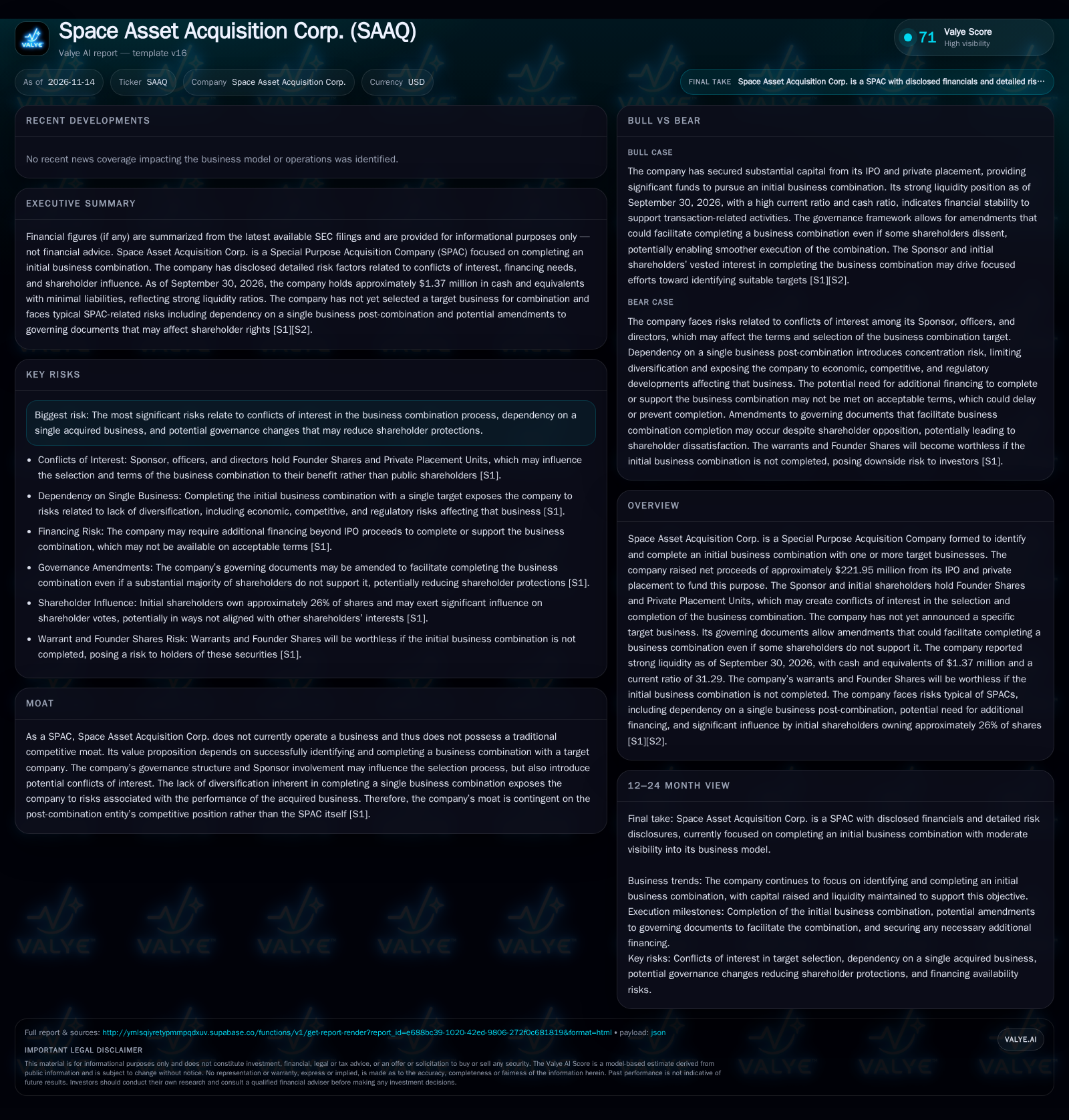
Space Asset Acquisition Corp. has completed its IPO and private placement, raising net proceeds of roughly $221.95 million to pursue a merger or acquisition, with a stated industry focus on the space economy, technology, and defense. No target has been identified, and the SPAC faces typical risks: sponsor conflicts, single-asset concentration, and the necessity of shareholder approval for a business combination. Investor outcomes will be determined by target selection, deal structure, and post-transaction performance, not current financials alone. [S1] [S2]
Space Asset Acquisition Corp. (SAAQ) is a recently formed SPAC with a broad mandate to acquire or merge with a company in the global space, technology, or defense sectors. Having raised over $221 million in its IPO and private placement, SAAQ is in the pre-deal phase, with no operating business and no target identified as of November 2026. Its current financials reflect idle capital, not business operations or value creation. As with all SPACs, the ultimate outcome for investors will be driven by the quality and terms of the eventual business combination—and by how sponsor incentives and governance structures align with public shareholder interests. [S1] [S2]
IPO Proceeds, Sponsor Influence, and Pre-Combination Balance Sheet
Space Asset Acquisition Corp. raised approximately $221.95 million in net proceeds from its January 2026 IPO and private placement, with the capital earmarked for a future business combination. As of September 30, 2026, the company reported cash and equivalents of $1.37 million and current assets of $1.45 million against minimal current liabilities, resulting in a current ratio of 31.29. These figures reflect the pre-deal, cash-preserving nature of the SPAC structure, with no operating revenues or business activities to date. The sponsor and initial shareholders hold founder shares and private placement units, together representing about 26% of the company's equity, which may influence the eventual selection and terms of the business combination. The company’s governing documents allow for amendments with shareholder approval, potentially smoothing the path to a deal even if some shareholders dissent. [S1] [S2]
How Value Could Be Created (or Destroyed) in the SPAC Lifecycle
The economic engine of Space Asset Acquisition Corp. is entirely contingent: until it completes a business combination, it generates no operating revenue and only earns interest on its trust assets. The overwhelming majority of capital is sequestered in trust, with minimal funds available for operating expenses. The SPAC model typically features low fixed costs (public company compliance, diligence, legal), but faces a binary outcome: either a successful business combination creates a new operating entity (with economics determined by the acquired business), or the SPAC liquidates and returns trust assets to shareholders.
Post-combination, economics hinge on the quality, growth prospects, and capital needs of the acquired company. If the target is capital-intensive (as many space and defense firms are), additional financing may be required—potentially diluting existing shareholders or straining the merged entity’s balance sheet. The sponsor’s promote (often 20% of post-IPO equity via founder shares) and warrants can create misalignment: sponsors may be incentivized to close any deal rather than the best deal, especially as the SPAC’s deadline approaches. For public shareholders, the upside comes from participating in a high-quality, undervalued business; the downside is dilution, poor target selection, or a failed transaction.
SPAC Competition for Targets and the Challenge of Differentiation
Space Asset Acquisition Corp. is one of many SPACs seeking attractive targets, especially in the high-profile space, technology, and defense sectors. Competition is not with operating companies per se, but with other SPACs and private equity vehicles pursuing similar targets—and with targets themselves, which may have alternative routes to capital (traditional IPO, direct listing, private funding). The sheer volume of SPAC capital chasing a limited pool of high-quality targets can inflate valuations and make negotiating favorable terms more difficult.
The company's differentiation may depend on sponsor expertise, relationships in the space/defense ecosystem, and the ability to structure a deal that aligns incentives for all parties. However, absent a specific target, SAAQ’s competitive position is theoretical—dependent on the perceived value-add of its sponsor team and governance flexibility. The risk is that competitive pressure leads to lower-quality deals or excessive dilution for public shareholders.
Sponsor Alignment and a High-Quality Space Sector Acquisition Drive Value
The bullish case rests on SAAQ leveraging its capital and sponsor relationships to identify a high-growth, high-quality target in the space, technology, or defense sector—preferably one that is capital-constrained but operationally sound. Successful negotiation and execution of a business combination could unlock value if the post-deal entity exhibits durable growth, defensible market position, and a path to profitability. The sponsor’s equity stake provides an incentive to select a target with genuine upside.
Evidence that would confirm this scenario includes: announcement of a credible, differentiated target with strong financials and growth prospects; transparent deal terms with manageable dilution; alignment between sponsor and public shareholder incentives; and positive market reaction to the proposed combination. Falsification would occur if SAAQ announces a deal with an overvalued, speculative, or cash-burning company, or if redemptions and dilution erode public shareholder value.
Most Plausible Outcome: Deal Execution Amid Typical SPAC Trade-Offs
The most likely outcome for SAAQ is the identification and negotiation of a business combination within the mandated SPAC timeframe, with trade-offs typical of the sector: moderate-to-high shareholder redemptions, some dilution via warrants and sponsor promote, and a target that is credible but not best-in-class. The merged entity may inherit both the growth potential and capital needs of the target, with post-deal performance dependent on execution, integration, and market conditions.
Confirmation would come from a timely deal announcement, reasonable redemption levels, and post-merger trading that reflects market confidence in the target’s business. Falsifying evidence would be a failure to announce a deal, repeated extensions, or a transaction that triggers high redemptions and negative market response.
Adverse Outcomes: Poor Deal Quality, Sponsor Misalignment, or SPAC Liquidation
Downside risk is concentrated in three main areas: sponsor misalignment leading to a poor-quality or overvalued acquisition; inability to secure a deal within the required timeframe, resulting in SPAC liquidation; and governance amendments that disadvantage public shareholders. If the company pursues a highly speculative or capital-intensive target without a clear path to value creation, public shareholders could face substantial dilution or loss of principal (especially if trust redemptions are high and the deal is still pushed through).
Liquidation of the SPAC—if no deal is found—would return trust proceeds (less expenses) to shareholders, but warrants and founder shares would become worthless. Evidence of downside would include repeated deadline extensions, lack of credible target announcements, or governance maneuvers that override shareholder protections and trigger investor exits.
Milestones That Will Determine Whether SAAQ Delivers Shareholder Value
Announcement of a business combination target, including industry, business model, and financial profile.
Disclosure of deal terms: valuation, capital structure, expected dilution, and sponsor promote mechanics.
Level of public shareholder redemptions at deal vote—high redemption rates may signal lack of confidence.
Any amendments to governing documents that affect shareholder rights or approval thresholds.
Sponsor and management equity participation in the post-merger entity—alignment with public shareholders.
Post-deal operational disclosures: revenue growth, profitability, and cash flow metrics (if disclosed).
Market reaction to deal announcement and post-merger trading pattern.
If disclosed, the pipeline and quality of other SPACs seeking similar targets, as a gauge of competitive pressure.
Disclaimer: This is research-only, informational analysis and not investment advice. It may include AI-generated interpretation and general industry context. Always verify important details using primary sources.

Comments