
The company reported cash and liquidity metrics for the period; these figures do not by themselves establish operating runway, investment capacity, financial flexibility, or financing capacity.
While financial stability appears strong in the short term, the lack of transparency into its business model and growth drivers presents significant uncertainty for investors evaluating future prospects.
While financial stability appears strong in the short term, the lack of transparency into its business model and growth drivers presents significant uncertainty for investors evaluating future prospects. [S2]
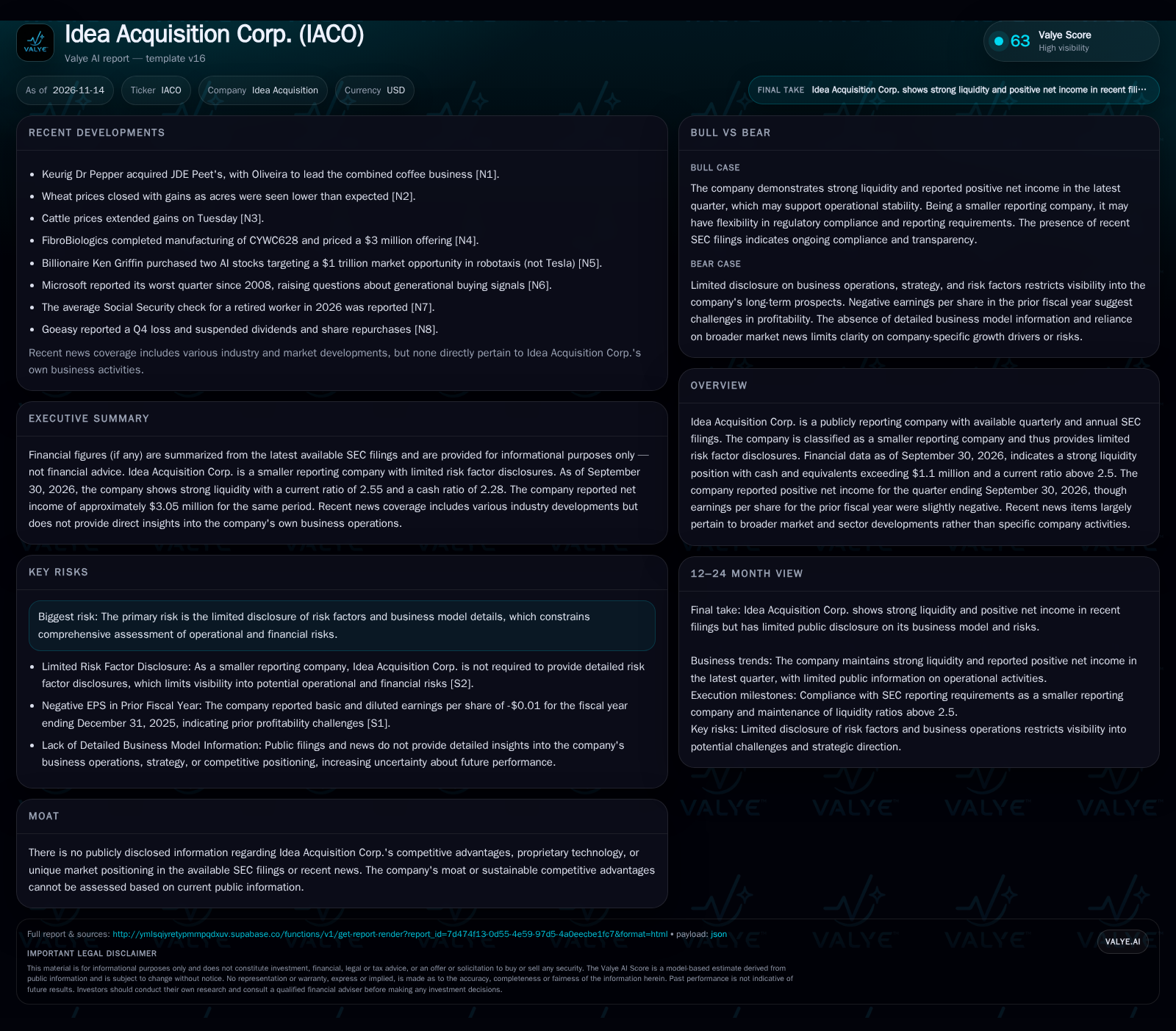
Idea Acquisition Corp. presents a paradox for investors: the company reports reported liquidity position and a swing to positive net income in its latest quarter, yet offers almost no insight into its actual business activities, strategy, or long-term drivers. As a smaller reporting company, it is exempt from detailed risk factor disclosures, making it difficult to assess its operational resilience or competitive positioning. This combination of near-term financial health and persistent strategic opacity creates both a floor of stability and a ceiling of uncertainty, suggesting that future value realization or risk cannot be meaningfully evaluated without further disclosure.
Recent Financial Performance: Liquidity and Profitability, But Limited Disclosure
As of September 30, 2026, Idea Acquisition Corp. reported cash and cash equivalents of $1,100,964 and current assets of $1,235,456, set against current liabilities of $483,663. This yields a current ratio of 2.55 and a cash ratio of 2.28, reflecting a reported liquidity position. The company also reported net income of $3,047,174 for the period, a notable improvement from the prior fiscal year's basic and diluted earnings per share of -$0.01. However, as a smaller reporting company, Idea Acquisition Corp. is not required to provide detailed risk factor disclosures and has not released substantive details about its operations, commercial activities, or strategic intent. This limits the ability to draw conclusions about the sustainability or drivers of its recent financial performance. [S1] [S2]
Revenue Streams and Cost Structure: The Unknowns Behind the Numbers
With no public disclosure on its core business model, Idea Acquisition Corp.’s sources of revenue, cost structure, and product or service mix remain opaque. The reported swing to positive net income could reflect one-time events, investment income, or non-operating gains, rather than recurring operational profitability. In the absence of operational detail, it is not possible to assess whether the company’s economics are driven by recurring revenue, project-based income, investment returns, or another model entirely.
If Idea Acquisition operates as a typical SPAC or blank-check company, the economics may be shaped by the management of IPO proceeds, interest income on trust assets, and the pursuit or consummation of a business combination. In this scenario, fixed costs are likely low, with variable costs tied to deal pursuit and due diligence, and significant value creation (or destruction) hinging on the success and terms of an eventual merger. Alternatively, if the company has transitioned into an operating business, understanding pricing power, customer concentration, and margin structure would be critical—but none of these details are presently disclosed.
Further analytical depth can be gained by considering the implications of various revenue recognition patterns on the company’s financial sustainability. For instance, if revenue is primarily derived from one-time transactional events, such as asset sales or deal fees, the reported profitability may be episodic and not indicative of ongoing cash flow generation. Conversely, a subscription or recurring revenue model would suggest more predictable income streams, enhancing valuation confidence. Additionally, the cost structure—whether dominated by fixed operating expenses or variable costs tied to deal activity—affects leverage and scalability. Without clarity on these components, it is challenging to model future earnings or assess sensitivity to market conditions.
Competitive Landscape: Assessing Position Without a Playbook
Without explicit information on Idea Acquisition Corp.'s sector, business model, or target markets, its competitive positioning is impossible to benchmark against peers or substitutes. If the company is a SPAC, its main competitors would be other blank-check companies vying for attractive acquisition targets in a crowded market, where sponsor reputation, deal-sourcing networks, and capital structure are key differentiators. If it has shifted to operating status, then its competitive set would depend entirely on the industry vertical it has entered.
In either case, the lack of disclosed competitive advantages—such as proprietary technology, unique distribution, or contractual relationships—means that any claim of moat or sustainable edge cannot be substantiated. This strategic opacity is a significant handicap for investors seeking to compare Idea Acquisition Corp. to listed peers or to assess its ability to withstand future competition or disruption.
Understanding competitive positioning also requires evaluating potential barriers to entry and the company’s ability to sustain differentiation over time. If operating as a SPAC, success often depends on the sponsor’s reputation and network, which can influence deal flow quality and pricing power in acquisition negotiations. In an operating context, factors such as intellectual property protection, customer switching costs, and regulatory environment critically shape competitive dynamics. The absence of disclosed strategic assets or partnerships raises questions about the company’s resilience to competitive pressures or market shifts. Hence, investors must consider that any latent competitive advantage is either minimal or unproven, increasing reliance on future disclosures for validation.
Strategic Clarity or a Value-Accretive Transaction Could Unlock Re-Rating
The most plausible route to significant upside is the emergence of a clear, credible business plan—either through the announcement of a value-accretive acquisition or a detailed operational strategy. If the company is a SPAC, consummating a merger with an attractive, fast-growing target in a sector with favorable secular trends (e.g., technology, healthcare, climate solutions) could transform Idea Acquisition Corp. from a cash shell into a growth platform, potentially justifying a premium to net asset value.
Confirmation of this scenario would come from new filings detailing a definitive business combination agreement, pro forma financials of the target, and forward-looking statements outlining synergies or strategic rationale. Additional confirmation would be provided by management presentations, investor calls, or increased trading volume and price re-rating following the announcement.
Sustained Opacity and Capital Preservation: Incremental Value or Stasis
Absent a transformative event, the most likely trajectory is continued capital preservation, with periodic updates on cash position and compliance but little change in strategic posture. If the company remains a blank-check entity, it may continue to generate modest interest income, offsetting administrative expenses and resulting in near-breakeven or slightly positive net income. The lack of operational detail, however, would persist, maintaining a discount to potential asset value.
The base scenario would be confirmed by continued filing of quarterly and annual reports with similar liquidity and profitability metrics, but without announcements of a business combination, operating pivot, or substantive strategic update. Investors would remain in a holding pattern, with value realization deferred until further disclosure or corporate action.
In a scenario of sustained opacity, the company’s valuation may increasingly reflect a discount to net asset value due to uncertainty and illiquidity. This discount could widen if investors perceive execution risk or lack confidence in management’s ability to identify and close value-enhancing transactions. Additionally, the cost of capital may rise as the company’s profile remains opaque, potentially limiting access to new financing or strategic partnerships. Over time, the company might face pressure to either increase transparency or undertake a material corporate action to unlock value, as passive capital preservation strategies rarely generate significant shareholder returns absent strategic progress.
Adverse Outcomes if Cash Is Consumed Without Value Creation
The primary risk is that, in the absence of a business combination or operating pivot, administrative costs, deal pursuit expenses, or unforeseen liabilities outpace passive income, eroding the company’s cash base and leading to sustained losses. Should the company fail to identify a viable target within a set timeframe (as is typical with SPACs), it may be forced to liquidate and return remaining cash to shareholders, often at a discount to initial investment.
Confirmation of this scenario would come from declining cash balances, persistent negative net income, or disclosures of unsuccessful deal attempts, as well as any announcements of liquidation, dissolution, or return of capital. Extended periods without strategic clarity would further reinforce the downside case.
What Would Illuminate the Outlook for Idea Acquisition Corp.
Any announcement of a definitive business combination agreement or material acquisition, including target details and pro forma financials.
Quarterly trends in cash and cash equivalents, especially if administrative or pursuit costs begin to erode the capital base.
Updates or disclosures regarding the company’s operational strategy, sector focus, or intended use of funds.
Earnings composition—clarity on whether net income derives from ongoing operations, investment returns, or one-time items (if disclosed).
Explicit risk factor disclosures or management commentary on potential headwinds, if provided in future filings.
Changes in board composition, sponsor group, or management that could signal a shift in strategic intent.
Shareholder meeting notices or proxy statements describing votes on business combinations, extensions, or liquidations.
Disclaimer: This is research-only, informational analysis and not investment advice. It may include AI-generated interpretation and general industry context. Always verify important details using primary sources.

Comments