
Laird Superfood: Functional Ingredient Differentiation Meets Omnichannel Growth Ambitions
Laird Superfood’s profitability and liquidity snapshot marks a pivotal moment as it integrates the Navitas acquisition and pursues omnichannel expansion. The company’s value proposition hinges on product innovation, consumer loyalty in daily-use categories, and the push for premium margins in an increasingly competitive natural foods landscape.
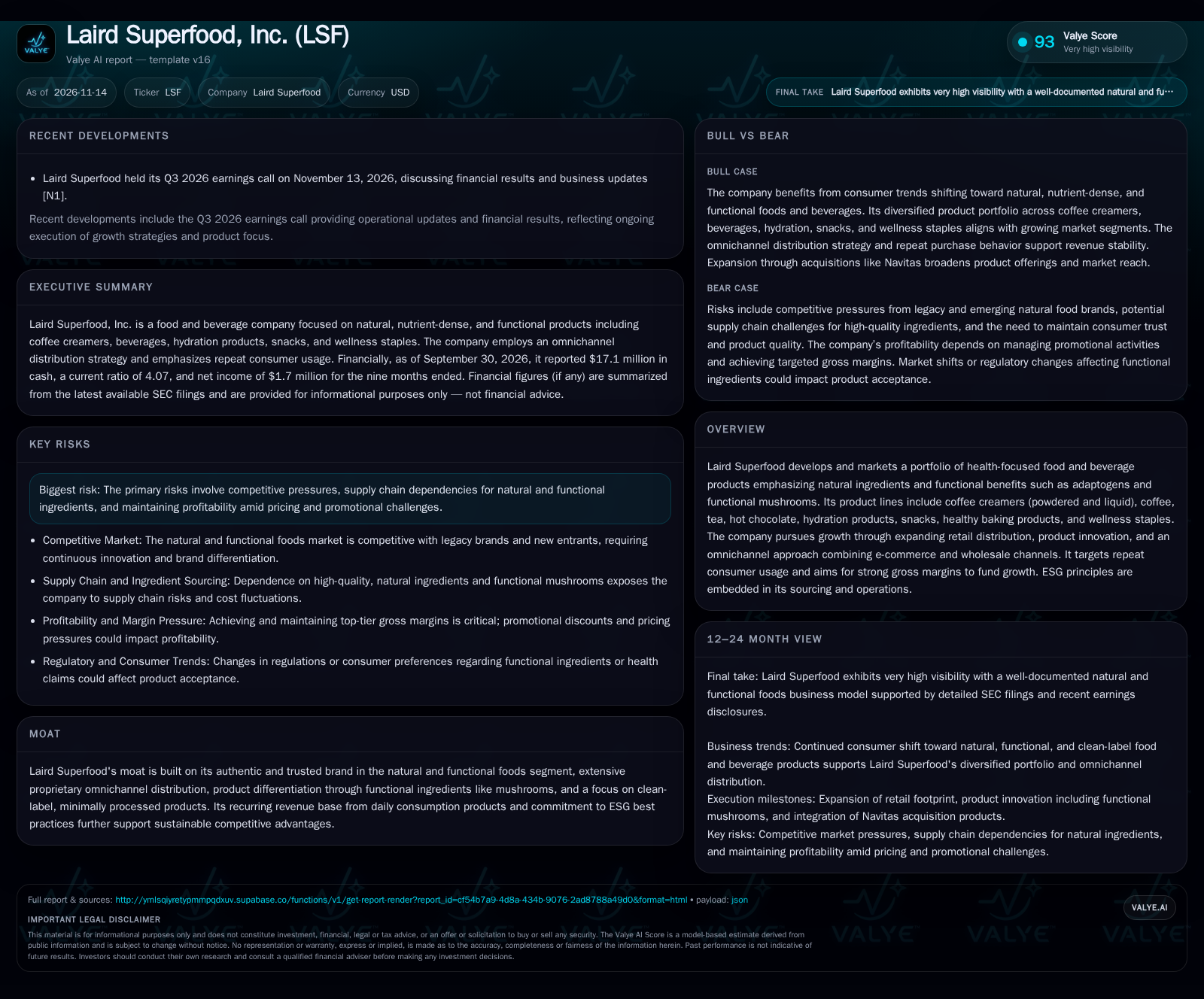
Laird Superfood reported $1.7 million in net income for the first nine months of 2026 and maintains a reported liquidity position. The company’s core strategy relies on differentiated product formulations—particularly plant-based creamers and functional snacks—distributed through both wholesale and direct-to-consumer channels. Its future depends on sustaining premium margins, integrating new product lines post-Navitas acquisition, and defending its brand in a crowded natural foods market. Key uncertainties include the pace of retail expansion, margin management, and resilience to competitive and regulatory pressures. [S2] [S1]
Laird Superfood, Inc. has reached a notable inflection point with the successful integration of Navitas-branded products, a return to profitability, and a reported liquidity position as of Q3 2026. Its business model, centered on natural, functional ingredients and omnichannel distribution, is designed to capture the growing consumer appetite for health-forward daily staples. However, the company’s ability to maintain premium pricing, innovate ahead of rivals, and secure supply chains for high-integrity ingredients will determine whether its current momentum can translate into durable, compounding value.
Profitability and Liquidity: Recent Financial Markers Shape the Growth Narrative
Laird Superfood posted net income of $1.7 million for the nine months ended September 30, 2026, with basic and diluted EPS of $0.03 per share, marking a return to profitability after a period of investment and integration [S2]. As of the same date, the company reported $17.1 million in cash and equivalents, current assets of $67.7 million, current liabilities of $16.6 million, and a current ratio of 4.07. These metrics reflect a period of operational stability and liquidity, providing financial headroom as the company executes on its expanded product and distribution strategy. The completion and integration of the Navitas acquisition is also a material development, broadening the portfolio into healthy baking and wellness staples [S1] [S2].
How Laird Superfood Monetizes Functional Ingredient Innovation
The company’s revenue engine is built around daily-use, repeat-purchase categories—most notably coffee creamers (both powdered and liquid), functional beverages, hydration mixes, and snacks. These products target health-conscious consumers seeking natural ingredients, clean labels, and functional benefits such as adaptogens and mushrooms. This value proposition could support premium pricing, but also requires continuous innovation to stay ahead of copycat products and shifting consumer preferences.
Gross margin expansion is a declared strategic goal, with management targeting top-tier food industry levels [S1]. However, achieving this is sensitive to input costs (especially for organic and specialty ingredients), supply chain reliability, and promotional intensity in both wholesale and e-commerce channels. Variable costs are significant due to ingredient quality and logistics, but the potential for operating leverage exists if the company can scale volume through expanded retail presence and direct-to-consumer growth.
The acquisition of Navitas expands revenue opportunities into healthy baking and wellness staples, potentially increasing the breadth of consumer offerings and cross-sell potential. However, integrating new product lines can temporarily elevate costs and complexity, requiring careful margin management. While capital needs appear stable in the near term, with no immediate pressure for external financing as of the latest balance sheet [S2], future expansion could require additional investment if growth ambitions accelerate.
Brand Authenticity and Ingredient Differentiation in a Saturated Marketplace
Laird Superfood’s competitive position is anchored in its authentic brand narrative—emphasizing natural, plant-based, and functional ingredients with a clean-label ethos. This positioning resonates with a growing segment of consumers, but the natural and functional foods market is intensely competitive, with both legacy food conglomerates and agile new entrants vying for share. Category leaders in plant-based creamers, functional beverages, and wellness snacks are investing heavily in innovation, marketing, and retail partnerships.
Switching friction for consumers is moderate: while brand trust and taste matter, the low cost and high frequency of these products mean that trial and churn rates can be high. The company’s omnichannel strategy—combining grocery, specialty retail, club, and direct-to-consumer channels—provides broad reach but also exposes it to channel conflict and margin variability.
Sustaining differentiation depends on continuous product innovation (e.g., functional mushrooms, adaptogens), supply chain credibility, and the ability to communicate health benefits without overstepping regulatory boundaries. ESG practices and responsible sourcing may provide incremental moat value, especially with institutional and younger consumers, but are unlikely to be a standalone defense against well-capitalized rivals.
If Premium Brand and Product Innovation Drive Accelerating Retail and DTC Growth
A favorable scenario sees Laird Superfood leveraging its expanded portfolio to secure additional shelf space in mainstream and specialty retailers, while driving higher repeat rates and potentially higher average order values in its direct-to-consumer channel. If consumer demand for functional and clean-label ingredients continues to outpace category growth, the company could realize operating leverage as fixed costs are spread over a larger revenue base.
Successful integration of Navitas-branded snacks and wellness staples would demonstrate management’s ability to cross-sell and innovate, increasing customer lifetime value. Sustained gross margin expansion—driven by pricing discipline, supply chain optimization, and premium product mix—would be a key confirming signal. Evidence for this scenario would include accelerating revenue growth, rising gross margins, and continued net profitability in future disclosures.
Omnichannel Expansion and Margin Discipline Amid Competitive and Cost Pressures
The most plausible trajectory is one where Laird Superfood grows modestly across both wholesale and e-commerce channels, with new products from the Navitas acquisition gradually gaining traction. Gross margins may improve incrementally if supply chain costs stabilize and promotional intensity is managed, but industry competition and private-label encroachment likely limit outsized pricing power.
Operational discipline—controlling SG&A and integrating new lines without margin dilution—remains essential. While net income remains positive, earnings growth is likely to be modest unless a step-change in volume or pricing is achieved. Confirming evidence would include stable or slowly rising gross margins, steady cash generation, and continued shelf and channel expansion. A reversal in these trends, material supply chain disruptions, or margin compression would challenge this scenario.
Margin Erosion and Brand Dilution in the Face of Intensifying Competition
In an adverse scenario, Laird Superfood could face margin compression due to aggressive discounting by larger competitors, rising ingredient costs, or failure to scale new product lines profitably. If consumer preferences shift away from functional ingredients, or regulatory scrutiny limits health claims, the brand’s differentiation could erode.
Supply chain disruptions or quality lapses in sourcing specialty ingredients could force higher costs or product recalls, undermining brand trust. Evidence of this scenario would be declining gross margins, negative net income, inventory write-downs, or slowed revenue growth. A spike in promotional expenses or loss of key retail placements would further validate downside risks.
What Will Determine If Laird Superfood’s Momentum Is Sustainable?
Gross margin trends by product category and channel—especially post-Navitas integration—if disclosed, will clarify the company’s ability to maintain premium positioning.
Rate of new retail account additions and shelf expansion in mainstream and specialty channels.
Direct-to-consumer repeat purchase rates and average order value, if disclosed, would help test the strength of brand loyalty and cross-sell efficacy.
Supply chain reliability and cost inflation for key ingredients such as coconut, functional mushrooms, and plant-based fats.
Promotional spend as a percentage of sales, indicating whether growth is being driven by discounting versus organic demand.
Integration milestones and revenue contribution from Navitas-branded products.
Any regulatory or market developments affecting the permissible use and marketing of functional ingredients.
Disclaimer: This is research-only, informational analysis and not investment advice. It may include AI-generated interpretation and general industry context. Always verify important details using primary sources.

Comments