
OTG Acquisition Corp. I: SPAC Structure, Sponsor Dynamics, and the Road to Value Creation
OTG Acquisition Corp. The company’s economics and future value hinge entirely on the quality and terms of a future business combination, with current sponsor share restrictions and amendable agreements shaping both alignment and risk.
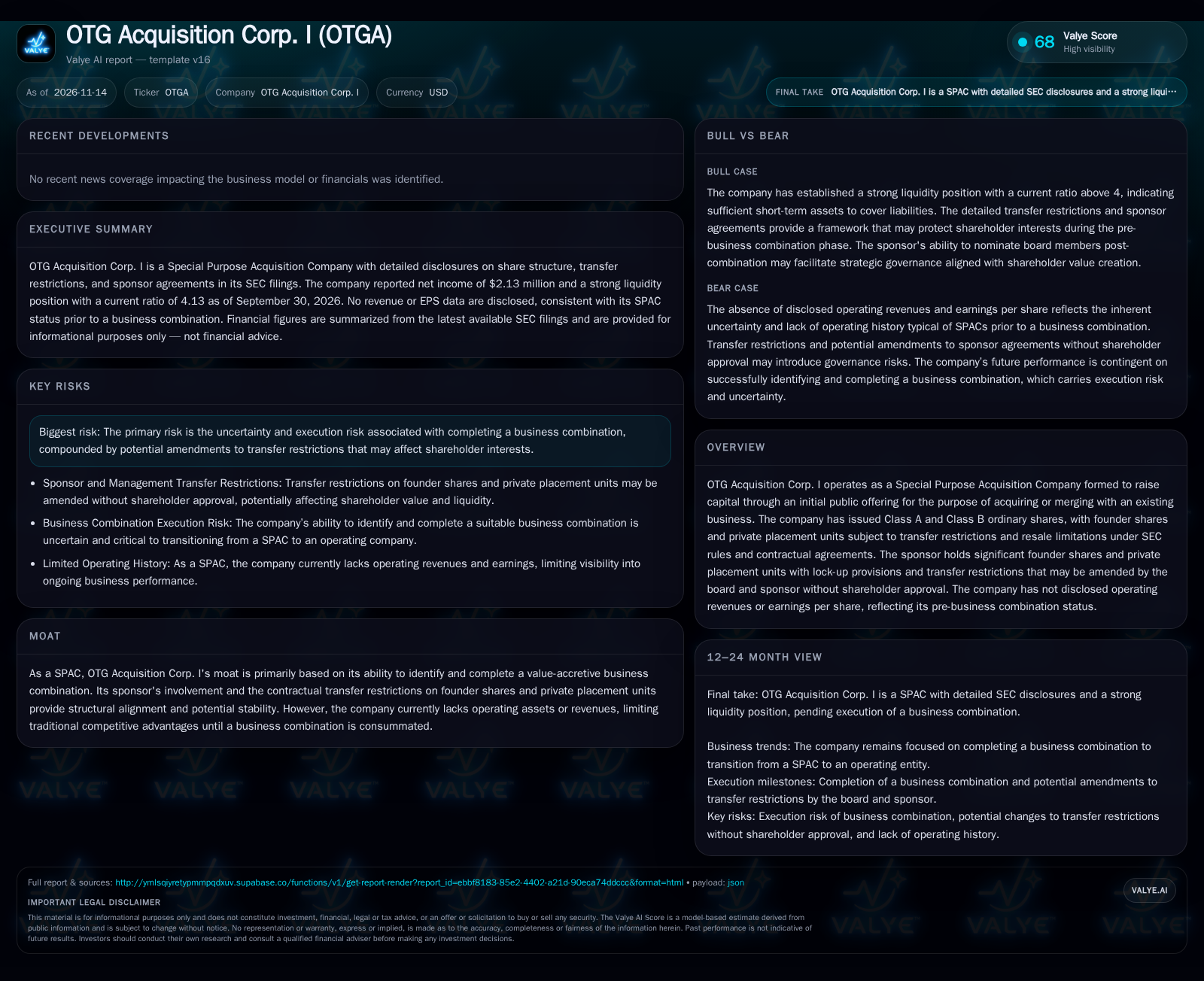
OTG Acquisition Corp. I is a blank-check SPAC with $230 million raised in its IPO and sponsor-aligned share structures. It has not yet identified a target, and its net income is driven by trust-account interest rather than operations. The path forward depends on finding and executing a value-accretive merger; governance risks include sponsor ability to amend transfer restrictions without shareholder approval. Execution risk and alignment mechanisms will determine eventual shareholder returns. [S2]
OTG Acquisition Corp. I exemplifies the modern SPAC model: a publicly listed shell company with ample trust-account liquidity and a sponsor-driven governance structure, yet no operating business or identified acquisition target. The company's current financials reflect only interest from IPO proceeds, not operational activity. With founder shares and private placement units subject to flexible transfer restrictions, the real test lies ahead—whether OTGA can secure a compelling merger and balance sponsor incentives with public shareholder interests. Until a business combination is announced and executed, the SPAC’s economics remain theoretical, but its structure and sponsor leverage set the stage for both opportunity and risk. [S2]
Current State: Trust-Account Earnings and Sponsor Control Shape the Pre-Merger Landscape
As of September 30, 2026, OTG Acquisition Corp. I reported net income of $2,131,872 for the quarter, driven entirely by interest earned on trust-account investments rather than any operating activity. The company’s balance sheet shows current assets of $380,555 against current liabilities of $92,056, yielding a current ratio of 4.13. All share classes—23,775,000 Class A and 5,750,000 Class B shares—are outstanding, with founder shares and private placement units held by the sponsor and subject to transfer restrictions. Importantly, these restrictions can be amended by the sponsor and board without shareholder approval, centralizing significant governance power. The company has not identified a business combination target, and its only income to date is from passive interest on IPO proceeds. [S2]
How a SPAC Like OTGA Creates Value: From Trust-Account Arbitrage to Post-Merger Economics
The economics of OTG Acquisition Corp. I are, by design, binary and event-driven. Until a business combination closes, the company’s sole source of income is interest from the funds raised in its IPO—typically invested in short-term U.S. Treasury securities or similar low-risk instruments. These yields have recently provided modest positive net income, but this is not sustainable value creation for public shareholders. Upon completion of a business combination, the operating model pivots entirely: the SPAC merges with or acquires an operating company, using the trust-account proceeds (minus redemptions and transaction fees) as growth capital. The economics of the post-merger entity—revenue mix, margins, capital needs, and growth profile—will depend on the selected target.
SPACs are typically structured so that sponsors and early backers receive founder shares (often 20% of post-IPO equity on a fully diluted basis) at a nominal cost, creating an incentive to complete a deal but also potentially misaligning interests if sponsor economics are not tightly linked to long-term value creation. Transfer restrictions and lock-ups are designed to align the sponsor with public shareholders, but the ability to amend these without a vote adds a layer of governance risk. Ultimately, OTGA’s long-term economics will be determined by the quality of the acquired business, the terms of the merger, and the dilution from both sponsor shares and possible redemptions.
SPAC Competition: Target Scarcity, Sponsor Reputation, and the Race for Quality Deals
OTG Acquisition Corp. I competes in a crowded SPAC landscape, where hundreds of blank-check companies vie for a finite pool of attractive private businesses willing to go public via merger. The primary competitive lever is the ability to source, negotiate, and close a deal with a company that has strong growth prospects, credible management, and a compelling public-market narrative. Sponsor reputation, sector expertise, and alignment mechanisms (such as earnouts or extended lock-ups) can help attract better targets and build trust with both the target company and prospective PIPE (private investment in public equity) investors.
However, OTGA’s ability to amend sponsor share restrictions without shareholder approval may be viewed skeptically by potential targets or PIPE participants who prioritize governance stability. Furthermore, high SPAC supply and increased regulatory scrutiny have made target companies more selective about which SPACs they partner with. The risk of shareholder redemptions at deal announcement can further erode trust-account funds, limiting the capital available to the merged entity and potentially undermining the economics for all parties.
Unlocking Value: What Success Would Look Like for OTGA and Its Shareholders
A favorable outcome for OTG Acquisition Corp. I would involve identifying a high-quality target with strong fundamentals, compelling growth prospects, and a clear path to public-market valuation expansion. Ideally, the sponsor would use its flexibility and deal-making experience to structure a transaction with minimal dilution, low redemptions, and significant PIPE participation to backstop the trust account. Post-merger, the combined entity would deliver operating leverage, revenue growth, and positive cash flow, validating the sponsor’s target selection and creating upside for public shareholders.
Confirmation of this scenario would include the announcement of a business combination with positive market reception (limited redemptions, PIPE funding at or above trust value), clear disclosure of target financials, and sponsor alignment mechanisms such as extended lock-ups or performance-based vesting. The share price would likely trade above the $10 per share trust value as the market anticipates future growth from the new operating company.
Probable Trajectory: Typical SPAC Timeline and the Role of Governance Frictions
The most plausible near-term path is that OTGA continues its search for an acquisition target, incurring modest operating expenses and generating interest income until a deal is identified. The sponsor may negotiate with several companies, but given target scarcity and competitive pressure, the eventual merger may involve a business with moderate growth prospects or require significant PIPE support to offset redemptions. The ability to amend transfer restrictions could be used to facilitate a deal but may also raise shareholder governance concerns.
This scenario is confirmed if OTGA announces a merger with a credible but not top-tier target, experiences significant redemptions, and relies on PIPE investors to close the transaction. Shareholder returns may be limited to the trust-account redemption value, with upside dependent on the post-merger company’s ability to execute its business plan. If no suitable target is found within the SPAC’s permitted timeframe, the company may be liquidated and trust funds returned to shareholders, net of expenses.
Execution Risks: Target Shortfall, Sponsor Amendments, and Shareholder Value Erosion
The primary risk is that OTGA fails to secure a business combination within the required timeframe, resulting in liquidation and the return of trust-account funds to shareholders—minus expenses and without any premium for time or opportunity cost. Alternatively, if the sponsor leverages its authority to amend transfer restrictions in ways that dilute or disadvantage public shareholders (for example, by accelerating vesting or reducing lock-up periods), it could further erode trust and lead to value leakage.
An adverse scenario would be confirmed by prolonged deal search with repeated deadline extensions, high redemptions at deal announcement, or public disputes over governance and sponsor economics. In this case, sponsor incentives may be misaligned with long-term shareholder value, and the share price could drift below trust value if the market perceives heightened risk of an unfavorable or failed transaction.
Milestones That Will Define OTGA’s Value Creation Path
Announcement of a definitive business combination agreement, including target identity, financials, and transaction terms.
Level of shareholder redemptions at the time of merger vote—high redemptions would signal weak market confidence and could shrink available capital.
PIPE (private investment in public equity) participation levels and pricing, if disclosed, as a sign of third-party investor confidence and deal quality.
Any amendments to sponsor share transfer restrictions or lock-up provisions prior to or after deal announcement.
Sponsor’s ongoing equity stake and alignment mechanisms (such as earnouts, performance vesting, or extended lock-ups), if disclosed.
SEC or regulatory developments affecting SPAC governance or disclosure requirements.
Timeline to merger completion or, if no deal is reached, approaching deadlines for SPAC liquidation.
Disclaimer: This is research-only, informational analysis and not investment advice. It may include AI-generated interpretation and general industry context. Always verify important details using primary sources.

Comments