
Hennessy Capital Investment Corp. VIII: Leveraging SPAC Expertise to Source Industrial Innovation Deals
With $241.5 million in IPO proceeds held in trust and a management team that has executed 14 prior SPAC combinations, HCIC enters the competitive energy transition and industrial innovation deal landscape. The question is whether execution, sector timing, and sponsor reputation can convert capital and experience into a value-accretive business combination before SPAC constraints bite.
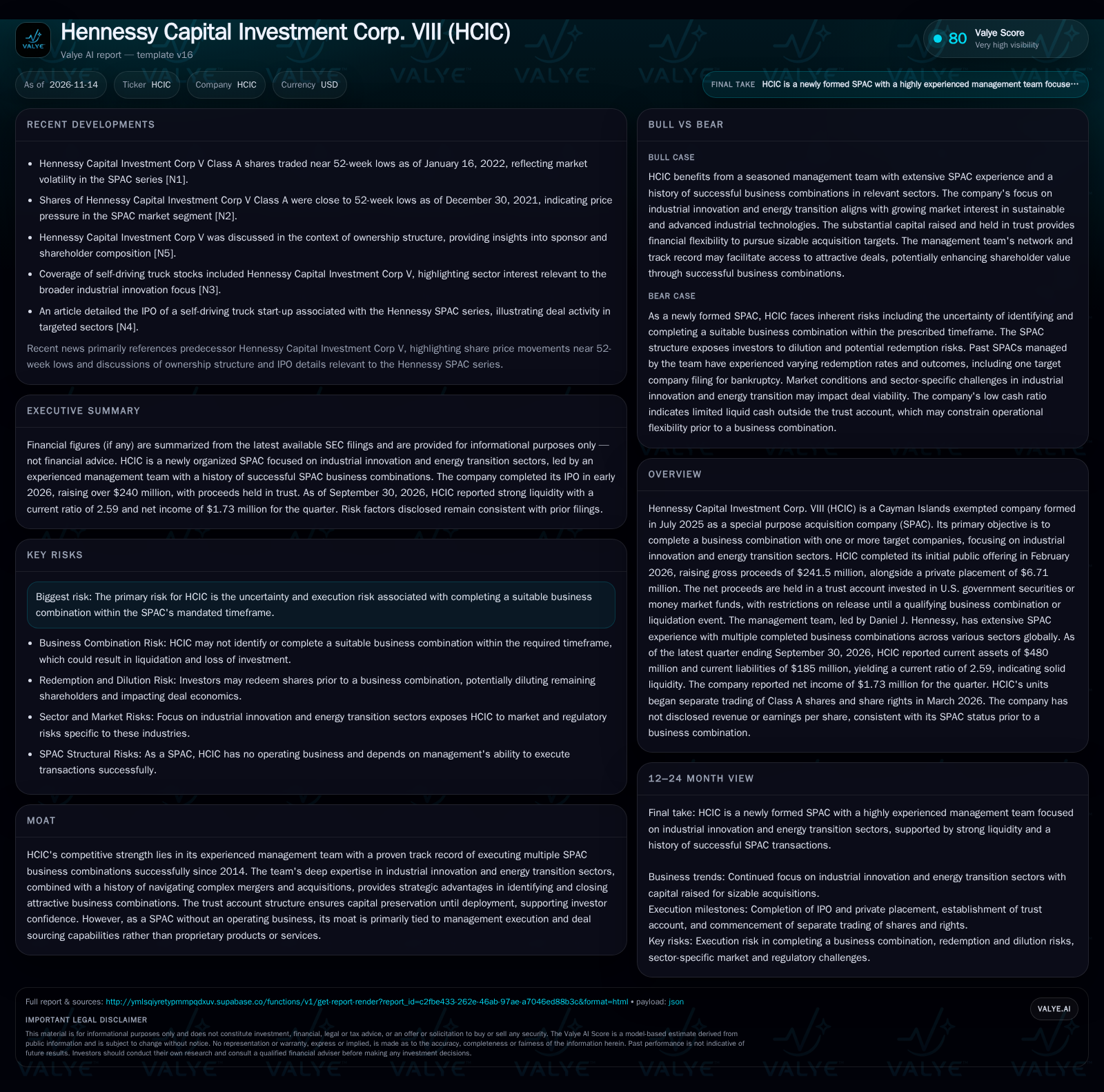
HCIC is a newly-formed SPAC with $241.5 million in trust and a mandate to target industrial innovation and energy transition companies valued at $500 million or more. The management team, led by Daniel J. Hennessy, brings a significant SPAC track record. No business combination target has been announced as of September 30, 2026. The central challenge is identifying and closing a high-quality deal before time and redemption pressures erode potential value. Risks include dilution, redemptions, and sector cyclicality, while upside hinges on sponsor deal-sourcing strength and timely execution. [S2]
Hennessy Capital Investment Corp. VIII (HCIC) exemplifies the modern blank-check company: a Cayman-incorporated SPAC, flush with over $240 million in trust, and steered by a sponsor team with a deep SPAC resume. The firm’s explicit target zone—industrial innovation and energy transition—remains a hotbed for both opportunity and deal competition. Yet as of the September 2026 quarter, HCIC had not announced or engaged in substantive talks with any acquisition candidate. With the SPAC market’s redemption and regulatory pressures mounting, HCIC’s thesis now depends on its ability to leverage sponsor experience and sector focus into a value-accretive combination before the SPAC clock runs down. [S2]
Initial Setup: IPO Funds, Trust Framework, and Management Track Record
HCIC raised $241.5 million from its February 2026 IPO, with an additional $6.71 million from a concurrent private placement. All net proceeds are held in a trust account, invested in U.S. government securities or money market funds, and cannot be accessed for operating purposes until a qualifying business combination or liquidation event occurs. As of September 30, 2026, HCIC reported current assets of $480.06 million and current liabilities of $185.3 million, resulting in a current ratio of 2.59. However, the vast majority of these assets are restricted within the trust. The management team, led by Daniel J. Hennessy, has a record of 14 prior SPAC business combinations, focusing on industrial and energy-related sectors. As of the latest reported quarter, HCIC had not identified or engaged a business combination target. [S2]
Understanding SPAC Economics: Capital Use, Dilution Concerns, and Value Creation
The standard SPAC economic model is transactional: sponsor capital and public funds are pooled, held in trust, and deployed to acquire a private operating company. Value creation for shareholders depends on the quality of the acquisition and the ability to execute a de-SPAC transaction that survives high redemption rates and minimizes dilution. In HCIC’s case, the $241.5 million in IPO proceeds and $6.71 million in sponsor capital are potential levers for a deal with a target valued at $500 million or more. However, unless a PIPE (private investment in public equity) or additional financing is secured, the trust size caps the cash consideration and may limit target selection to companies willing to accept a substantial stock component.
SPACs face a trade-off: the more equity issued (including conversion of founder shares and share rights), the greater the dilution for public shareholders. Redemption rates can shrink the cash pool, forcing renegotiation or additional capital raising. HCIC’s economics, therefore, will hinge on minimizing redemptions, structuring a deal that aligns incentives, and selecting a target with both growth potential and public market appeal.
Operating leverage is limited pre-deal, as SPACs generate interest income from trust assets and incur minimal ongoing expenses. After a business combination, the economics shift to those of the acquired company, with the SPAC structure itself providing no ongoing revenue stream. The key is deploying capital into a business that can generate robust cash flow and returns for shareholders post-merger.
Sponsor Reputation Shapes Deal Sourcing Amid Intense SPAC Competition
HCIC competes in a SPAC universe where hundreds of blank-check companies chase a finite pool of attractive targets, particularly in energy transition and industrial innovation. The sector focus aligns with long-term trends—decarbonization, automation, and infrastructure modernization—yet also attracts well-capitalized private equity, corporate buyers, and other SPACs. In this environment, sponsor reputation, deal-sourcing networks, and the ability to move quickly become decisive.
Daniel J. Hennessy’s track record—14 previous SPAC business combinations—may confer credibility with potential targets, especially those seeking a public listing with less execution risk. However, recent market history shows that even experienced sponsors face high redemption rates, challenging market conditions, and post-merger volatility. HCIC’s main competitive levers are its sponsor’s sector knowledge, relationships, and ability to structure deals that satisfy both target management and public investors. The absence of a proprietary product or operational moat means competitive advantage is transient and tied to the quality and timing of the business combination.
Potential Upside: Harnessing Sponsor Networks to Identify Prime Energy Transition Targets
The best-case outcome is that HCIC leverages its sponsor’s sector experience and relationships to identify and close a business combination with a high-growth, differentiated company in the industrial innovation or energy transition space. If the deal is struck before redemption pressures peak and the target has strong public market appeal, the transaction could minimize dilution and attract PIPE investors or strategic partners, preserving cash in trust.
Confirmation of this scenario would come from a timely deal announcement with a target exhibiting robust growth, defensible margins, and a compelling decarbonization or automation thesis. Evidence would include low redemption rates, a successful PIPE raise, and positive initial trading performance post-merger. Falsification would occur if the target is low-quality, the deal is repeatedly delayed, or redemptions erode the trust pool, forcing HCIC to renegotiate or abandon the transaction.
Expected Scenario: Deal Delays, Moderate Redemptions, and Execution Challenges
The most plausible outcome is that HCIC, like many of its peers, faces a protracted search for an attractive target amid intense competition and sector volatility. The combination process may extend into the latter half of the SPAC’s permitted window, with a deal eventually announced in the industrial innovation or energy transition vertical. Moderate to high redemption rates are likely, requiring the sponsor to seek PIPE financing or renegotiate deal terms to preserve sufficient cash for the target’s growth plans.
Confirmation would involve an eventual deal announcement, an S-4 filing with reasonable pro forma projections, and the completion of a shareholder vote with redemptions in line with SPAC market averages. Falsification would arise if HCIC fails to announce a deal, is forced to liquidate, or if the post-merger entity struggles to meet public market expectations due to overvaluation or operational missteps.
Risks to Value: Liquidation Threats and Dilutive Capital Raises Under SPAC Limits
The negative scenario unfolds if HCIC cannot secure a suitable target within the SPAC’s mandated timeframe or if market conditions deteriorate further in the industrial and energy transition sectors. In this case, shareholder redemptions could approach 90% or more, shrinking the cash pool to a level insufficient to close a meaningful deal. The sponsor might attempt to salvage the process via a highly dilutive PIPE or by renegotiating with a lower-quality target willing to accept primarily equity consideration.
If no viable deal emerges, HCIC would be forced to liquidate, returning trust proceeds (minus expenses) to shareholders and forfeiting sponsor investment. Confirmation of this scenario would come from extended periods without deal announcements, repeated deadline extensions, or public disclosures of deal terminations. Falsification would require a credible, timely deal with manageable redemptions and adequate financing.
Critical Milestones for HCIC’s Capital Deployment and Value Realization
Announcement of a binding merger agreement with a target in the industrial innovation or energy transition sectors.
Level of redemptions at the time of shareholder vote—low rates would suggest strong deal quality and sponsor alignment.
Disclosure and size of any PIPE or alternative financing raised to supplement trust proceeds.
Quality of target company financials—revenue growth, margins, and visibility—if disclosed in merger proxy materials.
Timing of deal announcement relative to SPAC’s liquidation deadline.
Sponsor and insider participation in any PIPE or backstop financing.
Market reaction to the de-SPAC transaction—initial trading volume, volatility, and post-merger price action.
A useful metric would be the final trust value per share at deal closing, net of redemptions and expenses.
Disclaimer: This is research-only, informational analysis and not investment advice. It may include AI-generated interpretation and general industry context. Always verify important details using primary sources.

Comments