
MDB Capital Holdings: Public Venture Capital Meets Platform Integration and Execution Risk
MDB Capital Holdings pursues a differentiated public venture capital model, combining early-stage technology company formation, financing, and integrated IP services. The company's approach offers structural advantages, but its financial losses and execution dependencies highlight the challenges of scaling a platform-driven, capital-intensive strategy in volatile markets.
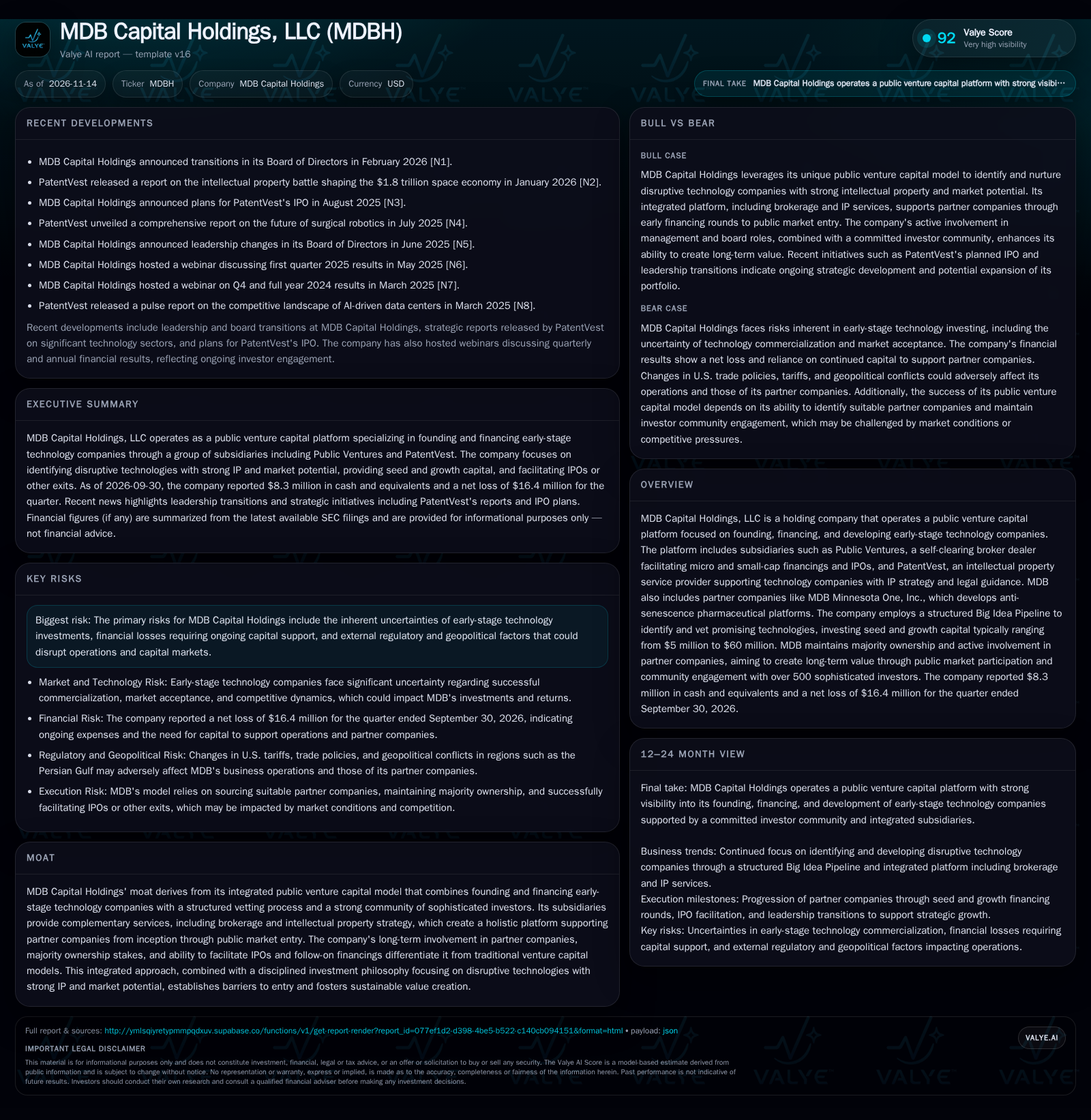
MDB Capital Holdings blends company founding, early-stage financing, and intellectual property services to create a public venture capital platform targeting disruptive technologies. While the integrated model and investor community offer potential for outsized value creation, sustained losses and heavy reliance on capital markets expose MDB to significant execution and market risks. The ability to consistently identify, fund, and exit high-potential companies will determine the durability of its business model and shareholder returns. [S1] [S2]
MDB Capital Holdings is attempting to redefine the venture capital landscape by fusing the roles of company founder, early financier, and intellectual property strategist into a single, integrated public platform. With subsidiaries spanning brokerage, IP validation, and direct company formation, MDB aspires to systematically identify and nurture high-potential technologies from inception to IPO. The question is whether MDB's structured model, community-driven capital formation, and active portfolio management can overcome the inherent risks of early-stage tech investing and deliver durable shareholder value.
Recent Financial and Strategic Moves Shape MDB’s Near-Term Outlook
MDB Capital Holdings ended the September 30, 2026 quarter with $8.315 million in cash and equivalents and reported a net loss of $16.444 million for that period, signaling ongoing high burn rates relative to liquidity. While this is not unusual for a platform supporting early-stage technology ventures, it highlights MDB’s dependence on continued capital formation and successful exits to sustain operations. [S2]
The company’s operational structure now includes Public Ventures (a self-clearing broker dealer), PatentVest (IP solutions), and majority control of MDB Minnesota One (M1), a pharmaceutical development platform. This structure enables direct influence over partner company strategy and execution. [S1]
Notably, MDB is preparing for a potential IPO of PatentVest, which could serve as a test of the model’s ability to spin out and monetize subsidiary value in public markets. [N3]
Leadership and board transitions in 2025-2026 further reflect an evolving governance structure, with potential implications for strategic direction and execution continuity. [N1] [N5]
How MDB’s Platform Model Seeks to Create and Capture Value
MDB’s economics are predicated on identifying promising early-stage technologies, providing initial and follow-on funding ($5–60 million range), and retaining majority stakes through the most value-accretive phases. By acting as both founder and financier, MDB seeks to capture outsized returns upon public market exits or asset sales, while also generating service revenues from brokerage and IP advisory activities. [S1]
The integrated model introduces multiple revenue streams: syndication fees and commissions from Public Ventures’ capital raises, IP validation and strategy fees via PatentVest, and equity appreciation in partner companies. However, the model is capital intensive, with substantial fixed costs for talent, due diligence, and portfolio support, and variable returns highly contingent on successful commercialization and exit events.
Operating leverage could be significant if multiple partner companies reach inflection points simultaneously, but the timing and magnitude of such payoffs are inherently unpredictable. Cash flow is lumpy and highly event-driven; recurring revenues from services may help smooth volatility but are unlikely to offset the costs of failed or slow-developing ventures in the near term.
MDB’s holding company structure allows shareholders to participate in upside from asset sales, IPOs, or portfolio company distributions, but also exposes them to dilution, capital calls, and the risks of concentrated bets.
Integrated Venture Platform: Differentiation, Barriers, and Rival Forces
MDB’s main differentiation lies in its public venture capital model—combining company origination, financing, and IP services—versus conventional VCs or investment banks that typically operate as external capital providers or advisors. The company’s structured Big Idea Pipeline provides a systematic approach to technology sourcing, narrowing hundreds of candidates to a handful of active investments. [S1]
Majority ownership and board participation offer MDB more control over partner company direction than most VCs, potentially accelerating development and aligning incentives for value realization. The in-house broker dealer and IP advisory arms provide integrated support, which could reduce friction and increase the likelihood of successful exits.
However, MDB faces intense competition for high-potential opportunities from traditional VCs, private equity, SPAC sponsors, and increasingly from corporate venture arms and sovereign funds. The company’s focus on public market entry also exposes it to capital market cycles; in risk-off environments, micro-cap IPOs and secondary financings can stall.
Switching costs for partner companies may be moderate, especially if alternative capital or strategic partners emerge. The durability of MDB’s investor community and the repeatability of its approach in different technology verticals remain open questions.
If the Pipeline Delivers: Cascading Exits and Compounding Platform Value
A favorable scenario sees MDB’s Big Idea Pipeline consistently surfacing high-value technologies, with multiple partner companies advancing to IPO or strategic sale. If PatentVest’s IPO is successful and demonstrates monetization of IP services, it could validate the platform’s ability to internally generate, support, and realize value across multiple verticals. [N3]
Leveraging its community of over 500 sophisticated investors, MDB could syndicate larger and more frequent financings, reinforcing its reputation and deal flow. As more portfolio companies exit, the holding company could distribute proceeds or reinvest in new ventures, compounding returns and building a defensible track record.
Evidence supporting this scenario would include: repeated successful IPOs or exits for partner companies, measurable growth in service revenues from Public Ventures and PatentVest, and expansion of the investor network. Confirmation would come from increasing cash flow from exits, rising NAV per share, and clear evidence of platform scale effects (e.g., faster time-to-exit, lower cost per deal, or improved post-IPO performance of portfolio companies).
Platform Execution and Capital Cycles Define MDB’s Mid-Term Trajectory
The most plausible path is that MDB’s platform yields a mix of modest wins, slow developers, and outright failures, with exit events occurring sporadically rather than in a steady cadence. The company will likely need to raise additional capital periodically to fund operations and new investments, especially given the high ongoing burn rate relative to current cash. [S2]
Service revenues from Public Ventures and PatentVest may partially offset losses, but are unlikely to make the platform self-sustaining until multiple, sizable exits are realized. The company’s ability to maintain majority stakes and active involvement in partner companies will be tested as outside investors are brought in during later rounds.
Confirmation of this scenario would be incremental progress in the pipeline (new investments, follow-on rounds), continued but lumpy service revenue growth, and periodic capital raises. Falsification would be an inability to attract new deals, deterioration of the investor community, or repeated failed IPO attempts.
What Happens if the Platform Falters: Funding Gaps and Value Dilution
A negative scenario for MDB involves a prolonged period without meaningful exits, coupled with increased burn from supporting underperforming or stalled partner companies. If capital markets tighten or investor enthusiasm wanes, MDB could struggle to raise new funds, forcing it to dilute existing shareholders or wind down positions at unfavorable terms.
Operationally, failed or delayed IPOs (including PatentVest’s) would undermine the thesis that the platform can reliably generate public market value. Fixed costs for talent and infrastructure could become unsustainable, and the company might be forced to sell assets or subsidiaries at a discount.
Evidence of this scenario would include: persistent net losses without offsetting asset sales, shrinking cash balances and working capital, unsuccessful capital raises, and a shrinking or disengaged investor community. Repeated board or executive turnover could further signal strategic drift or internal challenges.
Testing the MDB Platform: Milestones and External Factors That Will Shape Outcomes
Progress on the PatentVest IPO—timing, valuation, and investor reception will be a direct test of MDB’s ability to monetize platform assets. [N3]
Net cash flow from partner company exits or asset sales—if disclosed, this would provide concrete evidence of the platform’s return potential beyond service revenues.
Growth and engagement of MDB’s investor community—a useful metric would be repeat participation rates and capital commitments in follow-on rounds.
Number and quality of new investments entering the Big Idea Pipeline, and the conversion rate from pipeline to active portfolio companies.
Service revenue growth from Public Ventures and PatentVest—if disclosed, this would help test the ability of the platform to generate recurring income.
Burn rate relative to available cash and capital formation—the pace of capital deployment versus replenishment is critical given current losses. [S2]
Turnover among leadership and board members—frequent changes may signal instability or strategic misalignment. [N1] [N5]
Regulatory or market shifts affecting small-cap IPO windows or micro-cap financing conditions—external shocks could have outsized impact on MDB’s business model.
Disclaimer: This is research-only, informational analysis and not investment advice. It may include AI-generated interpretation and general industry context. Always verify important details using primary sources.

Comments