
Ashford Hospitality Trust: Strategic Moves and Liquidity Management in a Challenging Market
Ashford Hospitality Trust owns 68 upscale hotel properties in the U.S., outsourcing management and asset oversight.
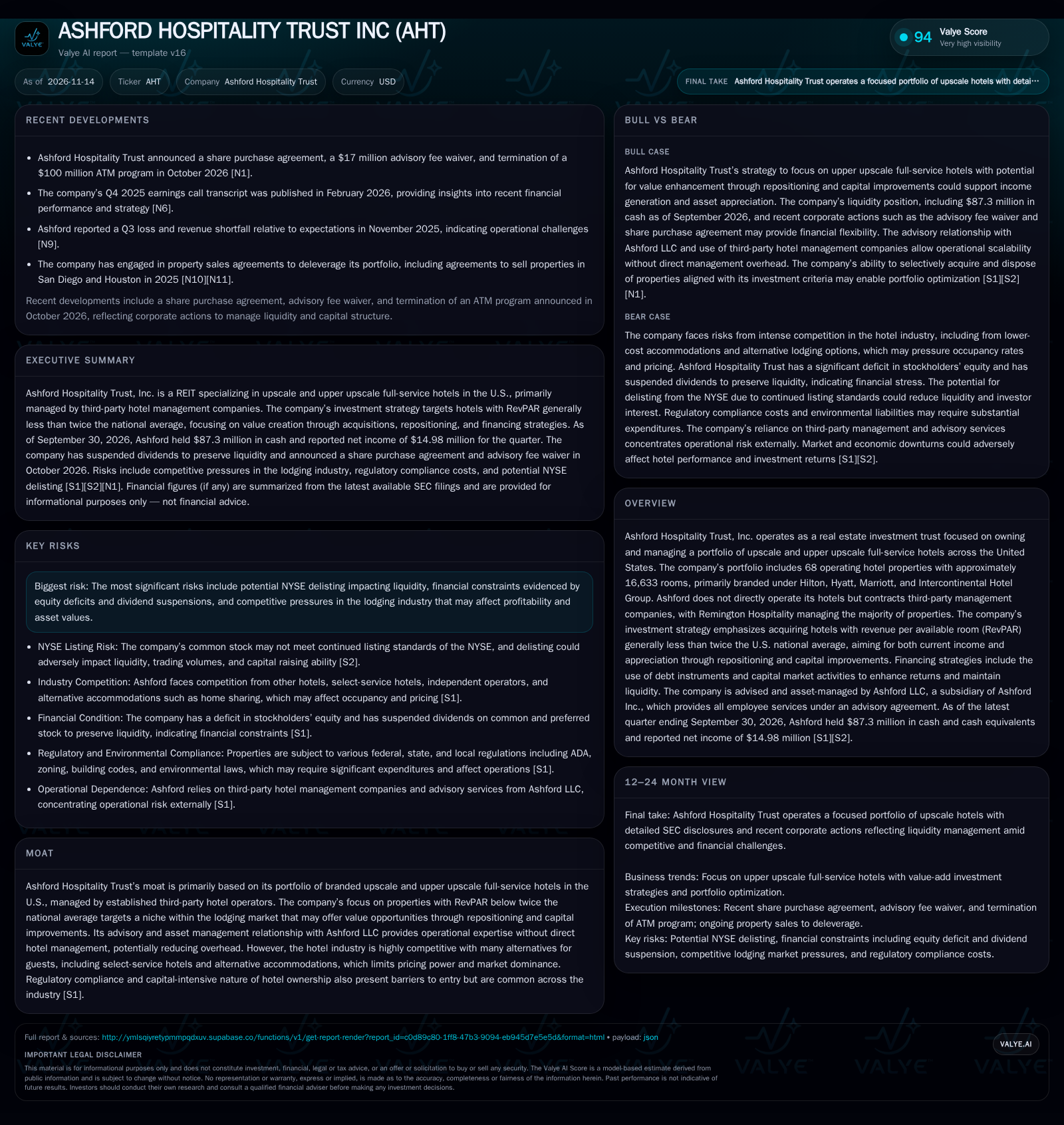
Ashford Hospitality Trust owns 68 upscale hotel properties in the U.S., outsourcing management and asset oversight. Facing a $626 million equity deficit and suspended dividends, AHT has announced a share purchase agreement, advisory fee waiver, and halted a $100 million ATM program to manage liquidity. The company’s strategy centers on value-add acquisitions and selective deleveraging, but faces NYSE delisting risk, intense competition, and regulatory burdens. The next phase hinges on successful asset sales, RevPAR trends, and evidence of financial stabilization.
Ashford Hospitality Trust (AHT) is at a strategic crossroads, balancing a large portfolio of branded upscale hotels with persistent financial strain and industry headwinds. Recent maneuvers—including a share purchase agreement, advisory fee waiver, and ATM program termination—underscore a defensive posture. The company’s future hinges on its ability to execute property sales, manage through stiff competition, and maintain compliance with NYSE listing standards, all while navigating a capital-intensive, cyclical industry.
Liquidity Moves Signal Strategic Shifts and Financial Strains
Ashford Hospitality Trust’s most recent quarter saw the company report $87.3 million in cash and cash equivalents, with net income of $14.98 million for the period ending September 30, 2026. Despite these headline positive figures, the company’s stockholders’ equity remains deeply negative at a deficit of $626.4 million as of December 31, 2025. To preserve liquidity, AHT has suspended all dividends on both common and preferred stock. In October 2026, the REIT announced a share purchase agreement, a $17 million advisory fee waiver, and the termination of a $100 million at-the-market (ATM) equity program. These moves signal a heightened focus on immediate liquidity and cost containment as the company seeks to stabilize its financial footing amid ongoing market and operational challenges [S1] [S2] [N1].
Portfolio Choices and Capital Structure Influence on Earnings Potential
Ashford Hospitality Trust generates income through ownership of full-service upscale hotels, primarily under major brands. The REIT’s economics revolve around the gap between hotel-level operating cash flows and the cost of capital, including debt service, management fees, and asset management/advisory expenses. Properties are managed by third parties—most notably Remington Hospitality, which oversees 50 of the 68 assets—shifting operational risk but introducing recurring management and advisory fees paid to external entities, including Ashford LLC [S1].
AHT’s investment thesis targets hotels with revenue per available room (RevPAR) below twice the U.S. average, aiming for value creation through acquisition, repositioning, and selective capital improvements. This approach seeks to capture both current yield and future appreciation, but can require significant upfront and ongoing capex. The company’s financing model relies on leverage to amplify returns, but high debt loads increase sensitivity to downturns and refinancing risk. The company reported cash and liquidity metrics for the period; these figures do not by themselves establish operating runway, investment capacity, financial flexibility, or financing capacity.
The capital structure's influence on earnings potential is particularly nuanced given the REIT's reliance on leverage. While debt can magnify returns during periods of operational improvement, it also introduces significant refinancing risk, especially if credit markets tighten or if the company's credit rating deteriorates. This risk is compounded by the cyclical nature of the hospitality industry, where downturns can quickly erode cash flows and constrain access to capital. Furthermore, the interplay between management fees paid to third parties and the operating margins at the property level can create pressure on net yields, especially if these fees are fixed or escalate regardless of performance. Understanding the sensitivity of earnings to both operational metrics and capital costs is critical to assessing the sustainability of the current business model.
Another important consideration is the timing and scale of capital expenditures required to maintain or enhance hotel competitiveness. Value-add strategies often necessitate significant upfront investment in renovations or repositioning to drive RevPAR growth. However, such investments can strain liquidity, especially if they precede revenue improvements. The capital allocation decision must balance the potential uplift in asset value and operating income against the risk of overextending financial resources. In periods of constrained liquidity, deferring or scaling back capex may preserve cash but could also impair long-term competitiveness and asset valuation, creating a delicate trade-off for management.
Navigating Brand Alliances and Outsourcing in a Competitive Landscape
AHT’s portfolio is anchored in major brands (Hilton, Hyatt, Marriott, IHG), providing access to loyalty programs and national sales channels. However, the upscale and upper-upscale lodging segment is intensely competitive, with significant pressure from both branded and independent hotels, as well as alternative accommodations like Airbnb and VRBO. This dynamic limits room for pricing power and makes occupancy rates highly sensitive to macroeconomic cycles and local supply-demand imbalances [S1].
The company’s use of third-party managers (Remington for most properties) and an external advisory model (Ashford LLC) allows for operational scalability and theoretically reduces internal overhead. Yet, these structures can dilute alignment and may result in higher recurring fees, especially if outsized compared to property-level performance. Regulatory requirements—ranging from ADA to environmental compliance—add further cost burdens that are difficult to mitigate at the property level and are largely shared across the industry.
The reliance on brand affiliation provides both advantages and constraints. While major brands offer broad distribution networks and customer loyalty programs that can drive occupancy, they also impose brand standards and fees that limit operational flexibility. These requirements can increase operating costs and capex obligations, potentially compressing margins if revenue growth does not keep pace. Additionally, the growing presence of alternative lodging options introduces a structural shift in consumer preferences, particularly among younger travelers, which may dampen demand for traditional upscale hotels. The company's ability to adapt its portfolio and service offerings to these evolving market dynamics will be pivotal in sustaining competitive positioning.
Outsourcing operational management and advisory services introduces complexity in aligning incentives across stakeholders. While third-party managers can bring specialized expertise and scalability, their fee structures may not always correlate directly with property-level performance, potentially leading to misaligned priorities. Moreover, external advisory arrangements may limit the REIT's ability to swiftly implement strategic changes or cost optimizations. The balance between leveraging external capabilities and maintaining sufficient internal control is a critical factor influencing operational efficiency and responsiveness in a highly competitive and regulated environment.
Potential for Asset Dispositions and RevPAR Growth to Strengthen the Balance Sheet
A constructive scenario for AHT would see successful execution of property sales at or above book value, enabling the company to retire debt and reduce leverage. This deleveraging could, in turn, narrow the equity deficit and potentially restore confidence with lenders and equity investors.
Confirmation of this scenario would include announced property dispositions at favorable multiples, sequential improvement in RevPAR and occupancy metrics, and commentary on refinancing or debt reduction progress. Falsification would be evident if asset sales occur at distressed prices, RevPAR stagnates, or if additional liquidity maneuvers (such as further fee waivers or dilutive equity raises) become necessary.
Managing Deleveraging Efforts Amid Cash Flow Fluctuations
The most likely path for AHT involves continued portfolio optimization through selective asset sales, using proceeds to pay down debt and marginally improve the balance sheet. Property-level cash flows may remain volatile, reflecting ongoing competition and the cyclical nature of the lodging sector. The company could maintain its dividend suspension and prioritize liquidity, potentially preserving the NYSE listing if minimum standards are met. Operational outsourcing continues, but fee structures and advisory alignment remain areas for scrutiny.
Evidence supporting this scenario would be stable or slightly improving cash balances, updates on asset sales and debt reduction, and maintenance of listing standards. Signs of deviation would include failure to close planned sales, cash burn accelerating, or new NYSE compliance issues emerging.
Escalating Risks from Liquidity Pressures and Possible Delisting
In a negative scenario, AHT could face failed or deeply discounted asset sales, ongoing cash outflows, and further erosion of equity value. If the hotel market weakens or if competitive pressures intensify—driving down occupancy and RevPAR—the company may struggle to cover fixed obligations, triggering further liquidity preservation measures. The risk of NYSE delisting becomes more acute, which could reduce share liquidity, increase cost of capital, and limit access to public markets.
Downside confirmation would include new or extended dividend suspensions, additional fee waivers or cost-cutting actions, negative trends in RevPAR and occupancy, or formal NYSE delisting notices. Falsification would require stabilization of portfolio cash flows, successful refinancing, and a visible path to resuming shareholder distributions.
Evaluating Developments That Could Define Ashford’s Trajectory
Progress and pricing on announced and future property sales—especially whether assets are sold at or above book value and if proceeds are used for meaningful debt reduction.
Quarterly RevPAR and occupancy trends across the portfolio, as these will directly impact operating cash flow and the potential to resume dividends or invest in capex.
Updates on NYSE listing compliance, including any warnings, remediation plans, or changes in minimum bid/market cap metrics.
Disclosure of advisory and management fee structures, and whether further waivers or renegotiations are needed to preserve liquidity.
Cash burn rate and quarterly changes in cash and cash equivalents, especially in relation to upcoming debt maturities and required capex.
Any new or extended suspensions of dividends or other shareholder distributions.
Refinancing activity, including terms, rates, and any covenant waivers or amendments, if disclosed.
Disclaimer: This is research-only, informational analysis and not investment advice. It may include AI-generated interpretation and general industry context. Always verify important details using primary sources.

Comments