
Enveric Biosciences: Advancing Non-Hallucinogenic Neuroplastogens in a Crowded CNS Therapeutic Landscape
With EB-003 nearing IND-enabling milestones and a proprietary platform fueling pipeline expansion, Enveric Biosciences is positioning itself at the intersection of neuroplasticity science and unmet psychiatric needs. The company’s deep intellectual property portfolio and recent capital raise create a foundation, but ultimate value realization will hinge on clinical translation, competitive differentiation, and capital discipline in a risk-prone sector.
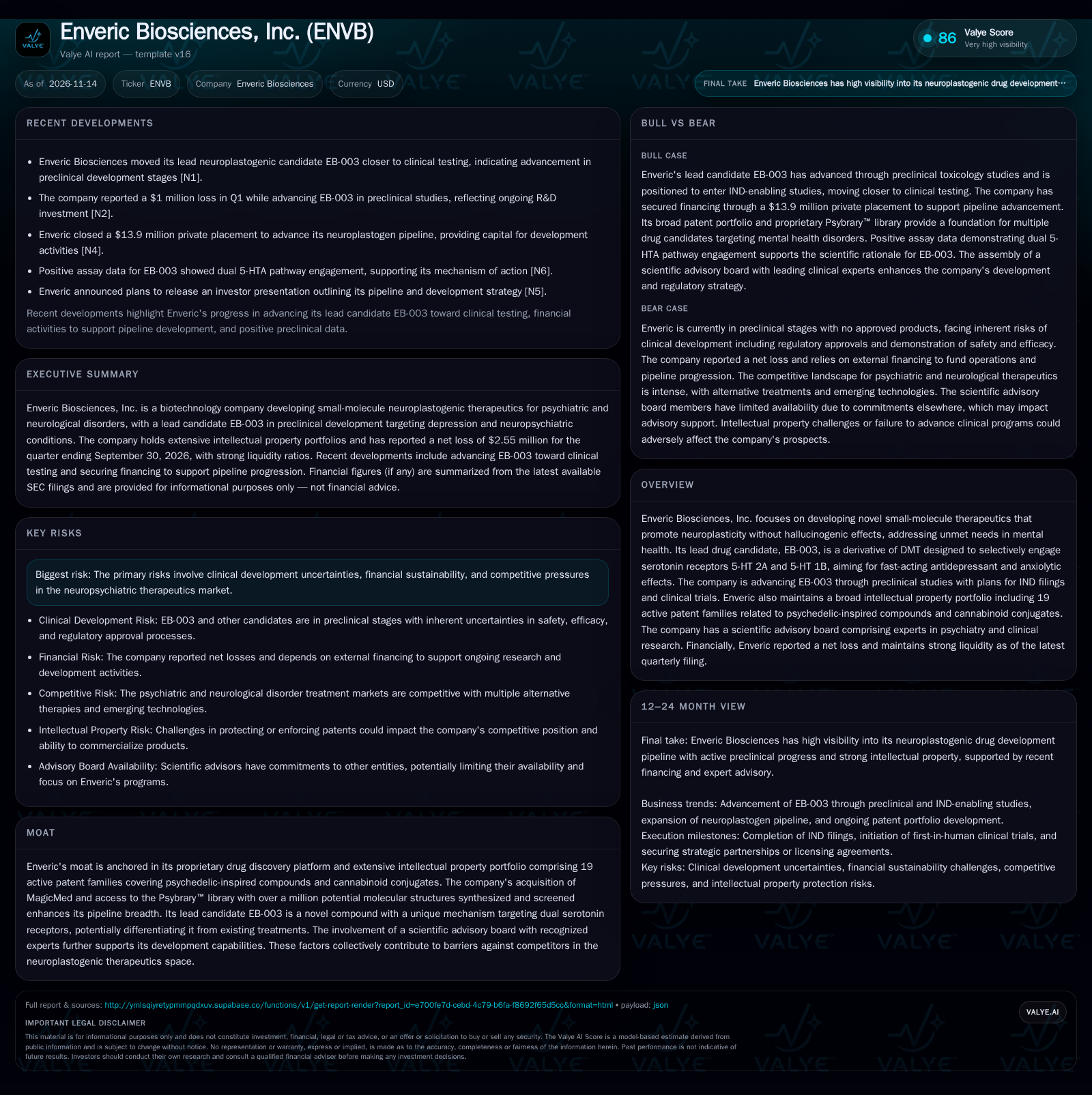
Enveric Biosciences is focused on developing non-hallucinogenic, small-molecule neuroplastogenic drugs for psychiatric and neurological disorders. Its lead candidate, EB-003, is advancing through preclinical IND-enabling studies, supported by a broad patent portfolio and a recent $13.9 million private placement. The company's commercial prospects rest on successful clinical execution, IP leverage, and navigating an increasingly competitive CNS therapeutics market.
Enveric Biosciences is betting on a differentiated approach in neuropsychiatric drug development: advancing non-hallucinogenic neuroplastogenic compounds with the goal of fast-acting, durable antidepressant and anxiolytic effects. Its lead asset, EB-003, is designed to avoid the logistical and regulatory barriers of classic psychedelics, targeting key serotonin receptors without inducing hallucinations. As the company transitions from preclinical to clinical stages, recent capital inflows and a robust IP portfolio provide resources and optionality. However, the path from promising mechanism to commercial success in CNS disorders remains fraught with scientific, regulatory, and competitive hurdles.
EB-003 Advances Toward Human Trials as Pipeline and Capital Position Strengthen
Enveric’s lead compound, EB-003—a novel, non-hallucinogenic DMT derivative—has completed short-term dose-range toxicology studies and is now advancing into IND-enabling, GLP-compliant safety pharmacology and longer-term toxicology work. The company has publicly communicated intentions to initiate first-in-human studies, targeting depression and other neuropsychiatric disorders [S1] [N1].
Financially, Enveric reported $2.84 million in cash and equivalents at the end of Q3 2026, with a current ratio of 9.7 and a cash ratio of 4.54, reflecting a strong current liquidity position [S2]. This is further supported by the closure of a $13.9 million private placement in April 2026, specifically earmarked to advance the neuroplastogen pipeline [N4].
The company’s intellectual property estate includes 19 active patent families and the proprietary Psybrary™ library, which comprises over a million potential molecular structures, with hundreds already screened for activity [S1].
Potential Commercial Model: From Pipeline to Product in a High-Cost, High-Uncertainty Sector
Enveric’s ability to generate revenue is entirely contingent on progressing EB-003 and subsequent candidates through clinical development, regulatory approval, and eventual commercialization. The business model for CNS therapeutics typically involves high upfront R&D and regulatory costs, offset by the potential for high-margin, protected revenues if clinical and regulatory hurdles are cleared. The company’s emphasis on outpatient, non-hallucinogenic neuroplastogens could theoretically enable broader market adoption compared to classic psychedelic therapies, which often require intensive in-clinic administration and monitoring.
Pricing in neuropsychiatric markets is influenced by the severity of unmet need, payer willingness, and the duration of effect. If EB-003 demonstrates rapid, durable effects and outpatient convenience, it could command premium pricing relative to generic antidepressants or anxiolytics, but will likely face scrutiny from payers and regulators regarding cost-benefit and safety. The capital intensity of development is high, with ongoing net losses ($2.55 million for Q3 2026) and continued reliance on external capital until commercialization [S2]. Operating leverage would only materialize if a candidate reaches late-stage clinical milestones or secures a partnership/licensing deal.
Patent Estate and Mechanistic Differentiation: Barriers and Challenges in Psychiatric Drug Development
Enveric’s competitive position is anchored in its robust patent portfolio—19 active families and 24 issued US patents—as well as the Psybrary™ library, which enables rapid generation and screening of novel compounds. This intellectual property breadth provides some protection against direct competition and may support partnering or licensing strategies [S1].
Mechanistically, EB-003’s design to selectively engage both 5-HT2A and 5-HT1B receptors without hallucinogenic side effects aims to differentiate it from classic psychedelics and traditional SSRIs. However, the CNS therapeutics space is increasingly crowded, with established pharmaceutical companies, venture-backed biotechs, and academic spinouts all pursuing non-hallucinogenic neuroplasticity modulators, rapid-acting antidepressants, and next-generation psychedelics. The true competitive advantage will depend on demonstrating clear efficacy, safety, and patient/clinician preference in clinical trials.
Potential substitutes include existing SSRIs/SNRIs, ketamine/esketamine, and other investigational rapid-acting antidepressants. The risk of IP challenges or overlapping claims in this domain is nontrivial given the volume of parallel innovation.
Breakthrough Clinical Data and Strategic Partnerships Could Catalyze Value Creation
The most favorable scenario for Enveric is that EB-003 demonstrates compelling safety, tolerability, and non-hallucinogenic efficacy in early-phase clinical trials, validating its dual 5-HT receptor engagement. This could enable expedited regulatory pathways (such as Fast Track or Breakthrough Therapy designation) and attract strategic partnerships with larger pharma companies seeking neuroplasticity assets.
Positive clinical data would also increase the value of Enveric’s IP estate and pipeline, potentially unlocking non-dilutive capital through licensing or co-development deals. Confirmation of this scenario would come from successful IND filing, rapid patient enrollment, robust safety/tolerability readouts, and clear signals of rapid, durable antidepressant/anxiolytic effect in first-in-human studies. Additional patent issuances or partnering announcements would further corroborate the upside thesis.
Incremental Progression Through Early Clinical Milestones Amid Capital Constraints
The most plausible path is that Enveric advances EB-003 into first-in-human studies, demonstrating acceptable safety and tolerability but requiring additional clinical work to establish efficacy. The company would likely continue to invest in pipeline expansion (e.g., EVM401 Series) and IP development while seeking further capital through equity offerings or licensing discussions.
In this scenario, value accretion is gradual, tied to the achievement of early clinical milestones (e.g., Phase 1 safety, proof-of-mechanism data) and maintenance of a reported liquidity position. Evidence confirming this trajectory would include steady progress in regulatory filings, ongoing patent issuances, and periodic capital raises to sustain operations.
Clinical Setbacks or Capital Shortfall Could Force Pipeline Retrenchment or Strategic Review
Adverse outcomes in preclinical or early clinical studies—such as unexpected toxicity, lack of efficacy, or emergence of hallucinogenic effects—would severely constrain Enveric’s prospects. Inability to secure additional capital as losses persist, or failure to differentiate in a noisy competitive space, could force the company to halt programs, seek distressed asset sales, or pursue strategic alternatives.
This scenario would be confirmed by negative or inconclusive clinical readouts, delays in IND or regulatory progress, IP litigation or invalidation, and a deterioration of liquidity (e.g., cash burn outpacing new financings). Announcements of workforce reductions, pipeline cuts, or strategic reviews would also corroborate the downside case.
Milestones and Markers That Will Shape Enveric’s Neuroplastogen Thesis
Timing and outcome of EB-003 IND filing and FDA feedback on trial design and endpoints.
Initial safety, tolerability, and non-hallucinogenicity data from first-in-human studies—if disclosed.
Progress and patent issuances related to the EVM401 Series and additional pipeline assets.
Disclosure of new strategic partnerships, licensing agreements, or non-dilutive funding deals.
Cash burn rate relative to reported liquidity and the timing/terms of any subsequent capital raises.
Any updates on IP litigation, patent challenges, or competitive patent activity in the neuroplastogen space.
Evidence of clinical differentiation versus other rapid-acting antidepressant modalities as peer data emerges.
Composition and bandwidth of the scientific advisory board and any notable changes in R&D leadership.
Disclaimer: This is research-only, informational analysis and not investment advice. It may include AI-generated interpretation and general industry context. Always verify important details using primary sources.

Comments