
Market Technology Acquisition Corp: SPAC Structure, Capital Cushion, and the Search for a Market Infrastructure Target
MTAK’s recent IPO and reported current ratio highlight its capital base, but limited operational disclosure and its early-stage SPAC status mean future value creation hinges entirely on sourcing and executing a compelling business combination within the capital markets ecosystem.
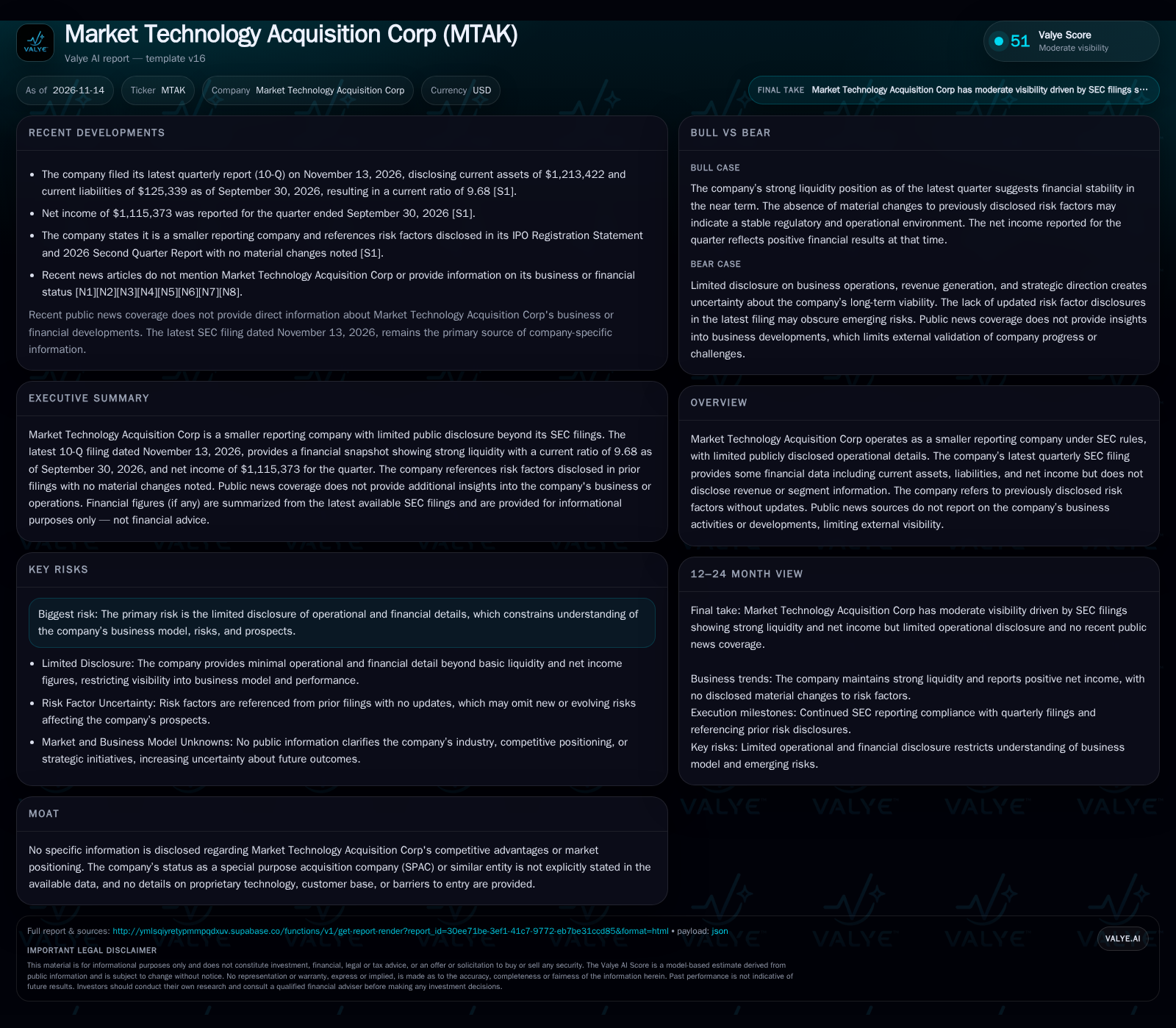
Market Technology Acquisition Corp (MTAK) is a newly public SPAC targeting the global capital markets infrastructure sector, reporting a reported current ratio and positive net income in its first post-IPO quarter. However, absent a completed acquisition, its long-term value depends on its ability to identify and execute a successful business combination, while limited disclosure leaves investors with little insight into ongoing progress or risks. The next 18–24 months will be defined by deal sourcing, sponsor alignment, and the evolving landscape of public market infrastructure targets. [S1]
Market Technology Acquisition Corp (MTAK) stands at the starting line of its SPAC lifecycle, armed with over $200 million in IPO and private placement proceeds and a mandate to acquire a business in the global capital markets ecosystem.Its reported current ratio and positive net income are typical of early-stage SPACs holding IPO proceeds in trust, but the absence of operating revenue or an announced target leaves investors with little visibility into future value creation. The next two years will be crucial, as MTAK must source, negotiate, and close a business combination in a highly competitive and evolving market infrastructure landscape. [S1]
IPO Proceeds, Liquidity, and the Blank-Check Mandate
Market Technology Acquisition Corp completed its IPO on July 27, 2026, raising $205 million through public units and an additional $7.1 million from a private placement. As of September 30, 2026, the company reported current assets of $1,213,422 and current liabilities of $125,339, resulting in a current ratio of 9.68. Net income for the quarter was $1,115,373. These figures reflect the typical cash-rich but operationally dormant status of a newly listed SPAC, with IPO and private placement proceeds held in trust. No operating revenue, segment data, or acquisition target has been disclosed. [S1]
The company’s stated purpose is to acquire a business in the global capital markets infrastructure space, including licensed U.S. equities and options clearing, post-trade, brokerage, custody, execution, and fintech platforms. MTAK is subject to Nasdaq's 36-month requirement to complete a business combination following its IPO registration effectiveness. [S1]
SPAC Economics: Fee Structure, Trust Account Dynamics, and Incentive Alignment
SPACs like MTAK generate little to no operating revenue prior to a business combination. Their economics are defined by the management of IPO proceeds held in a restricted trust account, modest interest income, and tight cost controls to preserve capital for the eventual acquisition. The net income reported in the first quarter post-IPO is likely a function of interest earned on trust assets minus administrative and public company expenses.
The real economic lever for MTAK is the successful identification and acquisition of a target company. If a business combination is completed, the economics shift dramatically: the target’s operating business is merged into the public SPAC shell, potentially unlocking value through public-market access, sponsor incentives (typically via founder shares and warrants), and the opportunity for post-merger operating leverage. However, failure to consummate a deal within the Nasdaq-mandated 36-month window typically results in liquidation, with trust assets returned to shareholders and sponsors forfeiting most of their at-risk capital.
SPAC sponsors are incentivized to close a deal—any deal—due to their disproportionate upside from founder shares, but market scrutiny and redemption risk create counterforces to value-destroying mergers. The capital structure is highly sensitive to redemptions, which can significantly reduce the effective acquisition war chest if public shareholders opt to redeem rather than participate in the merger.
SPAC Targeting in Market Infrastructure: A Crowded and Evolving Landscape
MTAK’s stated focus on capital markets infrastructure—particularly clearing, post-trade, and fintech platforms—places it in direct competition with other SPACs and private equity funds targeting similar sectors. The last several years have seen a surge in interest in exchanges, clearinghouses, digital asset infrastructure, and B2B financial technology, with many targets either consolidating, commanding premium valuations, or becoming pickier about public-market partners.
The competitive landscape includes not only other SPACs with similar sector mandates but also strategic acquirers (incumbent exchanges, brokerages, and large fintechs) and private capital. SPACs face particular challenges: targets are increasingly wary of the volatility and scrutiny associated with de-SPAC transactions, and regulatory attention to market infrastructure entities is heightened, adding complexity to deal-making.
If MTAK can demonstrate sector expertise, sponsor alignment, and a credible path to closing, it could appeal to niche targets seeking public currency and growth capital. However, the risk of overpaying or settling for suboptimal targets increases as the 36-month clock ticks down and the competitive field narrows.
Unlocking Value Through a High-Quality Market Infrastructure Acquisition
The best-case scenario for MTAK is sourcing and executing a high-quality business combination with a differentiated, scalable, and regulatory-compliant market infrastructure platform—such as a clearinghouse, post-trade technology provider, or a fintech with established B2B relationships and recurring revenue. Such a deal could command public-market interest, validate the sponsor’s sector expertise, and create the potential for operating leverage as the combined entity scales.
Confirmation of this upside scenario would include: an announced letter of intent (LOI) or definitive agreement with a credible and growing target; clear disclosure of target financials with recurring revenue streams and margin expansion potential; low redemption rates during the merger vote; and positive post-announcement trading performance. Evidence of sponsor reinvestment or PIPE (private investment in public equity) participation would further validate deal quality.
Navigating the SPAC Lifecycle: Deal Sourcing, Uncertainty, and Execution
The most plausible scenario is that MTAK spends the next 12–18 months searching for a suitable target, engaging in preliminary discussions with multiple prospects in the capital markets infrastructure sector. The company may announce a non-binding LOI or enter into exclusivity with a mid-sized or niche fintech, but execution risk remains high. Shareholder redemptions could erode available capital, and regulatory review may extend timelines.
Confirmation would come from periodic SEC filings indicating progress in deal sourcing, public communications about target engagement, and ultimately, the filing of a merger proxy with detailed target disclosures. Falsification would be signaled by repeated extensions, lack of deal announcements, or mounting administrative expenses relative to trust income.
Deal Deadlines and the Risk of Liquidation
If MTAK is unable to source or close a business combination within the 36-month deadline, it will be required to liquidate, returning trust assets to public shareholders and leaving sponsors with a loss on their at-risk capital. This downside is not uncommon among SPACs, especially as competition for high-quality targets intensifies and regulatory scrutiny increases.
Warning signs would include prolonged silence on deal progress, rising administrative expenses, negative arbitrage between trust yields and public company costs, or signals of sponsor disengagement. A spike in redemptions or failure to secure a PIPE for a proposed deal would further indicate a high risk of liquidation or a value-destructive merger.
Testing the Thesis: Milestones for MTAK’s SPAC Journey
Announcement of a letter of intent (LOI), exclusivity agreement, or definitive merger agreement with a credible market infrastructure target would be a critical milestone.
Disclosure of detailed target financials, especially recurring revenue, gross margins, and growth rates, if and when a deal is announced, would help test value-creation potential.
Shareholder redemption rates at the time of merger vote, if disclosed, to assess market confidence in the proposed acquisition.
PIPE (private investment in public equity) participation and sponsor reinvestment levels, if disclosed, as a proxy for deal quality and alignment.
Quarterly updates on trust account balance, administrative expenses, and interest income, as these affect the capital available for a business combination.
Evidence of regulatory progress or hurdles, including any SEC or industry-specific approvals required for a proposed target.
Indications of sponsor engagement or changes in management, which could signal shifts in deal momentum or strategy.
Disclaimer: This is research-only, informational analysis and not investment advice. It may include AI-generated interpretation and general industry context. Always verify important details using primary sources.

Comments