
M3-Brigade Acquisition V Corp.: Extension Maneuvers, Liquidity Stress, and the Uncertain Road to a Business Combination
With its initial business combination agreement terminated and liquidity ratios deeply negative, M3-Brigade Acquisition V Corp. now relies on recently secured shareholder extensions to keep its SPAC ambitions alive. The next phase will test whether management’s prior dealmaking expertise can overcome capital constraints and market turbulence before the clock runs out.
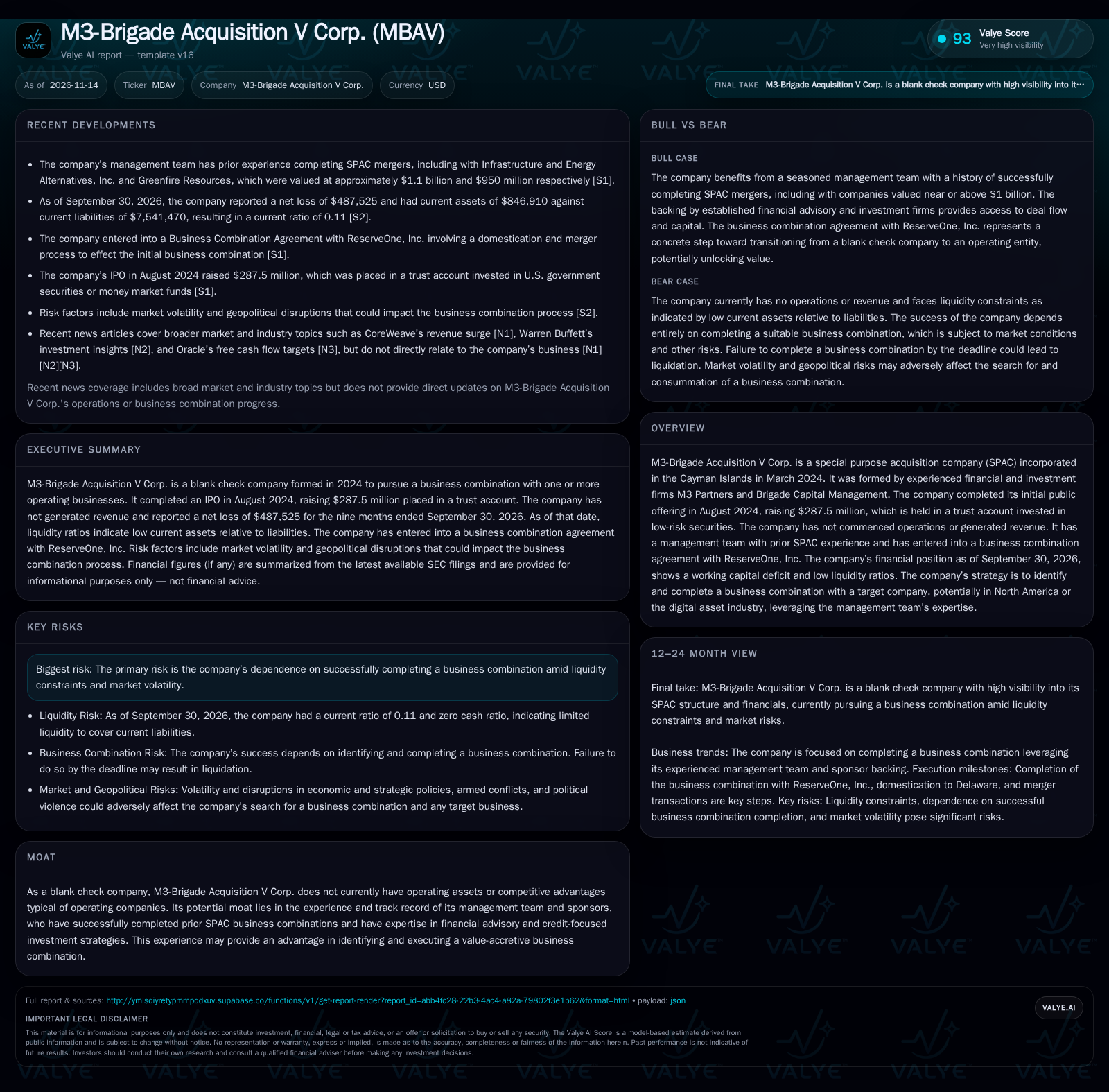
M3-Brigade Acquisition V Corp. (MBAV) is a SPAC that recently terminated its planned merger with ReserveOne, Inc. and faced an imminent liquidation deadline. With no operating revenues and a net loss for the period, MBAV’s fate hinges entirely on its ability to identify and close a new business combination before extended deadlines expire. The experienced sponsor team is a potential asset, but the window for execution is narrowing rapidly. [S2]
M3-Brigade Acquisition V Corp. finds itself at a critical juncture: following the mutual termination of its business combination with ReserveOne, Inc., the company was forced to secure a shareholder-approved extension to avoid triggering an automatic liquidation. With no revenues and a working capital deficit that has driven liquidity ratios to perilous lows, MBAV’s future is pinned on its ability to identify and consummate a new business combination under severe time and capital pressures. The SPAC’s management boasts a record of closing complex deals, but the current environment—marked by rising market uncertainty and acute funding constraints—means past success is no guarantee of future results.
Extension Secured After Terminated Merger, But Liquidity Remains Precarious
The most material recent development is the mutual termination of MBAV’s business combination agreement with ReserveOne, Inc. in June 2026, which left the company facing a hard liquidation deadline of August 2, 2026. To avert liquidation, MBAV entered into agreements with third parties and secured shareholder approval to extend the deadline, buying time to pursue another deal. However, as of September 30, 2026, the company reported just $846,910 in current assets against $7,541,470 in current liabilities, resulting in a current ratio of 0.11 and zero cash ratio—highlighting critical liquidity stress. MBAV has not generated operating revenue and posted a net loss of $487,525 for the nine months ended September 30, 2026. [S2] These facts underscore that the company’s survival now hinges on both its ability to quickly secure a new business combination and to manage through a period of acute capital constraint.
SPAC Structure: Economics of Cash Traps, Sponsor Promissory Notes, and the Race Against Time
MBAV’s business model, like all SPACs, is predicated on deploying IPO proceeds to acquire a target company, after which the combined entity may generate operating revenues. Until then, SPACs are structurally loss-making: IPO proceeds are held in trust, inaccessible for general operations, while day-to-day expenses accrue as losses—funded via sponsor loans or private placement warrant proceeds. MBAV’s sponsor note (with $2.5 million outstanding as of the last available data) reflects this model, providing temporary working capital but adding to liabilities. [S2]
The economics are highly binary: if a deal is closed, the trust funds (minus redemptions) and any PIPE financing can be deployed to the target, potentially creating value for sponsors and public shareholders. If no deal is closed by the deadline, the trust is returned to shareholders pro rata and the company is liquidated, with sponsors losing their at-risk capital. The acute working capital deficit and negative liquidity ratios mean MBAV faces elevated risk of default on obligations if the extension period is not used effectively.
SPACs typically face sharply escalating costs (legal, advisory, and extension-related) as deadlines approach, eroding any remaining sponsor capital. Unless a new deal is both identified and credibly financed, further capital infusions or sponsor backstopping may be needed to keep the entity solvent through the extension window.
Sponsor Experience: Double-Edged Sword in a Crowded, Unforgiving SPAC Market
MBAV’s management and sponsors, including M3 Partners and Brigade Capital, have a meaningful track record of closing large SPAC deals—such as with Infrastructure and Energy Alternatives, Inc. and Greenfire Resources, both valued near or above $1 billion. This network and reputation can help surface credible targets and negotiate complex transactions. However, the current SPAC environment is far more challenging than in prior cycles: competition for attractive targets is intense, regulatory scrutiny has increased, and PIPE capital is harder to source.
Unlike operating companies, MBAV cannot claim a product, customer base, or recurring revenue moat; instead, its edge (if any) is in deal origination, structuring, and execution. In the current climate, even sponsor reputation may not overcome market risk aversion or target valuation expectations. The company is also competing against hundreds of other SPACs facing similar deadlines and capital constraints, making the race for targets and funding even more acute.
Potential substitutes for SPACs—such as direct listings, traditional IPOs, or private growth equity—may also divert high-quality targets away, especially if public market conditions deteriorate further.
If a High-Quality Target Emerges and Redemptions Are Contained, Value Could Be Unlocked
The positive scenario for MBAV is contingent on management rapidly identifying a compelling, credible target that can close within the extension window. If the target is attractive enough to limit public shareholder redemptions (preserving trust capital) and/or to attract PIPE financing, MBAV could consummate a business combination, converting from a cash-burning shell to an operating entity with growth potential.
Confirmation of this scenario would come from the announcement of a signed, definitive merger agreement with a credible, institutional-quality target, swift SEC review, and evidence of sufficient committed financing to ensure the deal can close. A low redemption rate at the shareholder vote would further validate the scenario, as would any indication of sponsor or third-party backstopping.
Falsification would be signaled by further deal delays, inability to secure financing, or a repeat of the ReserveOne outcome—namely, mutual termination before closing. In such a case, the window for execution would be nearly exhausted, and the risk of forced liquidation would rise sharply.
Most Likely: Prolonged Search, Ongoing Capital Erosion, and Elevated Liquidation Risk
Given current liquidity constraints, a highly competitive SPAC landscape, and the short extension window, the most plausible outcome is a protracted search for a new business combination, with continued accrual of operating losses and sponsor backstopping. The probability of identifying a high-quality target in time is diminished by the glut of SPACs and the scarcity of willing PIPE investors.
Supporting evidence for this scenario would include ongoing working capital deficits, repeated extension requests, and a lack of credible deal announcements as the deadline approaches. Any uptick in sponsor loans or further deterioration in liquidity ratios would reinforce this base case.
Deviation from this scenario would require a clear, public step-change: either a credible deal announcement (moving toward the upside) or a formal wind-down/liquidation trigger (moving toward the downside).
Failure to Secure a Deal Triggers Liquidation and Sponsor Capital Loss
The adverse scenario unfolds if MBAV fails to sign and close a business combination before the extended deadline. In this case, regulatory requirements force the company to liquidate, returning trust proceeds to public shareholders pro rata and leaving sponsors with unrecoverable capital outlays (warrants and working capital loans).
Evidence confirming this scenario would be a formal liquidation announcement, cessation of deal negotiations, or inability to secure further extensions. Deteriorating liquidity, mounting unpaid expenses, and sponsor withdrawal would all be harbingers of this scenario.
This outcome remains a real risk given the company’s current financial state and the challenging market backdrop. It would also cement the company’s lack of value creation for public shareholders beyond trust value.
Milestones That Will Determine Whether MBAV’s SPAC Strategy Succeeds or Unwinds
Announcement of a signed, definitive business combination agreement with a new target—timing and perceived quality will be critical.
Disclosure of PIPE (private investment in public equity) commitments or other third-party financing to support any proposed transaction.
Shareholder redemption rates at the time of the business combination vote—a high redemption rate would materially reduce trust capital available.
Updates on working capital sources: further sponsor loans, bridge financings, or backstop agreements (if disclosed) would indicate ongoing sponsor commitment.
SEC review progress and any regulatory delays that could impact deal closing timelines.
Any formal communication regarding liquidation triggers, further extension requests, or sponsor withdrawal.
Disclaimer: This is research-only, informational analysis and not investment advice. It may include AI-generated interpretation and general industry context. Always verify important details using primary sources.

Comments