
Empire Petroleum: Operational Progress Meets Financial Strain in a Volatile Energy Market
Empire Petroleum delivers steady revenue but contends with acute liquidity pressures and persistent net losses. The company’s ongoing reliance on debt and capital markets highlights the challenges of sustaining growth in a capital-intensive, commodity-driven sector.
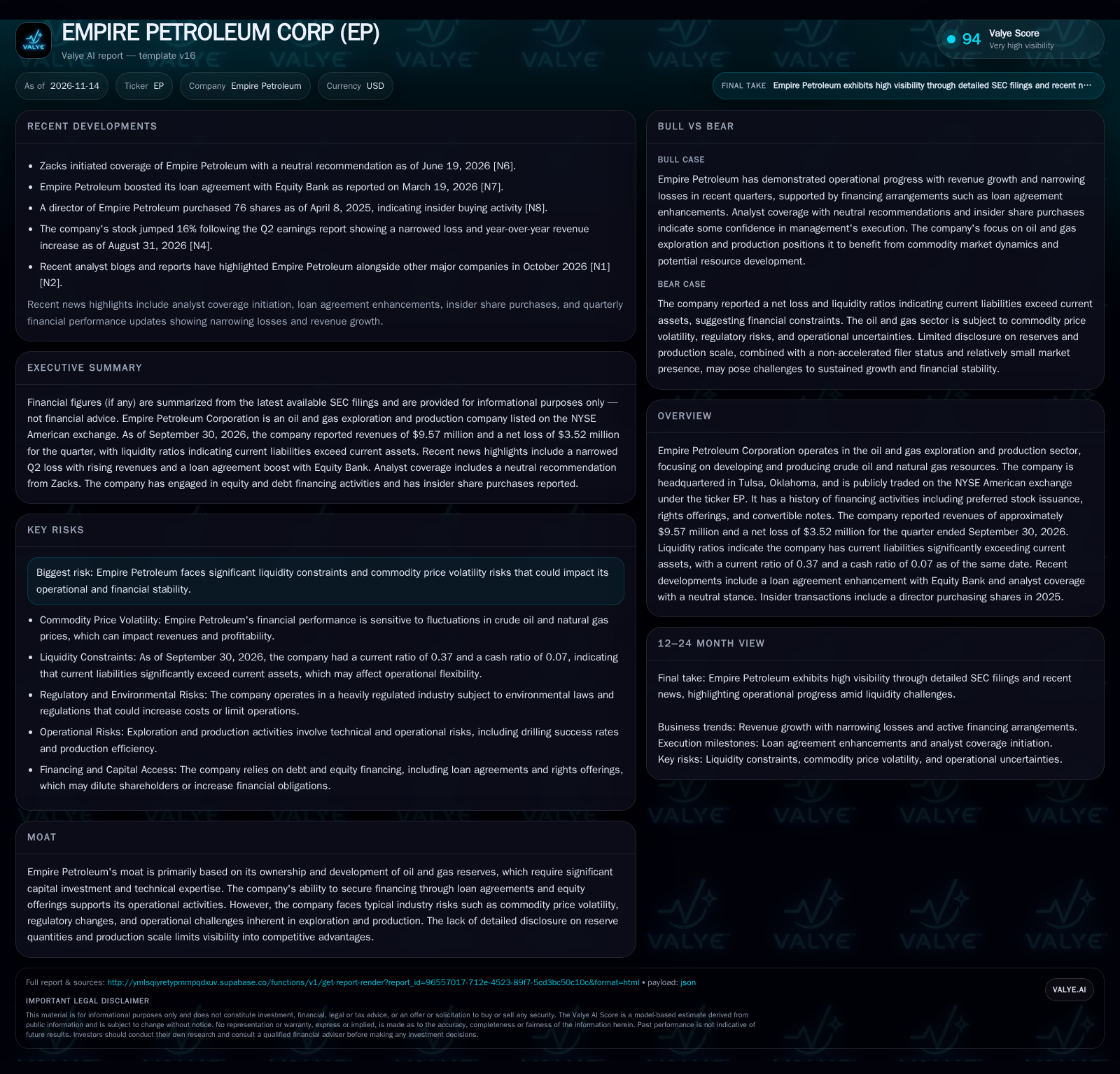
Despite analyst attention and expanded loan agreements, the company’s future hinges on managing funding needs, operational execution, and exposure to commodity price swings. The sustainability of its business model will depend on improving cash flow, securing additional financing, and navigating sector volatility. [S2] [N6] [N7]
Empire Petroleum, a Tulsa-based oil and gas exploration and production company, finds itself at the intersection of operational progress and acute financial strain. Recent filings show the company growing revenues but still posting net losses, while its liquidity position remains precarious with current liabilities vastly outpacing assets. With renewed loan agreements and neutral analyst coverage, Empire Petroleum faces a pivotal period where its ability to secure funding and improve cash flow will determine whether it can weather commodity market cycles or succumb to ongoing financial stress.
Liquidity Crunch and Ongoing Losses Define Empire’s Present State
Empire Petroleum reported $9.57 million in revenue for the quarter ended September 30, 2026, but also posted a net loss of $3.52 million, or -$0.08 per share, highlighting persistent operating losses. The company’s liquidity is under significant pressure: current assets of $13.08 million are dwarfed by $35.05 million in current liabilities, resulting in a current ratio of just 0.37 and a cash ratio of 0.07. The company reported cash and liquidity metrics for the period; these figures do not by themselves establish operating runway, investment capacity, financial flexibility, or financing capacity. The recent expansion of a loan agreement with Equity Bank suggests ongoing reliance on external financing to bridge cash shortfalls. Analyst coverage as of June 2026 remains neutral, reflecting uncertainty about prospects amid these financial constraints. [S2] [N6] [N7]
How Empire Petroleum’s Cost Structure Amplifies Commodity Cycles
Empire Petroleum’s core business—exploring for and producing oil and gas—exposes it to the full volatility of commodity markets. Revenue is a direct function of production volumes and realized prices for crude oil and natural gas. While the company’s fixed costs (leasehold, equipment, regulatory compliance) are significant, variable costs (drilling, completion, extraction, and transportation) also play a material role. This structure creates high operating leverage: small changes in commodity prices or production efficiency can disproportionately impact margins and cash flow.
The capital-intensive nature of the business means that sustaining or growing production typically requires ongoing investment, often funded by debt or equity issuance. The company’s history of preferred stock, rights offerings, convertible notes, and recent loan expansion indicate a pattern of tapping external capital markets, which may dilute existing shareholders or increase financial obligations if not matched by improved operational performance.
Peer Comparisons and the Struggle for Scale in a Fragmented Energy Sector
Empire Petroleum operates in a highly competitive industry dominated by both major integrated oil companies and numerous independent producers. Scale, reserve quality, cost structure, and access to capital are critical sources of advantage. Larger peers often benefit from lower per-unit costs, diversified asset bases, and broader access to financing. For smaller players like Empire, competitive threats include not only price volatility and regulatory shifts, but also the risk of being outbid for properties or squeezed out of lucrative markets.
While the company’s reserve base and specific production mix are not detailed in the supplied evidence, its reliance on external financing and smaller market presence suggest limited bargaining power and vulnerability to adverse price movements. Empire’s moat, to the extent it exists, likely derives from technical expertise, operational efficiencies in select basins, or niche asset positions—but these are difficult to sustain without adequate capital and scale. The company’s recent peer comparisons in analyst reports underscore the challenge of standing out in a sector where capital strength and operational scale drive resilience. [N5] [N6]
If Commodity Prices Rebound and Capital Access Improves, Cash Flow Could Turn the Tide
A plausible upside for Empire Petroleum would involve a sustained increase in oil and gas prices, which would immediately boost revenue and potentially move the company toward profitability given its high operating leverage. If Empire can simultaneously improve production efficiency and control costs, incremental revenue could translate into disproportionately higher operating income and cash flow. Access to fresh capital—possibly through further debt or equity raises—could allow the company to invest in higher-return drilling or acquisition opportunities, expanding its asset base and driving future production growth.
Evidence that would confirm this scenario includes: a series of quarters with positive operating cash flow, shrinking net losses or a return to net income, successful capital raises at non-punitive terms, and disclosures of materially increased production or reserve additions. A reversal in liquidity ratios—reflecting either debt reduction or a meaningful increase in current assets—would also support the bull case. Conversely, if commodity prices remain flat or decline, or if access to capital tightens, this scenario would be quickly falsified.
Sustained Operational Pressure and Tight Liquidity Remain the Default Outlook
The most plausible scenario for Empire Petroleum is continued operational strain marked by modest revenue growth, ongoing net losses, and persistent liquidity challenges. Without a step-change in commodity pricing or a major operational breakthrough, the company will likely remain dependent on external financing to fund both working capital and investment needs. In this environment, incremental improvements—such as cost reductions or efficiency gains—may help narrow losses, but are unlikely to fully offset the structural gap between revenue and expenses.
Confirming evidence for this middle path would include continued low or negative operating cash flow, repeated reliance on loan expansions or equity raises, and liquidity ratios remaining below 1.0. Analyst coverage that stays neutral or shifts negative, as well as a lack of disclosed major production additions or reserve upgrades, would further reinforce this scenario. If the company manages to achieve positive net income or meaningfully improve its liquidity metrics, however, this outlook would need to be revisited.
Liquidity Stress and Capital Market Fatigue Could Precipitate Restructuring or Asset Sales
Should Empire Petroleum’s liquidity deteriorate further—whether due to sustained net losses, higher-than-expected capital outflows, or tightening credit—the company could face acute funding shortfalls. In this scenario, the inability to service short-term obligations might force management to pursue distressed asset sales, seek dilutive rescue financings, or even consider restructuring options. A contraction in capital market appetite for small-cap E&P credits, or further declines in commodity prices, would exacerbate these risks.
Confirmation would come from additional SEC disclosures of going-concern language, emergency financings at punitive rates, or forced divestitures of core assets. A further decline in current or cash ratios, negative working capital trends, or loss of banking relationships would also validate the bear case. If the company instead stabilizes its liquidity or secures non-dilutive funding, this scenario becomes less likely.
What Will Determine Empire Petroleum’s Ability to Bridge Its Financial Gap?
Quarterly operating cash flow trends—whether the company is moving closer to or further from breakeven (if disclosed).
Any changes in the current ratio or cash ratio in upcoming filings, indicating improvement or further deterioration in liquidity.
Announcements of additional financing activities—such as new debt, equity raises, or amendments to existing loan agreements.
Production volume disclosures or reserve reports that would clarify the company’s ability to grow or sustain output.
Commodity price movements and hedging activity, which directly affect revenue and margin sensitivity.
Analyst recommendation changes or coverage updates, which may signal shifting external perceptions of risk and opportunity.
Insider transaction activity was reported in the cited source; this activity does not by itself establish insider confidence.
Disclaimer: This is research-only, informational analysis and not investment advice. It may include AI-generated interpretation and general industry context. Always verify important details using primary sources.

Comments