
WhiteHawk Minerals: Acquisition-Driven Growth Meets Dividend Ambition in a Volatile Minerals Market
WhiteHawk Minerals Corp. is deploying capital aggressively to scale its mineral interests while initiating a shareholder dividend, but faces the classic integration and commodity risk hurdles of the minerals sector.
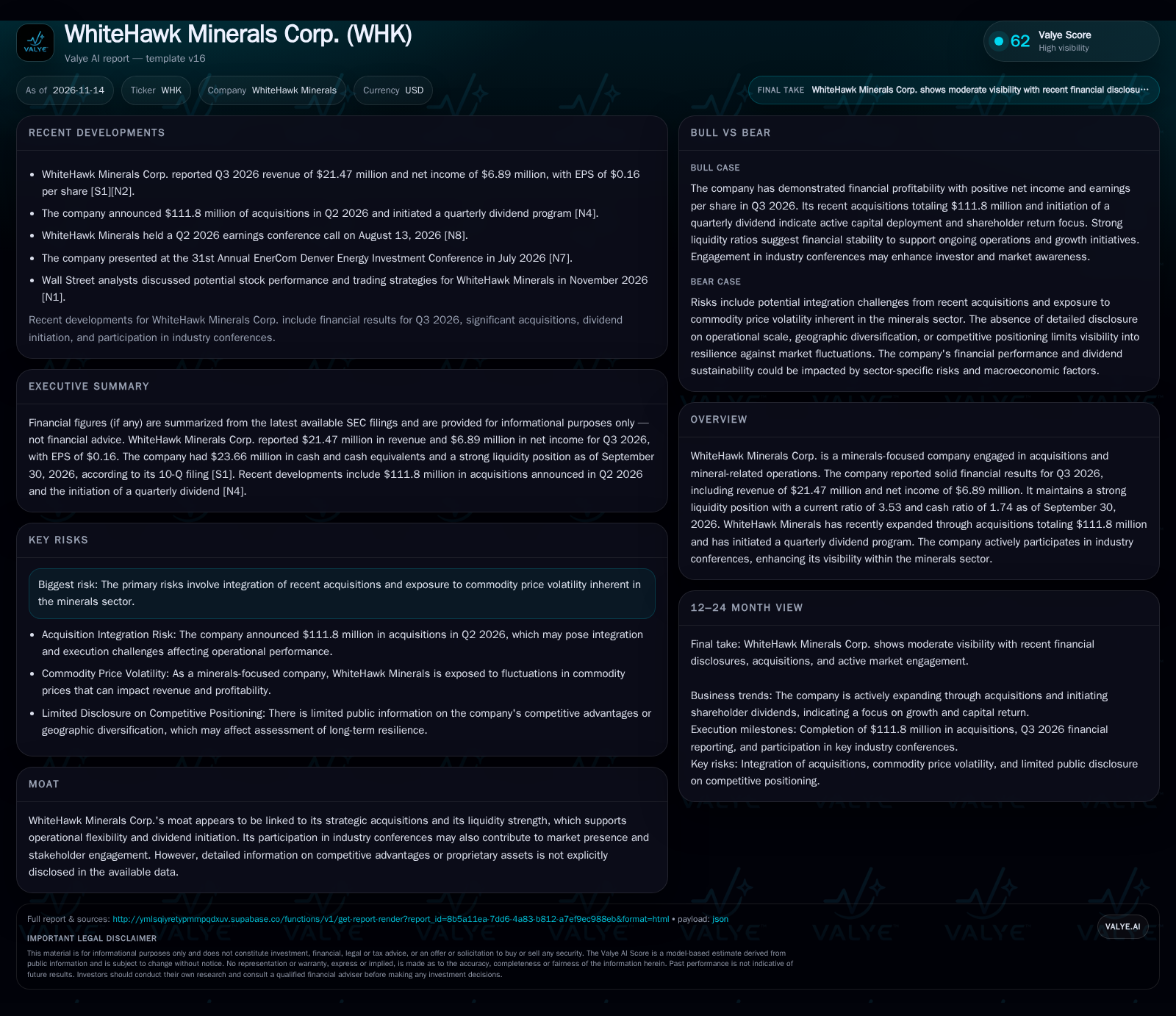
WhiteHawk Minerals is executing an acquisition-led growth strategy, reporting $21.47 million in Q3 2026 revenue and $6.89 million in net income, while launching a quarterly dividend. The durability of WhiteHawk’s cash flow—and thus its dividend—will hinge on effective management of these operational and market uncertainties. [S1] [N4]
WhiteHawk Minerals Corp. is pursuing a capital-intensive, acquisition-driven strategy to expand its portfolio of natural gas mineral interests across the U.S., aiming to generate steady cash flow for both reinvestment and shareholder dividends. The company’s Q3 2026 results—$21.47 million in revenue and $6.89 million in net income—reflect operational momentum, while $111.8 million in recent acquisitions and a reported cash position provide fuel for further growth. Yet, the real test will be whether WhiteHawk can integrate these new assets efficiently and maintain attractive payouts in the face of commodity market swings and sector competition.
Recent Acquisitions and Dividend Launch Shape WhiteHawk’s Strategic Direction
WhiteHawk Minerals reported revenue of $21.47 million and net income of $6.89 million for Q3 2026, translating to $0.16 in earnings per share. The company reported cash and liquidity metrics for the period; these figures do not by themselves establish operating runway, investment capacity, financial flexibility, or financing capacity. In Q2 2026, WhiteHawk announced $111.8 million in acquisitions and initiated a quarterly dividend program. These moves signal an aggressive push to expand its asset base and provide shareholder returns. The cited source reports dividend-related activity; that disclosure alone does not establish dividend-policy continuity, management confidence, or a material constraint on capital flexibility. [S1] [N2] [N4]
How WhiteHawk Seeks to Turn Mineral Assets into Recurring Cash Flow
WhiteHawk’s business model revolves around acquiring, owning, and managing mineral interests—primarily in U.S. natural gas resources—to generate cash flow from royalty and lease income. The economics of this model are highly sensitive to commodity prices, production volumes, and the cost basis of acquired assets. Revenue is typically a function of the underlying production from mineral rights, with relatively low operating costs compared to traditional E&P operators, offering potential for high incremental margins if asset selection and acquisition pricing are disciplined.
Fixed costs may be moderate, as the company is not directly operating wells, but variable cash flows are exposed to swings in natural gas prices and production rates. The recent $111.8 million in acquisitions could increase revenue and cash flow if integration is smooth and acquired assets perform as expected. Operating leverage can be attractive if commodity prices rise, but can turn negative in a downturn, pressuring both earnings and dividend sustainability.
The initiation of a quarterly dividend introduces a cash return discipline that may appeal to yield-focused investors, but also sets a recurring cash outflow that must be covered by operating results. If acquisition economics or commodity pricing disappoint, dividend coverage could quickly become a risk factor.
A critical factor in WhiteHawk’s ability to generate recurring cash flow lies in the quality and longevity of the mineral assets acquired. Mineral rights typically provide long-term, passive income streams if production remains steady or grows. However, production decline rates at underlying wells can vary significantly based on geology, operator activity, and technological improvements. Therefore, the company’s asset evaluation process must incorporate rigorous decline curve analysis and operator reliability assessments to avoid overestimating future cash flows. Additionally, the timing of acquisitions relative to commodity cycles can materially influence realized returns, as paying premiums near peak prices may compress future margins.
Strategic Positioning Amid Fragmented Mineral Ownership and Large-Cap Peers
WhiteHawk operates in a fragmented U.S. minerals market, competing with public and private mineral aggregators, institutional investors, and occasionally with E&P companies seeking to control royalty streams. Its recent IPO and acquisitions suggest a bid to scale rapidly and achieve portfolio breadth, which can provide some negotiating leverage and risk diversification.
Potential advantages may include a disciplined acquisition process, internalized management structure, and a focus on cash-generative assets. However, counterforces are strong: acquisition multiples can become inflated in a competitive market, and larger incumbents may have better access to deal flow and capital. Substitution risk remains high—investors can gain exposure to mineral interests via other listed vehicles, private funds, or by direct ownership.
The lack of detailed disclosure on WhiteHawk’s geographic diversification, asset quality, or unique sourcing channels leaves its competitive differentiation somewhat opaque. Its visibility at industry conferences may help with deal sourcing and investor engagement, but without proprietary technology or exclusive acreage, defensibility likely hinges on scale efficiency, disciplined capital allocation, and cost control.
In a fragmented minerals market, scale can confer significant operational and financial advantages. Larger portfolios may enable WhiteHawk to spread fixed administrative costs over a broader asset base, improving margins. Scale also enhances bargaining power with operators and service providers, potentially securing more favorable lease terms or cost efficiencies in asset management. However, rapid growth through acquisitions can strain internal systems and governance, risking integration inefficiencies or oversight lapses. Maintaining disciplined capital allocation and robust due diligence processes is essential to prevent value erosion amid competitive pressures and market fragmentation.
If Integration Delivers and Gas Prices Cooperate, Cash Flow and Dividends Could Surprise to the Upside
The most favorable scenario for WhiteHawk involves seamless integration of its $111.8 million in recent acquisitions, with underlying assets outperforming production and royalty expectations. Scale advantages may allow WhiteHawk to negotiate better terms on future deals, enhancing acquisition economics.
Confirmation of this scenario would come from consistent quarterly revenue and net income growth, stable or rising cash balances even after dividend payments, and management commentary highlighting successful integration and asset optimization. Additional accretive acquisitions—if funded without excessive dilution or leverage—would further support the thesis. Evidence that WhiteHawk is able to source high-quality deals at attractive prices, and deliver dividend increases, would signal the upside is being realized.
Stable Cash Generation with Episodic Volatility Defines the Likely Trajectory
Dividend payments are maintained, but growth is incremental and closely tied to the pace of successful acquisitions and commodity market conditions.
This scenario would be confirmed by sustained positive net income, maintenance of a reported current ratio, and continued execution of moderate-scale acquisitions without major operational setbacks. Any dividend increases are gradual and justified by underlying cash flow growth. Missed integration targets, cost overruns, or a sharp drop in commodity prices would challenge this base case.
Acquisition Stumbles or Commodity Correction Could Expose Dividend and Balance Sheet Weakness
The adverse scenario involves missteps in integrating the $111.8 million in recent acquisitions—whether through overpaying, operational underperformance, or unexpected legacy liabilities. If acquisition multiples remain high and new deals fail to deliver accretive returns, capital could be misallocated, eroding shareholder value.
Signs of this scenario would include declining quarterly earnings, negative free cash flow after dividends, rising leverage or capital raises at unfavorable terms, and management acknowledgment of integration or commodity headwinds. A dividend cut or suspension would be a clear red flag. Asset impairments or reserve write-downs—if disclosed—would further confirm downside risk materializing.
What Will Determine Whether WhiteHawk’s Growth and Dividend Story Endures?
Quarterly revenue and net income trends, especially post-acquisition, to assess whether new assets are performing as expected. [S1]
Dividend coverage ratio—operating cash flow divided by dividend payments—if disclosed, would help gauge the sustainability of shareholder returns.
Integration progress updates on the $111.8 million in recent acquisitions, including any cost overruns or operational setbacks. [N4]
Natural gas price benchmarks and realized pricing for WhiteHawk’s mineral interests, as these directly impact royalty income.
Changes in cash and cash equivalents post-acquisition and dividend payments to monitor liquidity trends. [S1]
Disclosure of acquisition multiples and return expectations on new deals, if provided, to assess capital allocation discipline.
Commentary on geographic and asset diversification, as concentration risk could amplify volatility or downside.
Any announced impairments, reserve write-downs, or material changes in asset performance would help falsify the bull case.
Disclaimer: This is research-only, informational analysis and not investment advice. It may include AI-generated interpretation and general industry context. Always verify important details using primary sources.

Comments