
Keystone Acquisition Corp.: SPAC Structure, Capital Deployment, and the Uncertain Road to a Business Combination
Keystone Acquisition Corp. remains in its pre-acquisition SPAC phase, with recent financials reflecting interest income and reported liquidity position, but absent a definitive target or operational business. The path forward will depend on its ability to identify, negotiate, and execute a value-accretive business combination before its capital structure and timeline constraints close in.
Keystone Acquisition Corp. is a blank check company (SPAC) that has yet to announce or complete a business combination. The company's reported net income is entirely from interest and minimal referral fees, with no operating revenues or business activity to date. Its $287.5 million IPO and associated warrant placements leave it well-capitalized, but execution risk is high as the clock ticks down on its acquisition window. The central question is whether Keystone can identify and consummate a deal that justifies its public capital structure before sponsor incentives and redemptions erode the value proposition.
Keystone Acquisition Corp. exemplifies the high-opportunity, high-uncertainty profile of newly listed SPACs: flush with IPO proceeds, but absent a defined operating model, sector focus, or target acquisition as of late 2026. Its financials reflect the classic pre-business-combination SPAC reality—interest income from trust assets, minimal operational costs, and a ticking clock to deploy capital before time and sponsor economics become headwinds. The company's future hinges not on current performance, but on its ability to source, diligence, and close a compelling acquisition in an increasingly competitive and scrutinized SPAC environment.
Recent Financial Position and SPAC Status: Keystone’s Pre-Deal Reality
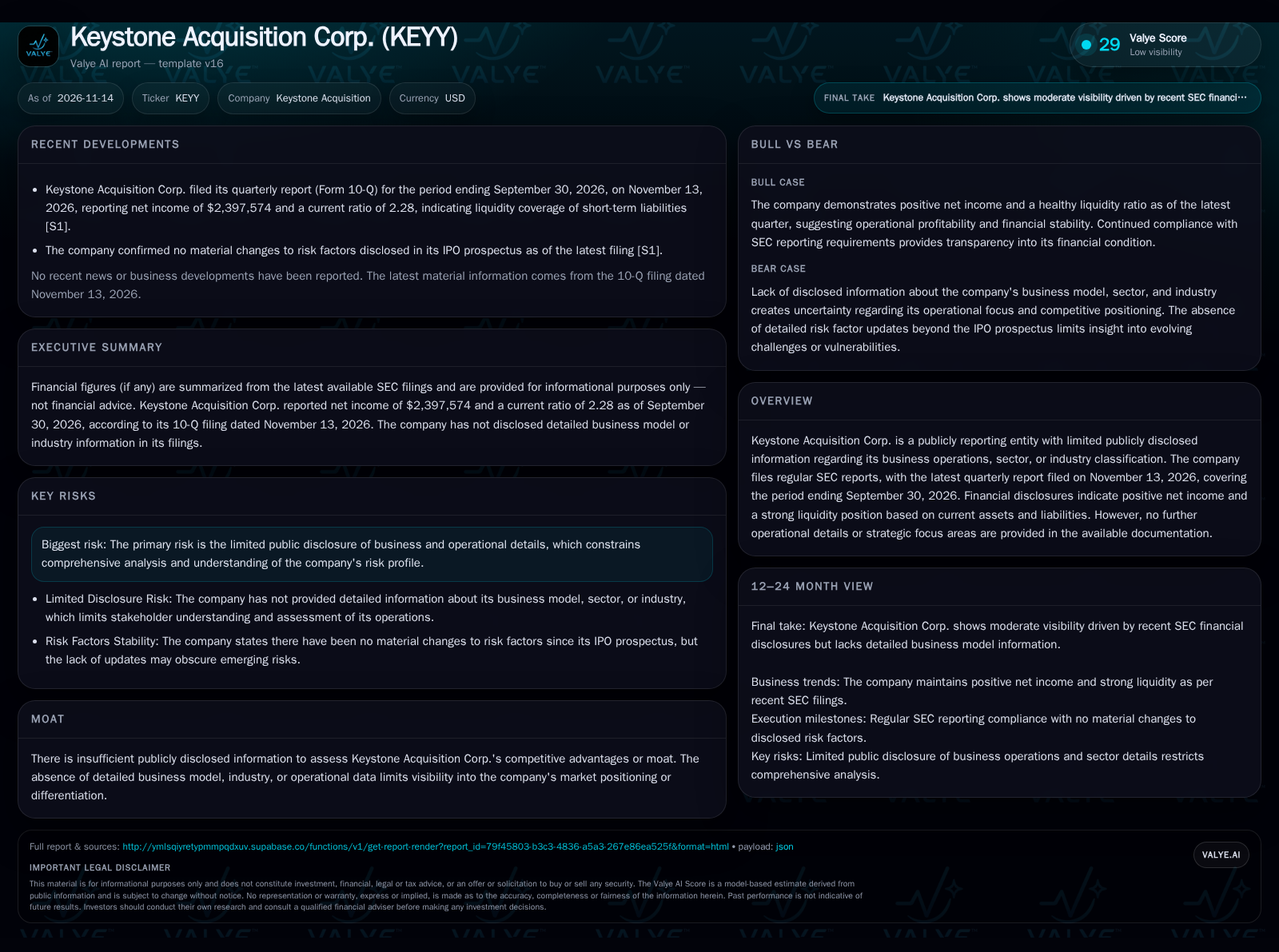
Keystone Acquisition Corp. reported net income of $2,397,574 for the quarter ended September 30, 2026, driven entirely by interest income on trust investments and minor referral fees, with no revenue from business operations [S1]. As of the same date, it had $1,061,387 in current assets against $466,102 in current liabilities, yielding a current ratio of 2.28 [S1]. The company completed its IPO in June 2026, raising $287.5 million, and has not yet announced or closed a business combination [S1].
The company reported cash and liquidity metrics for the period; these figures do not by themselves establish operating runway, investment capacity, financial flexibility, or financing capacity. There is no disclosed operating business, revenue, or sector focus, and the company’s risk disclosures remain unchanged since its IPO [S1].
Additionally, the absence of operating revenues means Keystone's financial resilience is tied closely to the yield environment on its trust assets, which could fluctuate with broader interest rate movements, potentially impacting net income and available capital for deal-related costs.
SPAC Economics: How Capital, Incentives, and Deal Structure Shape Value Creation
Keystone’s economics, like those of all SPACs, are defined not by current operations but by the structure of its capital pool and the incentives embedded in the sponsor agreement. The company’s $287.5 million IPO proceeds are held in trust, generating interest income (the sole source of current net income), and are intended to fund a future acquisition. Public shareholders typically hold the right to redeem shares at approximately $10 per unit if they disapprove of the eventual transaction.
SPACs operate under a fixed timeline—often 18 to 24 months post-IPO—to identify and consummate a business combination. Failure to do so typically results in liquidation and return of trust proceeds (less certain expenses) to shareholders. Sponsor teams are incentivized via founder shares and warrants, which convert to significant equity only if a deal closes. This creates a strong, sometimes misaligned, incentive to complete a transaction before the deadline, regardless of target quality.
Operating leverage, margin structure, and capital needs will depend entirely on the economics of the eventual acquisition target. Until then, Keystone’s financials reflect low expenses (accounting, legal, diligence) and non-operating income. The real test of value creation will come only after a deal is completed and the acquired business’s unit economics, growth profile, and capital needs are revealed.
The SPAC's capital structure also introduces complex incentive dynamics that can influence deal outcomes. Sponsor dilution through founder shares and warrants creates a scenario where sponsors may prioritize deal closure over deal quality, especially as the acquisition deadline approaches. This misalignment can pressure the SPAC to accept targets with less robust fundamentals or higher risk profiles. Moreover, public shareholders’ redemption rights serve as a counterbalance, but high redemption rates can deplete the trust pool, complicating the financing and operational viability of the post-merger entity. Therefore, the interplay between sponsor incentives and shareholder protections is a critical factor shaping Keystone's path to value creation.
SPAC Market Dynamics: Sourcing, Competition, and the Challenge of Target Selection
Keystone operates within a crowded field of SPACs, all competing for a finite pool of attractive acquisition targets. Its lack of disclosed sector or industry focus means it is not differentiated by domain expertise or a proprietary sourcing pipeline. In the current environment, many high-quality private companies are wary of SPAC mergers due to valuation uncertainty, sponsor dilution, and post-merger volatility.
Relevant competitor categories include other SPACs with overlapping timelines, traditional private equity buyers, and direct IPO routes for target companies. Keystone’s success will hinge on its ability to source a willing and suitable target, negotiate favorable terms, and convince public shareholders of the deal’s merits to minimize redemptions. Without a disclosed deal or industry focus, it is difficult to assess any inherent advantage beyond capital availability and sponsor relationships.
In the competitive landscape, Keystone's lack of a defined sector focus may offer both flexibility and disadvantage. On one hand, a broad mandate allows pursuit of diverse opportunities, potentially enabling Keystone to pivot toward emerging sectors or undervalued assets. On the other hand, absence of specialized expertise or a targeted network can hinder the ability to source proprietary deals or conduct in-depth due diligence, increasing reliance on competitive auction processes where pricing and terms may be less favorable. This trade-off suggests that Keystone's success may depend heavily on the quality of its sponsor team's relationships and deal execution capabilities rather than purely on capital availability.
Unlocking Value: What Would a Successful Keystone Business Combination Look Like?
The best-case scenario for Keystone is the identification and completion of a business combination with a high-growth, defensible private company at a reasonable valuation. This would require not only sourcing a willing target, but also navigating due diligence, structuring a deal that aligns sponsor and shareholder interests, and minimizing redemptions so that meaningful capital remains to fund the combined entity.
Evidence that would support this outcome includes: an announced letter of intent or definitive agreement with a credible, growth-oriented target; limited pre-merger redemptions (indicating shareholder enthusiasm); PIPE (private investment in public equity) financing to supplement trust proceeds; and post-merger financial projections that show compelling revenue growth, margin expansion, and capital efficiency.
Falsification would come from failure to announce a deal before the deadline, high redemption rates that drain trust capital, or a deal with a low-quality or distressed target that erodes shareholder value.
Likely Outcomes: SPAC Clock Ticks as Options Narrow
The most plausible outcome is that Keystone will continue its search for a target, and may announce a business combination within its allotted window, but will face significant execution risk. The competitive environment and sponsor incentives may pressure the team to pursue a marginal or late-stage target, especially as the deadline approaches. High redemption rates are possible, especially if public market sentiment toward SPACs remains skeptical.
Confirmation of this scenario would include a late-cycle deal announcement, a target from a less competitive sector, higher-than-average redemptions, and post-merger dilution or capital shortfall. Falsifying evidence would be an early, high-quality deal with robust PIPE participation and low redemptions.
When the Clock Runs Out: Liquidation Risk and Sponsor-Shareholder Friction
In the downside scenario, Keystone fails to secure or close a deal before its SPAC deadline, resulting in liquidation and return of trust proceeds to public shareholders. This would render the sponsor’s founder shares and warrants worthless, and would mean no operating company emerges from the process. Alternatively, the company could complete a poor-quality merger—often with a distressed or speculative target—leading to post-merger value destruction, high redemptions, and share price decline.
Evidence of this scenario would be repeated deadline extensions, lack of meaningful deal announcements, or a rushed transaction with red flags (e.g., limited disclosure, no PIPE, or poor financials). High redemption rates and sharp post-merger stock declines would further confirm the downside.
Milestones That Will Define Keystone’s Value-Creation Trajectory
Announcement of a definitive agreement or letter of intent with a specific target business.
Disclosure of the target’s industry, financial profile, and growth plan—if and when a deal is announced.
Shareholder redemption rates at the time of deal approval, as a proxy for confidence in the transaction.
PIPE financing participation or additional capital raised to support the business combination.
Sponsor economics and dilution impact—would help test alignment with public shareholders.
Regulatory or legal hurdles associated with the proposed transaction, if disclosed.
Projected post-merger operating metrics: revenue, EBITDA, cash flow, and capital needs.
Any deadline extensions or changes to the SPAC timeline or structure.
Disclaimer: This is research-only, informational analysis and not investment advice. It may include AI-generated interpretation and general industry context. Always verify important details using primary sources.

Comments