
Aptera Motors: Solar EV Ambitions Collide with Capital Constraints and Execution Hurdles
Aptera Motors pursues an ambitious vision of energy-efficient, solar-powered vehicles through a high-stakes partnership with a Chinese contract manufacturer.
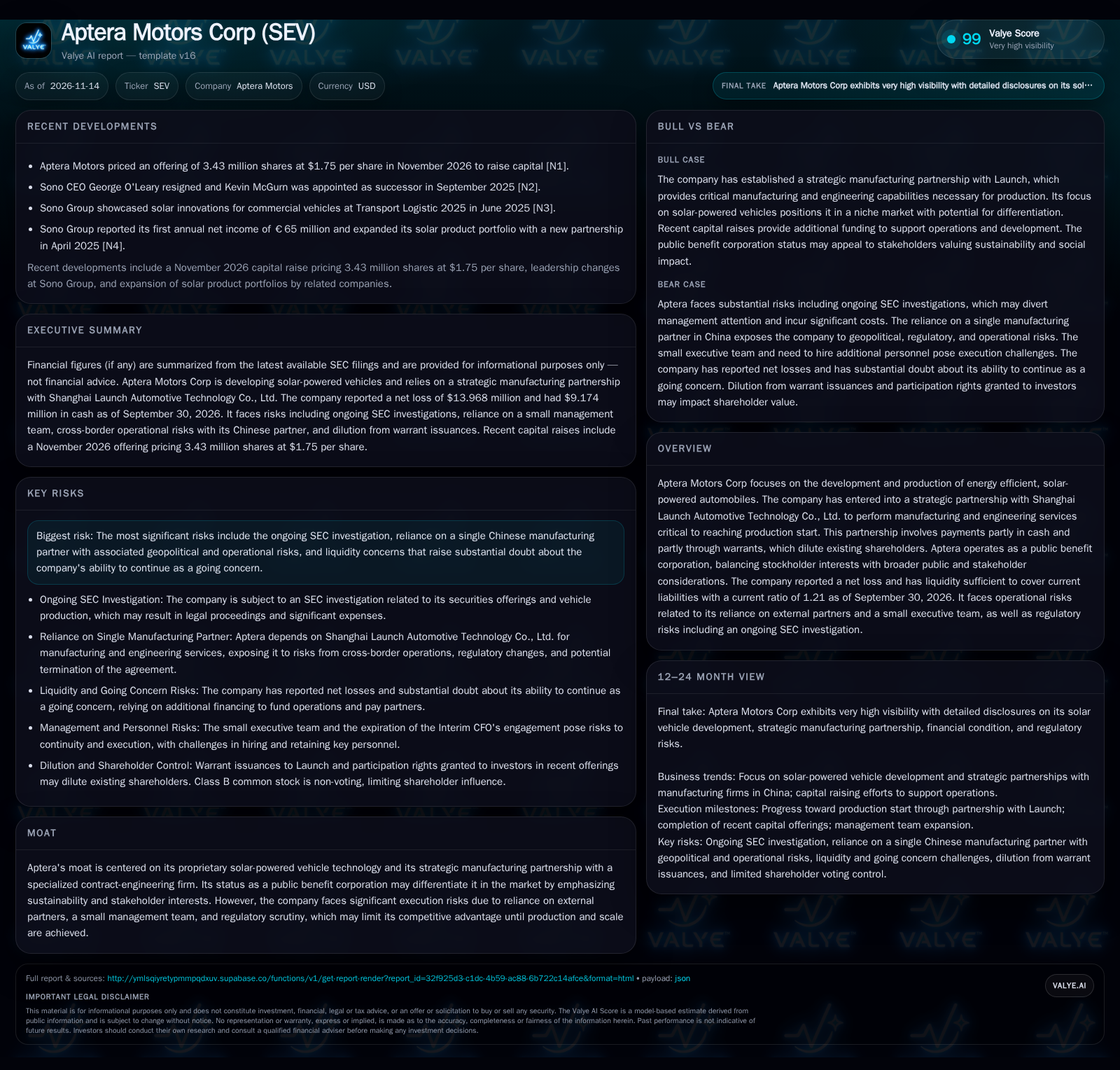
Aptera Motors is progressing toward solar-powered vehicle production via a strategic partnership with Shanghai Launch Automotive Technology, but faces substantial doubt about its ability to continue as a going concern. Recent capital raises and warrant-based payments to Launch are dilutive, and the company is under SEC investigation. Execution hinges on securing further financing and successfully managing cross-border and operational risks. [S2] [N1]
Aptera Motors stands at a pivotal juncture as it attempts to commercialize solar-powered vehicles through a partnership with Shanghai Launch Automotive Technology. While its differentiated product vision and public benefit corporation status may appeal to sustainability-minded stakeholders, the company faces acute financial and operational challenges. With limited cash, an ongoing SEC investigation, and reliance on a single external manufacturing partner, Aptera’s ability to reach scaled production and long-term viability will depend on its capacity to secure further financing, manage dilution, and navigate complex cross-border risks. [S2] [N1]
Recent Developments Reshape Aptera’s Production and Financing Landscape
Several pivotal events define Aptera’s current operating context. The company entered into a strategic manufacturing and engineering partnership with Shanghai Launch Automotive Technology, with payments structured as a mix of cash (up to RMB 200 million) and warrants to purchase Class B Common Stock. As of August 2026, 3,369,629 warrants at $2.20 per share had been issued, with further issuances possible. This arrangement is essential for production readiness but dilutes existing shareholders and introduces cross-border execution and regulatory risks. [S2]
Financially, Aptera reported $9.174 million in cash, a current ratio of 1.21, and a net loss of $13.968 million for the quarter ended September 30, 2026. The company acknowledges substantial doubt about its ability to continue as a going concern, highlighting an urgent need for additional capital. [S2]
In November 2026, Aptera completed a registered direct offering and concurrent private placement, issuing 3.43 million shares at $1.75 per share. The deal included participation rights for investors in future financings, which could complicate or delay subsequent capital raises. [N1] [S2]
Overlaying these financial and operational hurdles is an ongoing SEC investigation into Aptera’s securities offerings and vehicle production, creating further uncertainty and potential legal or financial consequences. [S2]
How Aptera’s Business Model Faces the Realities of Capital-Intensive Vehicle Production
Aptera’s core economic proposition is the commercialization of highly energy-efficient, solar-powered vehicles—an inherently capital-intensive and technologically ambitious endeavor. The company’s cost structure is dominated by upfront R&D, tooling, manufacturing setup, and regulatory compliance, with a heavy reliance on external partners for engineering and production.
The partnership with Launch aims to mitigate some fixed-cost burdens by leveraging contract manufacturing and engineering services. However, the payment structure—combining cash outlays and significant warrant issuance—means that Aptera must balance cash preservation with the risk of shareholder dilution. The up-to-RMB 200 million commitment to Launch, partly settled through warrants, ties production progress directly to capital-raising and share issuance capacity. [S2]
Revenue generation hinges on the successful launch and scaling of vehicle sales, which could theoretically benefit from premium pricing tied to solar technology differentiation. However, the market for solar-powered vehicles is unproven at scale, and volumes will likely be constrained by consumer adoption rates, regulatory approvals, and supply chain readiness.
Operating leverage could become favorable if Aptera achieves meaningful production scale, as fixed R&D and engineering costs are spread over more units. In the near term, however, the company’s losses are likely to persist, and further fundraising is nearly inevitable. The participation rights granted in the recent equity raise may further constrain flexibility, as future rounds could require new negotiations or trigger anti-dilution protections. [S2] [N1]
Assessing Aptera’s Advantages and Exposures in a Crowded EV Innovation Race
Aptera’s most salient differentiator is its commitment to solar-powered vehicle technology, which—if proven at scale—could offer a compelling value proposition for consumers seeking maximum efficiency and sustainability. Its public benefit corporation status may also resonate with environmentally focused investors and customers, potentially aiding brand differentiation.
However, Aptera’s competitive position is fragile. The company is pre-revenue and relies on a single manufacturing partner in China, introducing concentrated supplier risk and exposure to geopolitical and regulatory volatility. Unlike established EV manufacturers with vertically integrated supply chains and deeper capital reserves, Aptera lacks diversification and scale advantages.
The solar EV space is also attracting both established automakers and startups, intensifying competition for talent, capital, and early adopter customers. Substitution risk is high: consumers may opt for traditional EVs with broader charging infrastructure or wait for larger brands to introduce solar-augmented models. Aptera’s reliance on outside consultants and a small executive team compounds execution risk, as does its limited ability to influence supply chain and cost structures compared to vertically integrated peers. [S2]
What Success Could Look Like: From Prototype to Scalable, Differentiated Production
A favorable scenario for Aptera would see the company successfully leveraging its partnership with Launch to commence and ramp up production of solar-powered vehicles, establishing itself as a leader in the energy-efficient mobility segment. If Aptera can secure additional financing on favorable terms, avoid further material dilution, and execute on production milestones, it could benefit from first-mover advantage in a niche but growing market.
Confirmation of this scenario would include: public announcements of a successful production launch, early customer deliveries, positive media or regulatory reviews of vehicle performance, and evidence of sustained demand for solar-powered vehicles. Additional favorable indicators would be the extension or expansion of the Launch partnership, successful onboarding of key executive talent, and the resolution of the SEC investigation without major penalties or disruptions.
The scenario could be further validated by signs of operating leverage—such as narrowing losses or initial gross margin improvement—as production scales, and by the company’s ability to raise incremental capital at improving valuations, reducing the pace of dilution.
Navigating Financial and Execution Hurdles on the Road to Limited Production
The most plausible near-term outcome is that Aptera manages to initiate limited production and delivery of its solar-powered vehicles, but only after securing additional dilutive capital and overcoming significant operational delays. Execution is likely to be hampered by the complexities of cross-border manufacturing, potential regulatory hiccups, and the ongoing SEC investigation, which may distract management and deter some prospective investors.
Progress would likely be incremental, with modest initial volumes and a slow ramp-up, as Aptera works through supply chain, quality, and regulatory challenges. Losses would persist, and the company would continue to rely on periodic equity or hybrid financings to fund operations and partner payments. Participation rights and warrant structures from prior rounds could make subsequent capital raises more complex or less attractive to new investors.
Evidence for this scenario would include announcements of small-batch production, continued net losses, and further capital raises at similar or lower valuations. Any positive developments would be tempered by ongoing dilution and unresolved regulatory overhang.
How Execution Failure or Funding Shortfall Could Derail the Aptera Thesis
In a negative scenario, Aptera fails to secure sufficient new financing in time to meet its obligations to Launch or to fund ongoing operations, leading to a halt in production preparations and a potential breach of contract. The dilution from warrant exercises and participation rights could further erode existing shareholder value, especially if additional share offerings are required at depressed prices.
Operationally, an inability to manage cross-border logistics, regulatory compliance, or partner performance could result in missed milestones, product delays, or quality issues, undermining customer and investor confidence. The ongoing SEC investigation could escalate, resulting in penalties, restrictions, or reputational damage that further constrain access to capital and strategic partners.
This scenario would be confirmed by negative disclosures on cash runway, missed payment or production deadlines, material legal or regulatory setbacks, or the announcement of asset sales, layoffs, or a formal restructuring process.
Milestones and Risks That Will Determine Aptera’s Ability to Deliver on Its Solar EV Vision
Progress updates on the Launch manufacturing partnership, including any changes to payment terms, production milestones, or contract extensions.
Disclosure of additional capital raises or financing arrangements—terms, size, and impact on dilution and participation rights.
Announced production start dates, initial deliveries to customers, and any regulatory or quality approvals received for the vehicles.
Updates on the status, findings, or resolution of the SEC investigation, and any material legal or financial implications.
Retention and hiring of key executive and engineering talent, especially the appointment of a permanent CFO and expansion of the management team.
Evidence of sustained or growing customer demand, such as reservation counts, waitlist updates, or signed purchase agreements if disclosed.
Changes in the geopolitical or regulatory landscape affecting US-China manufacturing partnerships or cross-border payments.
Operating cash burn and updated runway projections, especially in light of new capital raised or changes in operating costs.
Disclaimer: This is research-only, informational analysis and not investment advice. It may include AI-generated interpretation and general industry context. Always verify important details using primary sources.

Comments