
URSB Bancorp: Post-Conversion Banking Model Faces Scale, Credit, and Margin Crosscurrents
Following its mutual-to-stock conversion, URSB Bancorp operates with a diversified loan book and transparent financials, but its small scale and regional exposure shape both opportunity and risk. The company’s ability to manage credit quality, expense discipline, and deposit retention will determine its future earnings trajectory in a competitive, rate-sensitive environment.
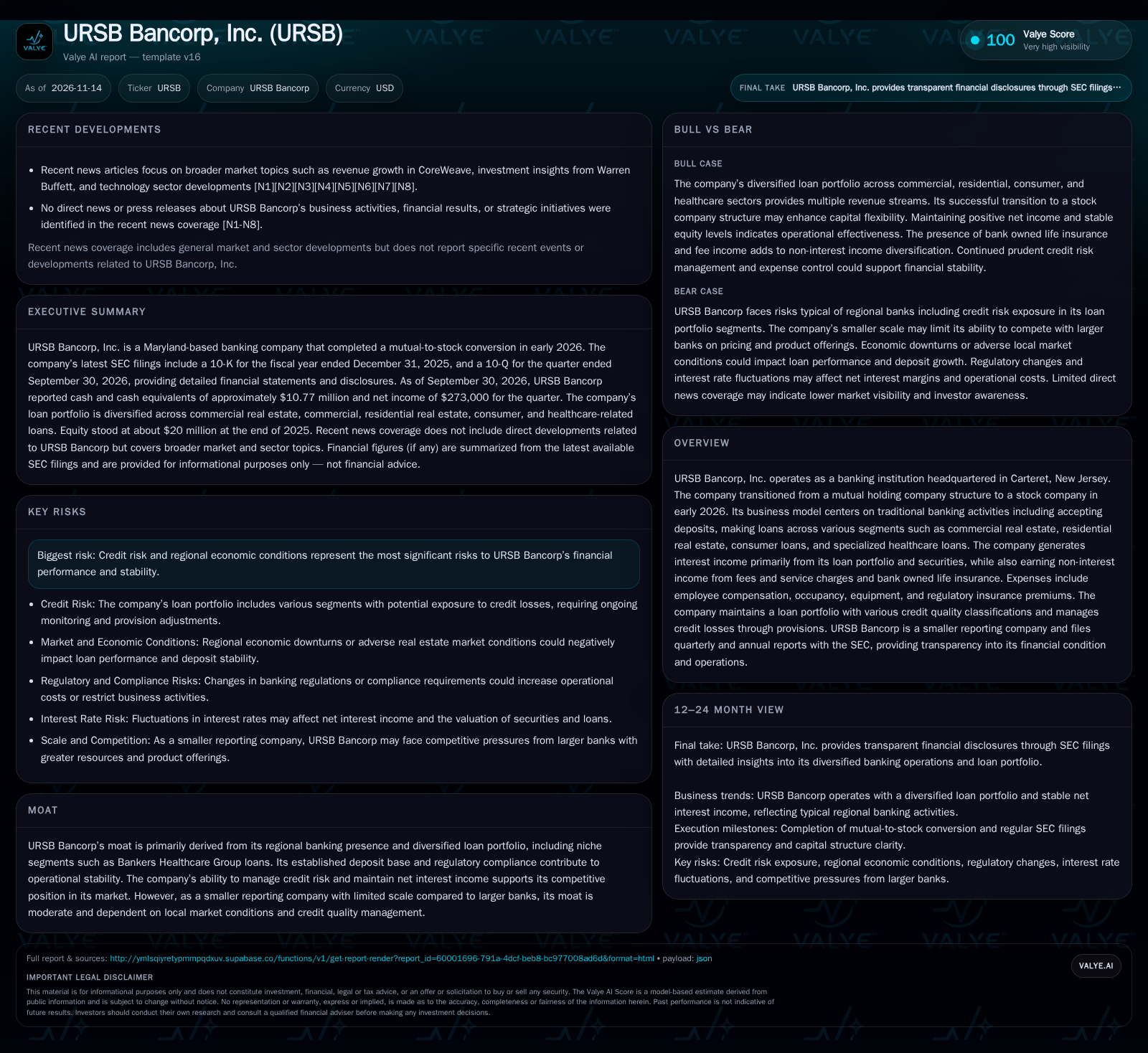
URSB Bancorp, Inc. completed its conversion to a stock company in January 2026 and reported net income of $273,000 for the September quarter, with cash of $10.77 million and total assets of $368 million at year-end 2025. The bank’s diversified loan portfolio and positive net interest income support its regional model, but its small scale, credit risk, and margin sensitivity remain key variables for future performance. Sustainable earnings growth will depend on disciplined credit management, operational efficiency, and the ability to defend deposit share amid industry competition and interest rate uncertainty. [S1] [S2]
URSB Bancorp’s transition from a mutual holding company to a publicly traded stock company in early 2026 marks a pivotal moment for the regional New Jersey bank. With $368 million in assets and a diversified loan portfolio, the company’s recent financial disclosures show modest profitability and a stable deposit base. Yet, as a smaller player in a consolidating industry, URSB faces acute challenges from credit risk, operational leverage, and intense competition for deposits—factors that will test its ability to sustain growth and shareholder value in the post-conversion era.
Recent Financial Milestones and Structural Shift
URSB Bancorp, Inc. completed its mutual-to-stock conversion effective January 9, 2026—a move that fundamentally altered its capital structure and potential for shareholder alignment. As of September 30, 2026, the company reported cash and cash equivalents of $10.77 million and net income of $273,000 for the quarter, translating to $0.13 per share. At year-end 2025, URSB Bancorp’s total assets were $368 million, with deposits of $291 million and borrowings of $53.6 million. The loan portfolio is diversified across commercial real estate, residential, consumer, and healthcare loans. These facts matter because the conversion opens new avenues for capital raising and corporate governance, while the latest financials set a baseline for post-conversion performance and risk-bearing capacity. [S1] [S2]
How URSB Generates Earnings: Interest Spread and Expense Realities
URSB Bancorp’s core earnings engine is the spread between interest income on loans/securities and funding costs from deposits and borrowings. For the year ended December 31, 2025, net interest income after provision for credit losses was $7.63 million. Non-interest income—including fees and bank-owned life insurance—adds incremental revenue, but remains a secondary contributor. On the expense side, salaries, occupancy, equipment, and regulatory insurance premiums form the bulk of non-interest costs. As a smaller reporting company, fixed costs weigh more heavily on margins, limiting operating leverage compared to larger peers.
The mutual-to-stock conversion could, over time, lower the cost of equity capital and facilitate incremental growth investments or capital returns. However, the company’s capital base ($20 million in equity at year-end 2025) restricts large-scale expansion or aggressive buyback/dividend strategies. The bank’s ability to drive higher returns depends on growing its loan book without outsized credit risk, expanding fee income, and tightly controlling expenses—a classic challenge for community banks operating at subscale.
In addition to the core interest spread dynamics, the sensitivity of URSB Bancorp's earnings to interest rate fluctuations merits close examination. Given the bank's funding mix, changes in benchmark rates can differentially impact asset yields and funding costs, potentially compressing net interest margins if deposit rates rise faster than loan yields. The bank's ability to manage this repricing gap through asset-liability management strategies, such as adjusting loan pricing or deposit product offerings, will influence margin stability. Moreover, the relatively high fixed cost base implies that any margin compression directly pressures net income, underscoring the importance of operational efficiency in preserving profitability.
Regional Banking’s Double-Edged Sword: Local Moat and Scale Limitations
URSB Bancorp’s competitive position is rooted in its regional presence and longstanding customer relationships in Carteret, New Jersey, and surrounding areas. The diversified loan book, including healthcare and commercial real estate exposures, provides some insulation from single-sector shocks. However, as a smaller reporting company, URSB lacks the scale, product breadth, and technology resources of larger regional or national banks. This makes it vulnerable to pricing pressure on both loans and deposits, particularly during periods of heightened competition or when rate cycles shift rapidly.
Switching costs for retail and small business clients are modest, and larger banks can often outcompete on digital offerings, product bundles, or rate incentives. The key counterforce for URSB is its ability to maintain localized service quality and credit knowledge—advantages that can foster loyalty but are insufficient moats against broad market shifts or aggressive acquisition by larger competitors.
The bank’s regional focus also shapes its strategic options for growth and risk mitigation. While deep local knowledge and relationships can foster customer loyalty and tailored credit decisions, they also concentrate exposure to regional economic cycles and sector-specific downturns. This concentration risk means that adverse developments in key local industries or real estate markets could disproportionately affect asset quality and earnings. Additionally, the limited scale constrains investments in technology and product innovation, which are increasingly critical for competing with larger banks and fintech entrants. Therefore, balancing the benefits of local expertise with the risks of geographic and product concentration is a central challenge for URSB.
Furthermore, the competitive landscape for deposits is particularly challenging in a rising rate environment. Larger banks and non-bank financial institutions often have greater capacity to offer higher yields or more sophisticated digital platforms, attracting depositors away from smaller regional banks. URSB's ability to differentiate through personalized service and community engagement may help retain core deposits, but this advantage may erode if competitors intensify pricing or product innovation. Maintaining a stable deposit base without resorting to costly rate increases will be critical for funding cost control and margin preservation.
Unlocking Value Through Credit Discipline and Deposit Growth
A favorable outcome for URSB Bancorp would see steady expansion of its loan book—especially in higher-yielding segments such as commercial and healthcare lending—while keeping credit losses contained. If the company can grow deposits organically without increasing funding costs disproportionately, it could expand its net interest margin and improve operating leverage. The mutual-to-stock conversion, if followed by prudent capital deployment (e.g., selective branch investments, technology upgrades, or targeted share repurchases), could further enhance shareholder returns.
Evidence that would confirm this scenario includes sustained growth in net interest income, stable or improving credit quality metrics (e.g., low nonperforming loan ratios), and incremental gains in fee-based income. A successful demonstration of cost control—reflected in a declining efficiency ratio—would also support the upside thesis.
Earnings Stability Amid Margin Compression and Incremental Growth
The most plausible trajectory for URSB Bancorp is a continuation of modest earnings, with incremental asset and deposit growth offset by ongoing pressure on net interest margins. In this scenario, the bank manages to keep credit losses within historical norms and maintains its current expense base, but struggles to materially expand its market share or fee income due to competitive constraints and limited scale. The mutual-to-stock conversion improves governance and transparency, but does not immediately translate into higher returns or capital deployment flexibility.
Confirmation of this scenario would come from relatively flat net income, stable loan quality, and only gradual changes in deposit or loan balances in subsequent quarterly reports. Falsification would be signaled by a material swing in credit losses, a sharp drop in deposits, or a significant deterioration in operating efficiency.
Credit Deterioration and Funding Cost Spike Threaten Profitability
The primary adverse scenario for URSB Bancorp is a combination of rising credit losses—particularly in commercial or healthcare loan segments—and increased competition for deposits leading to higher funding costs. This could be triggered by a regional economic downturn, sector-specific stress, or a rapid shift in interest rates that compresses net interest margins. As a smaller bank, URSB may have fewer levers to offset these pressures, making it vulnerable to swings in quarterly performance.
Evidence supporting the downside would include a spike in nonperforming loans, a material increase in provision for credit losses, or a notable outflow of deposits requiring replacement with more expensive wholesale funding. An uptick in non-interest expenses, especially if not matched by revenue growth, would compound the risk.
Benchmarks for Testing URSB Bancorp’s Post-Conversion Trajectory
Quarterly trends in net interest margin and net interest income—if disclosed—will be critical for assessing earnings power in a shifting rate environment.
Credit quality metrics, including nonperforming loan ratios and provision for credit losses by segment, would help gauge the risk of downside scenarios.
Deposit growth and mix—especially the share of non-interest-bearing accounts—could indicate competitive positioning and funding cost resilience.
Efficiency ratio (non-interest expense as a percentage of net revenue), if disclosed, would be a key measure of operational discipline and scalability.
Updates on capital deployment post-conversion, such as share repurchases, dividends, or branch investments, would clarify management’s strategic priorities.
Any material changes in loan portfolio concentration or underwriting standards—if disclosed—would affect risk and return dynamics.
External signals from regional economic indicators or competitor deposit pricing trends could provide early warning of market stress or opportunity.
Disclaimer: This is research-only, informational analysis and not investment advice. It may include AI-generated interpretation and general industry context. Always verify important details using primary sources.

Comments