
JATT II Acquisition Corp.: SPAC Mechanics, Zura Bio Merger, and the Realities of Early-Stage Biopharma Bets
JATT II Acquisition Corp.'s transformation into Zura Bio Limited underscores both the promise and pitfalls of SPAC-led biopharma development. Recent clinical setbacks, a reported liquidity position snapshot, and the absence of near-term revenue reveal the high-stakes, binary nature of the company's value proposition.
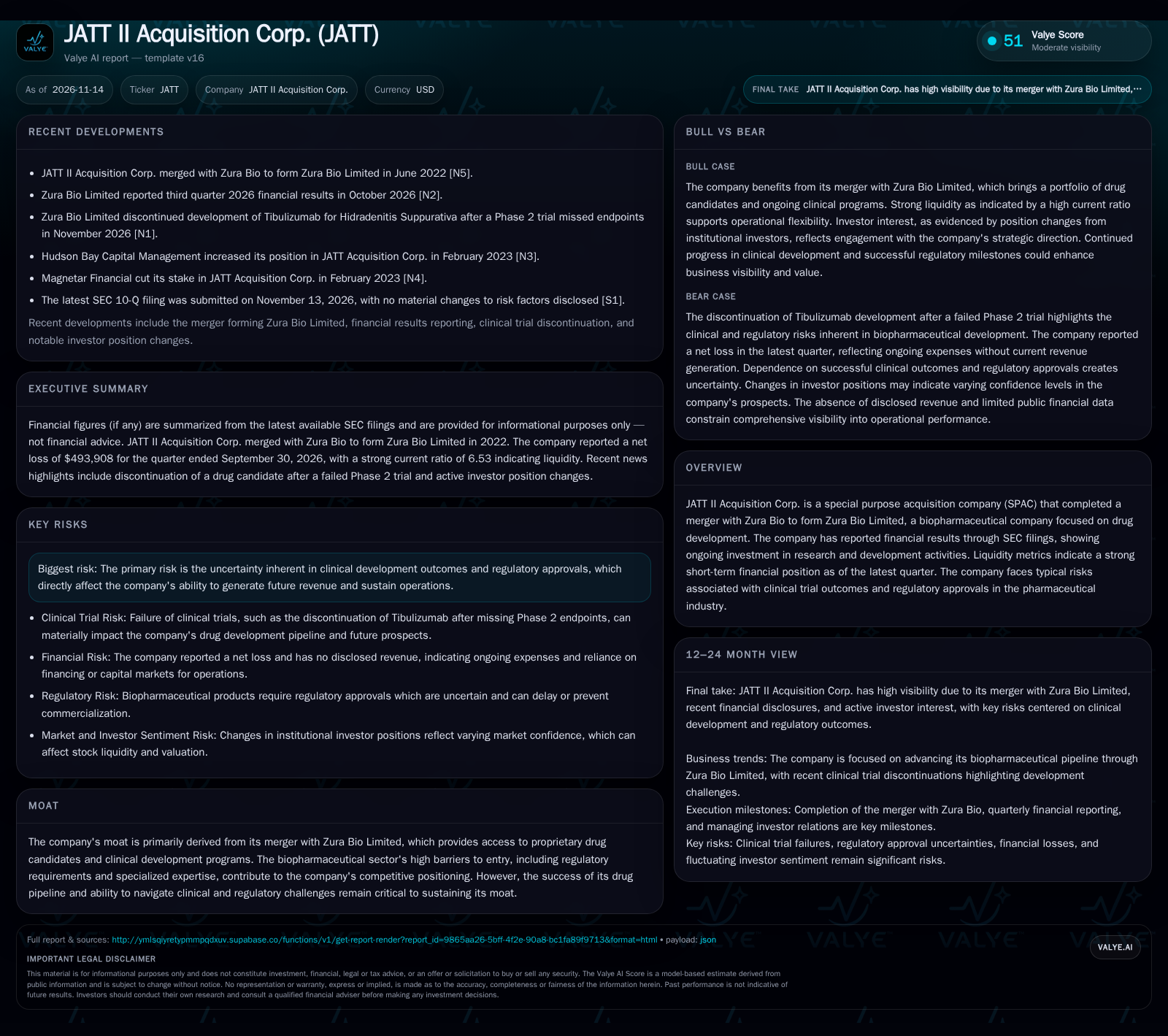
JATT II Acquisition Corp. completed a SPAC merger with Zura Bio Limited, shifting its focus to biopharmaceutical R&D. The company maintains reported liquidity position but posted a net loss for Q3 2026, and recently discontinued a leading drug candidate after a failed Phase 2 trial. The investment case now hinges on the success of remaining pipeline assets and the company's ability to navigate clinical and regulatory hurdles.
The evolution of JATT II Acquisition Corp. from a blank-check entity into Zura Bio Limited epitomizes the high-risk, high-reward dynamics of SPAC-backed biopharmaceutical ventures. With no revenue yet generated and continued net losses, the company's future now rests on the success of its remaining pipeline and its ability to convert scientific promise into commercial reality.
Recent Developments Set the Stage: Merger, Liquidity, and Clinical Setbacks
JATT II Acquisition Corp. completed its merger with Zura Bio in June 2022, forming Zura Bio Limited and pivoting to biopharmaceutical R&D [N5]. As of September 30, 2026, the company reported current assets of $1,208,864 and current liabilities of $185,014, yielding a current ratio of 6.53—a strong indicator of near-term liquidity [S1]. However, the company posted a net loss of $493,908 for the third quarter of 2026, reflecting ongoing costs without offsetting revenue. The most material recent event is the discontinuation of Tibulizumab development for Hidradenitis Suppurativa after a Phase 2 trial missed its efficacy endpoints, underscoring the unpredictable and often binary outcomes of clinical-stage drug development. Meanwhile, institutional investor activity remains dynamic, with Hudson Bay Capital Management increasing its stake and Magnetar Financial reducing its position in early 2023 [N3] [N4].
How the SPAC-to-Biotech Model Drives Cash Flow and Risk
Zura Bio Limited, as the operating entity post-merger, is fundamentally a pre-revenue drug development company. Its economics are driven by capital raised through the SPAC process and private placements, rather than by operating cash flow. The company’s cost structure is heavily weighted toward R&D expenses, regulatory compliance, and general administrative costs. With no product revenue, the primary inflows are investment income (e.g., interest on trust assets) and, potentially, milestone or partnership payments if any pipeline asset attracts outside interest.
Operating leverage is negative in this phase: each dollar spent on clinical or regulatory activity increases losses until a drug is approved and commercialized. Fixed costs (such as management, compliance, and core lab operations) are significant, and variable costs spike with clinical trial enrollments or new pipeline additions. Capital needs are typically high, with future funding rounds or non-dilutive partnerships likely required before any commercial revenue is realized. The discontinuation of Tibulizumab removes a near-term opportunity for value inflection and may concentrate risk onto a smaller set of pipeline assets.
The capital structure and financing strategy of SPAC-to-biotech entities like Zura Bio Limited also merit deeper consideration. Given the extended timelines and high attrition rates typical in drug development, the company must carefully balance equity dilution against the urgency of funding clinical programs. Each financing round potentially dilutes existing shareholders, which can pressure stock price performance and investor sentiment. Conversely, insufficient capital can lead to stalled trials or missed regulatory milestones, which may irreversibly damage valuation. Strategic timing of capital raises, possibly aligned with clinical readouts or partnership announcements, can optimize valuation and investor appetite, but this requires precise execution and market conditions conducive to biotech risk.
The company reported cash and liquidity metrics for the period; these figures do not by themselves establish operating runway, investment capacity, financial flexibility, or financing capacity. In periods of rising rates, investment income may improve, offering marginal relief to cash burn. Conversely, market downturns could impair asset values and reduce liquidity, exacerbating funding challenges. This dynamic underscores the importance of maintaining a prudent cash runway and diversified financing options, including potential non-dilutive mechanisms like grants or collaborations, which can mitigate reliance on capital markets and buffer against adverse economic cycles.
Barriers, Differentiation, and the Contest for Pipeline Value
The company’s competitive position is defined by its proprietary drug candidates and the high entry barriers of regulated biopharmaceutical development. The merger with Zura Bio provided access to an existing pipeline, but the discontinuation of Tibulizumab after a failed Phase 2 trial illustrates how quickly a competitive edge can erode in this sector. The primary sources of durable advantage in early-stage biotech are intellectual property, first-mover advantage in novel mechanisms, and the ability to attract capital and talent.
However, biopharma is intensely competitive, with large pharmaceutical companies, mid-cap biotechs, and other venture-backed drug developers all racing to advance similar or substitute therapies. The absence of a disclosed commercial-stage asset means that Zura Bio’s moat is currently theoretical, reliant on the future success of its remaining programs and the ability to navigate regulatory and reimbursement hurdles faster or more effectively than peers. The company’s position could improve if it demonstrates clinical differentiation or secures strong partnership terms, but it remains highly vulnerable to both internal setbacks and external competition.
Intellectual property protection and patent life are critical dimensions influencing Zura Bio’s competitive durability. Early-stage biopharma companies must secure robust patent portfolios to defend novel compounds and mechanisms, thereby preserving exclusivity windows essential for recouping R&D investments. The timing of patent filings relative to clinical development stages can impact effective market exclusivity post-approval. Additionally, the ability to innovate around existing patents or develop combination therapies may provide strategic advantages. Failure to establish or maintain strong IP rights could invite generic competition or patent challenges, eroding potential market share and valuation.
Another layer of competitive complexity arises from the evolving regulatory landscape and reimbursement environment. Regulatory agencies have increasingly emphasized not only safety and efficacy but also real-world evidence and health economics in approval and coverage decisions. Zura Bio’s ability to anticipate and integrate these considerations into clinical trial design and development strategy could differentiate its candidates and facilitate smoother market access. Moreover, payer acceptance and pricing negotiations will be pivotal for commercial success, particularly in crowded therapeutic areas. Early engagement with regulators and payers, alongside strategic partnerships with experienced commercialization entities, could materially enhance competitive positioning.
What a Turnaround Would Require: Clinical Success and Strategic Partnerships
A favorable scenario for Zura Bio Limited would hinge on one or more remaining pipeline assets achieving positive clinical trial results, thereby restoring investor confidence and attracting new capital or strategic partners. Successful Phase 2 or Phase 3 data could unlock milestone payments, licensing deals, or even acquisition interest from larger pharmaceutical firms. Such outcomes would validate the company’s scientific platform, enhance its negotiating leverage, and potentially enable non-dilutive financing to support further development.
Evidence that would confirm this scenario includes the announcement of positive clinical data, expanded pipeline disclosures, or the signing of lucrative partnership agreements. Additionally, a marked increase in institutional investor positions or analyst upgrades would signal a shift in market sentiment. Conversely, further clinical delays, ambiguous trial results, or the absence of new partnerships would weaken this upside narrative.
Typical Biopharma Trajectory: Continued Losses and Binary Catalysts
The most plausible path for Zura Bio Limited involves continued investment in R&D, periodic net losses, and a reliance on the capital markets for additional funding. The company will likely progress its remaining pipeline assets through early-to-mid-stage clinical development, with each program representing a binary risk/reward proposition. Incremental value may be created through modest pipeline de-risking, incremental data releases, or minor licensing deals, but transformational upside likely requires a clear clinical win.
Confirmation of this scenario would come from a steady cadence of clinical updates (positive or negative), continued net losses without revenue, and periodic equity or debt financings to replenish cash reserves. Falsifying evidence would include a major pipeline setback, inability to secure follow-on funding, or a strategic pivot away from high-risk clinical assets.
Pipeline Attrition and Funding Risk Could Accelerate Value Erosion
In the adverse scenario, continued pipeline attrition—such as additional failed or discontinued trials—would reduce the company’s asset base and increase the risk of a value-destructive capital raise or forced asset sale. Without near-term revenue or meaningful non-dilutive funding, the company could face severe dilution or even insolvency if capital markets become less receptive to early-stage biotech.
Confirming evidence would include ongoing net losses with shrinking cash balances, announcements of further clinical discontinuations, difficulties in raising new capital, or management turnover. A failure to communicate a clear R&D or financing strategy would further erode investor confidence and could precipitate a downward spiral in valuation and market access.
Milestones That Will Define Zura Bio’s Investment Thesis
Progress or setbacks in advancing remaining pipeline assets through Phase 2 or 3 clinical trials would be the most direct indicator of value inflection.
Disclosure of new licensing, partnership, or co-development agreements would help gauge the company’s ability to attract strategic or non-dilutive capital.
Cash burn rate and quarter-end cash balances, if disclosed, would provide insight into the company’s runway and funding needs.
Any updates on regulatory interactions, such as IND approvals or fast-track designations, would clarify timelines for potential commercialization.
Changes in board composition, management team, or scientific leadership could signal shifts in strategy or execution capacity.
Material changes in the positions of major institutional investors would reflect evolving market sentiment and risk appetite.
Announcements regarding expansion or contraction of the pipeline—whether through in-licensing, asset sales, or discontinuations—would directly impact the company’s risk profile.
Disclaimer: This is research-only, informational analysis and not investment advice. It may include AI-generated interpretation and general industry context. Always verify important details using primary sources.

Comments