
1RT Acquisition Corp.: Digital Assets SPAC Approaches Its Critical Window Without a Target
With its IPO proceeds in trust and a management team focused on digital assets and blockchain, 1RT Acquisition Corp. faces mounting pressure to identify a suitable $1B+ target before its mid-2027 deadline. The company’s financial structure, sector focus, and lack of operating revenue highlight the binary nature of the SPAC path ahead.
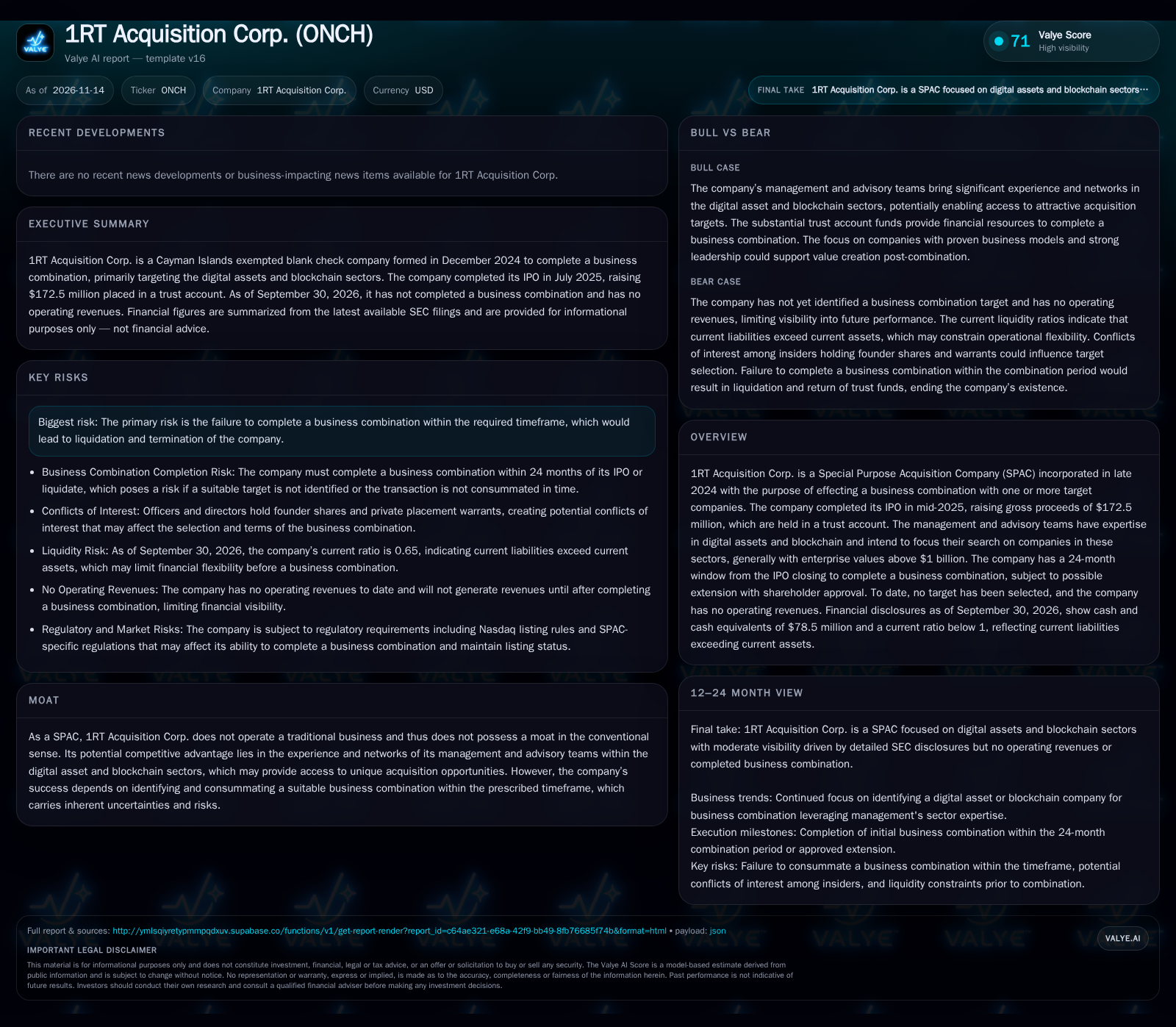
1RT Acquisition Corp., a Cayman Islands-based SPAC, is targeting a digital assets or blockchain business valued above $1B but has yet to select a target. With $172.5M raised in its July 2025 IPO, the company’s trust account and management’s sector expertise are its main assets. However, a current ratio below 1 and no operating revenues underscore the ticking clock: failure to close a deal by July 2027 means liquidation and return of funds to shareholders. The next year is decisive for value creation or dissolution. [S1] [S2]
1RT Acquisition Corp. sits at a classic SPAC crossroads: flush with IPO trust proceeds and a sector-specific mandate, it has yet to announce a target as it nears the midpoint of its 24-month deal window. With no operating revenues and a current ratio below 1, the company’s ability to deliver value hinges entirely on its management’s ability to identify and execute an accretive digital assets or blockchain acquisition before the July 2027 deadline. The coming quarters will determine whether 1RT can leverage its sector connections for a transformative merger or face the default path of liquidation.
IPO Trust, Deal Clock, and Financial Snapshot Define the Current Phase
As of September 30, 2026, 1RT Acquisition Corp. has not selected a business combination target and reports no operating revenue. The company raised $172.5 million in its July 2025 IPO, with all proceeds placed in a trust account. Current assets stand at $165.6 million versus current liabilities of $255.7 million, resulting in a current ratio of 0.65 and a cash ratio of 0.31. The SPAC must complete a deal by July 3, 2027, or liquidate. These facts frame a binary outcome: either execute a qualifying combination in the digital asset or blockchain sector, or return funds to shareholders. The lack of operating revenue and the below-par current ratio reflect the typical SPAC structure, where trust proceeds are largely untouchable for operating purposes prior to a merger, but also highlight the absence of margin for missteps or protracted negotiations. [S2]
SPAC Economics: How Value Is Created or Lost in the Pre- and Post-Combination Stages
For 1RT Acquisition Corp., value creation is almost entirely contingent on the successful completion of a business combination. Until then, the company generates minimal non-operating interest income from trust account investments, while incurring ongoing expenses for compliance, advisory, and diligence. The economics flip dramatically post-merger: if a deal closes, the combined entity’s business model, capital structure, and market valuation become central. In the digital asset and blockchain space, targets are likely to be capital-intensive, with economics varying widely by business model—ranging from transaction-based platforms (high fixed costs, potential network effects) to infrastructure providers (significant R&D and regulatory spend). The SPAC structure itself introduces significant dilution through founder shares and warrants, which affects post-merger equity value. If no deal is consummated, the trust is returned to shareholders, and sponsors lose their at-risk capital. Thus, the pre-combination phase is largely a waiting game, while the post-combination phase sees a reset of financial dynamics based on the acquired business’s fundamentals.
Target Search in a Crowded Field: Sourcing Advantages and Sector Headwinds
1RT’s management and advisory team brings sector-specific experience in digital assets and blockchain, which may provide an edge in sourcing proprietary or higher-quality targets. In theory, this network-driven advantage could enable access to companies that might otherwise remain private or choose alternative exit routes. However, the competitive landscape for SPACs in the digital assets sector is intense, with multiple vehicles chasing a limited pool of mature, scalable, and regulatory-compliant candidates. Traditional IPOs, direct listings, and private equity exits are all viable alternatives for high-quality targets, especially those with established business models and strong leadership. Regulatory uncertainty in the digital asset sector further complicates dealmaking, as evolving compliance demands can delay or derail transactions. The presence of founder shares and private placement warrants also introduces alignment challenges: sponsors may be incentivized to close a deal even if it is not ideal for public shareholders.
Catalyst for Value: Closing a High-Quality Digital Assets Merger
The optimal outcome for 1RT is the identification and successful merger with a digital assets or blockchain company that delivers both scale and differentiation—ideally an enterprise with proven revenue growth, strong leadership, and a defensible position in its niche. If such a transaction is announced and closed well ahead of the July 2027 deadline, the company could benefit from market enthusiasm, potential re-rating, and access to public market capital for the combined entity. Confirmation of this scenario would include a definitive merger announcement with a target valued above $1 billion, investor presentations highlighting credible financials and growth prospects, and signs of positive market or sector momentum. The ability to negotiate favorable terms that minimize dilution and align sponsor and shareholder interests would further validate the upside thesis. Conversely, delays in deal announcement or market skepticism about the chosen target’s quality would weaken this scenario.
Most Likely Course: Deal Sourcing Pressure and the Risk of a Rushed or Marginal Transaction
Absent early success in sourcing a top-tier target, 1RT is likely to face mounting time pressure as the July 2027 deadline approaches. The median SPAC process often results in a deal announcement within 18-22 months post-IPO, but as the window narrows, negotiation leverage may shift toward targets, raising the risk of less attractive terms or selection of a suboptimal business. The most plausible outcome is the eventual identification of a digital assets or blockchain company with some, but not all, of the desired attributes—perhaps lacking scale, profitability, or regulatory clarity. Evidence confirming the base scenario would include a deal announcement late in the SPAC’s life and a mixed market reaction, with post-merger performance tracking sector volatility. Signs of repeated deadline extensions or ambiguous deal terms would reinforce the view that 1RT is struggling to secure a high-quality partner.
Deal Failure or Liquidation: How the Clock Could Run Out
The principal downside scenario is failure to consummate any business combination by the July 2027 deadline, triggering mandatory liquidation and return of trust assets to shareholders. This outcome becomes more likely if regulatory headwinds intensify, target valuations remain elevated, or market conditions for digital asset businesses deteriorate. Confirmation would come from a lack of deal announcements as the deadline approaches, repeated communications about deadline extensions, or a formal notice of intent to liquidate. Additional downside risk includes the possibility of a poorly vetted or rushed transaction that destroys value post-merger—evidenced by sharp share price declines, high redemption rates, or negative post-combination operating results.
Milestones and Metrics That Will Determine 1RT Acquisition Corp.’s Fate
Announcement of a definitive agreement to merge with a digital asset or blockchain company, including target identity and transaction terms.
Disclosure of the target’s financials, business model, regulatory compliance status, and growth trajectory—if and when available.
Shareholder redemption rates and voting results at the time of a proposed deal, which would signal confidence or skepticism in the transaction.
Any requests for deadline extensions, special shareholder meetings, or amendments to the combination period.
Market reaction to deal announcements and subsequent investor presentations, including trading volumes and price volatility.
Updates regarding regulatory developments impacting digital asset and blockchain business combinations.
Management and sponsor disclosures or insider transactions that could signal alignment or conflict of interest dynamics.
Disclaimer: This is research-only, informational analysis and not investment advice. It may include AI-generated interpretation and general industry context. Always verify important details using primary sources.

Comments