
Forge Nano Holdings: Post-SPAC Financial Complexity and Steps Toward Operational Clarity
Following its October 2026 business combination, Forge Nano Holdings faces a pivotal inflection: the company’s financial disclosures reveal a complex capital structure—marked by a substantial PIPE derivative liability and a zero-cash balance at quarter-end—while operational details remain opaque. The central question is whether Forge Nano can translate its capital markets maneuvering into a sustainable, cash-generating enterprise.
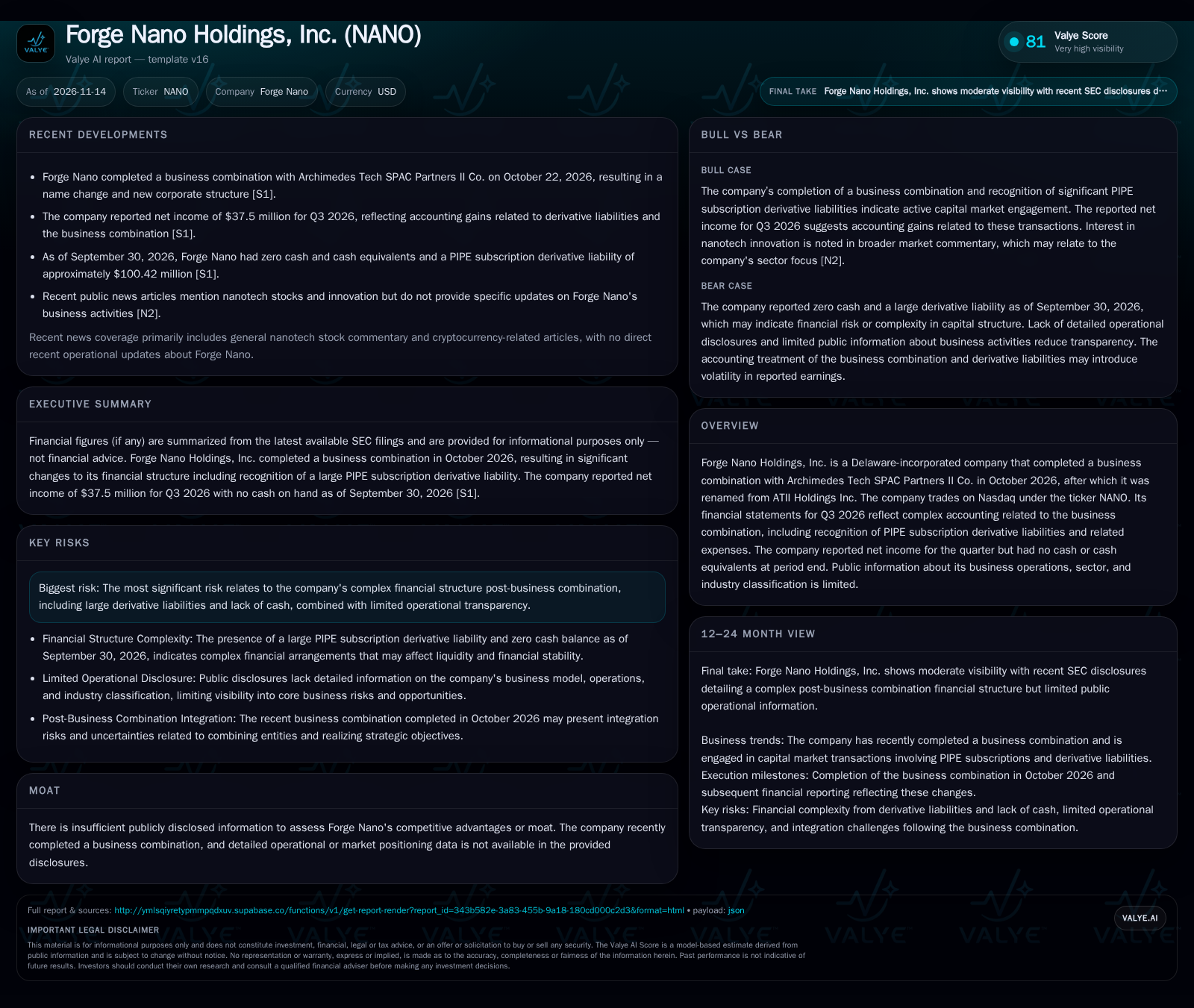
Forge Nano Holdings, Inc. completed a high-profile SPAC merger in October 2026, resulting in a new capital structure with a $100 million+ PIPE derivative liability and no cash as of September 30, 2026. While the company reported net income in Q3 due to accounting gains, its underlying business operations and revenue model remain undisclosed, leaving the sustainability and economic engine of the business in question. The next phase hinges on operational transparency, effective deployment of newly raised capital, and management’s ability to establish a viable business model post-merger. [S1]
Forge Nano Holdings, Inc. emerges from its October 2026 SPAC merger with a dramatically reshaped balance sheet and a critical need to prove its business fundamentals. Despite reporting substantial net income for Q3—driven almost entirely by accounting treatment of PIPE derivative liabilities—the company ended the period with no cash on hand and a sizeable working capital deficit. Management claims that post-merger capital has stabilized liquidity, but with no disclosed operating revenues or commercial model, Forge Nano’s future will be defined by how quickly and effectively it can transition from financial engineering to operational execution. [S1]
Post-Merger Financial Structure: Key Facts and Immediate Effects
Forge Nano Holdings, Inc. completed its business combination with Archimedes Tech SPAC Partners II Co. on October 22, 2026, resulting in a new public entity trading as NANO on Nasdaq. As of September 30, 2026, the company reported net income of $37.5 million for the quarter, but this was driven by a $37.5 million gain from changes in the fair value of PIPE subscription derivative liabilities—not from operating revenues. At quarter-end, Forge Nano had zero cash and a working capital deficit exceeding $100 million, primarily due to the recognition of a $100.42 million PIPE subscription derivative liability. The company reported cash and liquidity metrics for the period; these figures do not by themselves establish operating runway, investment capacity, financial flexibility, or financing capacity. [S1]
Analyzing Revenue Potential and Cost Dynamics in Nanotech Commercialization
With no operating revenue reported and minimal disclosed expenses ($19,960 in general and administrative costs for Q3), Forge Nano’s underlying business economics are effectively a blank slate. In general, companies operating in the nanotechnology sector may pursue revenue through licensing proprietary coatings or nanomaterial processes, direct sale of engineered materials, equipment sales, or contract R&D services. These models can be capital-intensive, especially if scaling manufacturing, but may yield high-margin returns if intellectual property creates defensible differentiation.
The recent business combination and PIPE financing suggest ambitions for rapid scaling or commercialization, but the absence of disclosed cash flows, customer contracts, or product lines means it is unclear whether Forge Nano is positioned as a technology licensor, a materials manufacturer, or a platform developer. The company’s net income in Q3 is entirely a function of financial accounting, not underlying business activity. Future economics will depend on (1) the speed and scale of revenue ramp post-capital infusion, (2) the mix of fixed R&D and variable production costs, and (3) the ultimate capital requirements for any manufacturing or scale-up initiatives.
A critical factor influencing Forge Nano’s future economics will be the capital intensity associated with scaling nanotechnology manufacturing processes. If the company’s technology requires specialized equipment or cleanroom environments, fixed costs could be substantial, potentially delaying profitability until sufficient volume is achieved. Conversely, if the business model leans toward licensing intellectual property or providing technology services, fixed capital requirements might be lower but would depend heavily on the strength of patent protection and the ability to enforce licensing agreements. Understanding the cost structure—particularly the balance between fixed R&D investments and variable production expenses—will be essential to assessing the timing and magnitude of potential operating leverage.
Another dimension worth examining is the potential customer adoption cycle in nanotechnology applications. Given the nascent stage of many nanotech markets, sales cycles can be lengthy and involve extensive validation and pilot testing. This dynamic could impose a significant working capital burden and necessitate sustained investment before material revenues are realized. Additionally, the diversity of end markets—ranging from energy storage to electronics—implies varying regulatory and certification hurdles that could affect time to market and cost structures. Therefore, the company’s ability to prioritize high-potential segments and navigate adoption barriers will critically shape its revenue trajectory and capital needs.
Evaluating Market Position and Competitive Advantages Amid Uncertainty
Absent public disclosures on products, customers, or technology, Forge Nano’s competitive position is indeterminate. In the broader nanotech space, sustainable advantages typically derive from proprietary process technology, patents, or unique capabilities in atomic layer deposition, nanocoatings, or advanced materials. The sector is characterized by a mix of emerging startups, university spinouts, and large diversified industrials pursuing nanotech applications for batteries, coatings, catalysts, and electronics.
Without clarity on Forge Nano’s business model, customer relationships, or IP portfolio, it is impossible to assess switching costs, retention, or pricing power. The recent attention to nanotech in the investment community may help with fundraising or partnership formation, but does not guarantee commercial traction. The risk is that, without a clear market focus or demonstrable differentiation, Forge Nano could face intense competition from both emerging and established players once its operating model is revealed.
Competitive advantage in nanotechnology often hinges on the ability to protect and continuously innovate proprietary processes. Without clarity on Forge Nano’s intellectual property portfolio, it is challenging to gauge the durability of any competitive moat. Furthermore, the presence of established industrial players with deep pockets and existing customer relationships could limit market entry or compress margins. Strategic partnerships or collaborations may be necessary to overcome these barriers, but such alliances typically require demonstrable technology readiness and commercial validation. Hence, the company’s path to establishing defensible positioning likely involves not only technological innovation but also effective ecosystem engagement and go-to-market execution.
Additionally, the risk of commoditization in nanomaterials and coatings should be considered. If Forge Nano’s offerings do not deliver differentiated performance or cost advantages, customers may opt for lower-cost alternatives or incumbent suppliers. This risk underscores the importance of clear value propositions and measurable benefits in targeted applications. Moreover, given the technical complexity of nanotechnology, customer education and trust-building are critical, potentially lengthening sales cycles and increasing marketing costs. Thus, the company’s competitive strategy must balance innovation with pragmatic market development efforts to achieve sustainable differentiation.
Capital Deployment as a Catalyst for Commercialization Growth
The most favorable scenario hinges on Forge Nano successfully deploying post-merger capital into a scalable commercial platform—whether through proprietary nanomaterial manufacturing, licensing, or enabling technology partnerships. If the company can demonstrate customer adoption, recurring revenue streams, and a clear value proposition (e.g., cost or performance advantages in energy storage, coatings, or electronics), the business could benefit from operating leverage and first-mover advantages in niche but rapidly growing markets.
Confirmation would come from disclosed contracts with major industrial or technology customers, evidence of recurring revenues, and margin expansion as scale is achieved. Additional validation would come from patent issuances, licensing deals, or strategic alliances with leading firms in target verticals. Falsification would occur if, in subsequent filings, Forge Nano fails to report any material revenue, customer wins, or progress toward commercialization despite the capital infusion.
From Financial Engineering to Demonstrated Operational Performance
The most plausible near-term path is a transitional period, during which Forge Nano uses its post-merger liquidity to build out operations, clarify its business model, and begin generating commercial traction. In this scenario, initial quarters post-merger may show elevated expenses as the company invests in R&D, business development, and operational infrastructure. Revenue recognition could lag, with only modest or pilot-scale sales as customer validation is sought.
This scenario would be confirmed by gradual increases in operating expenses, hiring, and R&D outlays, coupled with early-stage revenue disclosures or partnership announcements. Falsification would be evident if, several quarters post-merger, there are still no signs of operational activity, commercial engagement, or forward-looking guidance from management.
Financial Complexity Concealing Business Model Weaknesses
In the adverse scenario, Forge Nano’s post-merger capital proves insufficient to build a viable business due to a lack of differentiated technology, commercial demand, or execution capability. The company could face ongoing losses, high cash burn, and be forced to return to the capital markets for additional funding before achieving commercial milestones.
This outcome would be confirmed by persistent negative operating cash flows, growing working capital deficits, and the absence of customer, product, or partnership disclosures. If, after several reporting periods, the company continues to rely on accounting gains or financial engineering (rather than operating revenue) to generate positive net income, the investment case would materially weaken.
Milestones Indicating Forge Nano’s Progress Toward Commercial Viability
Disclosure of operating revenue, broken down by business line or customer segment, if available.
Announcements of customer contracts, pilot deployments, or recurring revenue arrangements.
Evidence of intellectual property development, such as granted patents or licensing deals.
Updates on R&D, hiring, or manufacturing capacity expansion, indicating operational buildout.
Guidance or commentary from management on commercialization strategy and target markets.
Resolution or material change in the PIPE subscription derivative liability and its impact on future earnings.
Any additional capital raises, restructurings, or strategic pivots that alter the company’s trajectory.
Disclaimer: This is research-only, informational analysis and not investment advice. It may include AI-generated interpretation and general industry context. Always verify important details using primary sources.

Comments