
Churchill Capital Corp XIII: SPAC Structure, Cash Preservation, and the Countdown to a Business Combination
With over $414 million initially raised and strong near-term liquidity, Churchill Capital Corp XIII enters the critical phase of seeking a business combination. The company’s future now hinges on its ability to identify and execute an attractive merger, as typical SPAC time constraints and execution risks come into view.
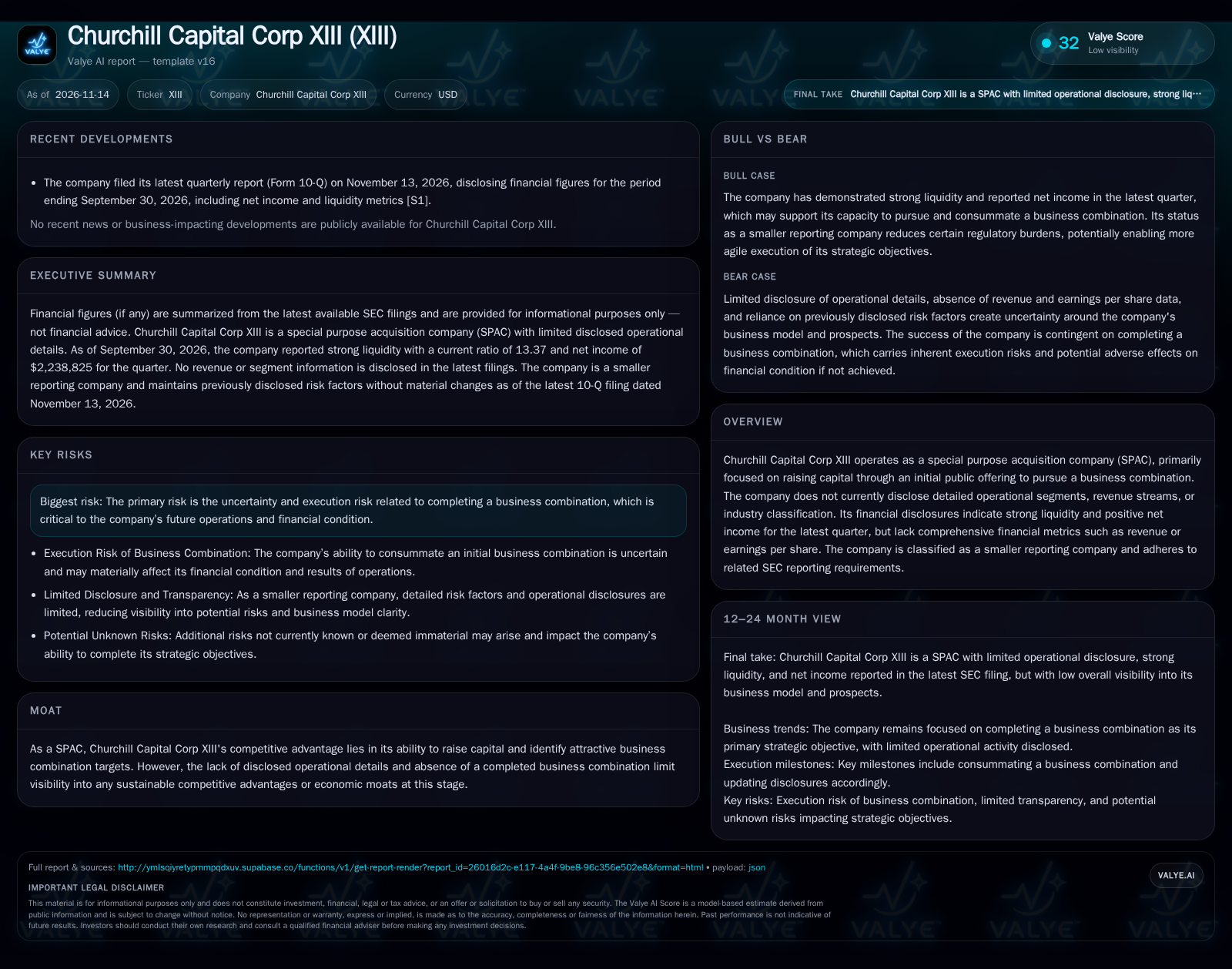
Churchill Capital Corp XIII is a newly listed SPAC with substantial cash preserved in trust and high short-term liquidity. The company has yet to announce a merger target, making its value proposition entirely contingent on successful deal execution within the Nasdaq-mandated timeframe. Investors should focus on combination progress, trust account status, and deal terms as the next phases unfold. [S1]
Churchill Capital Corp XIII stands at a familiar SPAC crossroads: flush with IPO proceeds but operating in a pre-acquisition holding pattern. With $414 million initially parked in trust and recent filings showing a robust current ratio, the company offers investors short-term liquidity and downside protection typical of the SPAC vehicle. However, with no announced merger target and the clock ticking on its 36-month Nasdaq deadline, Churchill’s future value creation depends entirely on its ability to source, negotiate, and close an attractive business combination. The next year will be decisive for both management and investors, as execution risk and deal quality become paramount.
IPO Proceeds, Trust Structure, and Liquidity: Where Churchill Capital Corp XIII Stands
Churchill Capital Corp XIII completed its IPO on August 3, 2026, raising $414 million through the sale of 41.4 million units at $10 each, including full exercise of the over-allotment option. Proceeds were placed in a U.S.-based trust account, a standard SPAC practice designed to protect shareholder capital while the company seeks a business combination. As of September 30, 2026, Churchill reports current assets of $1.05 million and current liabilities of just $78,000, producing a current ratio of 13.37. The company also reported quarterly net income of $2.24 million, which likely reflects interest income from trust investments rather than operating activity. No revenue or segment details are disclosed, and the company remains in a pre-deal holding pattern. [S1]
SPAC Economics: How Value Is Created (or Lost) Pre- and Post-Combination
As a SPAC, Churchill’s economics are initially straightforward: nearly all capital raised is held in trust and invested in low-risk U.S. government securities or money market funds, generating modest interest income. Operating expenses are minimal, limited to deal sourcing, legal, and administrative costs. The trust capital cannot be deployed until a merger is approved by shareholders, ensuring cash preservation but also capping upside until a deal is struck.
Value creation for Churchill’s public shareholders comes almost entirely from the quality and terms of the eventual business combination. If management sources an attractive, high-growth target at a favorable valuation, the merged entity could command a premium and drive post-deal returns. Conversely, overpaying for a target, failing to close a deal within the 36-month deadline, or seeing large-scale redemptions can erode or even destroy shareholder value.
The operating leverage for Churchill only emerges post-combination, when the acquired business’s revenue, margin profile, and capital needs come into play. Until then, Churchill’s economics remain largely fixed, with its only variable being the yield on trust assets and the cost of deal pursuit.
SPAC Competition: Sourcing Targets in a Crowded Market
Churchill Capital Corp XIII operates in a highly competitive SPAC landscape, with dozens of similar vehicles simultaneously seeking merger targets. Its main competitive lever is the size and reputation of its sponsor and management team, which can influence both the quality of targets available and the willingness of private companies to merge. However, there is no disclosure of a specific industry focus or unique sourcing advantage in current filings.
The SPAC market has seen cycles of target scarcity and heightened competition, with many high-quality private companies able to choose between SPACs, traditional IPOs, or private funding. Churchill must offer compelling deal terms, speed, and certainty of execution to win attractive targets. At the same time, shareholder redemptions and market skepticism about SPAC structures can weaken Churchill’s negotiating position if not carefully managed.
Substitution risk also looms: private companies may bypass SPACs altogether if public market conditions are unfavorable or if regulatory scrutiny increases. Thus, Churchill’s competitive position is fluid and highly dependent on market cycles and sponsor reputation rather than any structural moat.
What Success Looks Like: Securing a High-Quality Merger and Delivering Post-Deal Upside
The most favorable outcome for Churchill shareholders is the identification and successful completion of a merger with a high-growth, well-managed private company at a valuation that leaves room for public market appreciation. In this scenario, Churchill’s large trust account provides both the capital and the credibility to attract strong targets, while the SPAC’s reputation helps minimize redemptions and maximize post-merger trading liquidity.
Evidence that would confirm this scenario includes the announcement of a merger with a widely recognized company, positive market reaction to the deal terms, low redemption rates among public shareholders, and clear communication of the target’s growth and profitability profile. Early indications of PIPE (private investment in public equity) support or anchor investor commitments would further validate the quality of the transaction and the likelihood of post-deal value creation.
Most Likely Near-Term Trajectory: Deal Search, Execution Risk, and Capital Preservation
The most plausible scenario is that Churchill continues to evaluate potential merger targets over the coming quarters, incurring modest operating expenses while maintaining the bulk of IPO proceeds in trust. Given the competitive SPAC environment, deal timelines could stretch, and target quality may be mixed. If Churchill announces a merger, the outcome will depend on market sentiment, redemption levels, and the operational quality of the target.
Confirmation of this scenario would come from periodic SEC filings showing ongoing operating expenses, no revenue, and continued preservation of trust assets. A merger announcement with a mid-tier target, moderate redemptions, and a post-deal share price near or slightly above the $10 trust value would support this base case. Conversely, failure to announce a transaction or signs of diminished sponsor engagement would call this scenario into question.
When SPACs Stall: Deal Failure, Sponsor Fatigue, and Capital Return
The principal risk for Churchill is the failure to consummate a business combination within the 36-month Nasdaq window. In this scenario, the company would be required to return the bulk of trust capital to shareholders, minus limited permitted withdrawals for taxes and working capital. Shareholders would receive close to $10 per share, likely with minimal upside after accounting for time value and any redemptions.
Other downside drivers include overpaying for a low-quality target, which could result in heavy redemptions, poor post-merger trading, and dilution from warrants. Additional red flags would be sponsor disengagement, repeated deal terminations, or regulatory interventions that delay or derail merger prospects. Confirmation of the downside scenario would include missed self-imposed or regulatory deadlines, rising sponsor loans to fund operations, or shareholder activism pressing for liquidation.
Milestones That Will Define Churchill Capital Corp XIII’s Next Chapter
Announcement of a definitive merger agreement, including target identity, valuation, and transaction structure.
Level of public shareholder redemptions upon deal announcement and at the shareholder vote; a useful metric would be the percentage of shares redeemed, if disclosed.
Trust account balance and any permitted withdrawals for working capital or taxes; changes here may signal increased deal activity or operational stress.
PIPE or anchor investor participation in the merger, if any, as a proxy for institutional confidence in the target.
Sponsor loans or backstop arrangements to cover deal expenses or redemptions, which may indicate execution risk or sponsor commitment.
SEC filings detailing merger progress, deal terms, and post-combination financial projections.
Market reaction to the merger announcement, including share price performance relative to the $10 trust value.
Disclaimer: This is research-only, informational analysis and not investment advice. It may include AI-generated interpretation and general industry context. Always verify important details using primary sources.

Comments