
Genprex’s Gene Therapy Ambitions: Capital, Execution, and the Road to Clinical Validation
Genprex stands at a pivotal juncture, as its proprietary gene therapy candidates for diabetes and oncology move from promising preclinical data toward the clinical trial phase. With no current revenue and a finite cash runway, the company’s future hinges on successful financing, clinical execution, and the ability to carve out a defensible niche in a competitive biotech landscape.
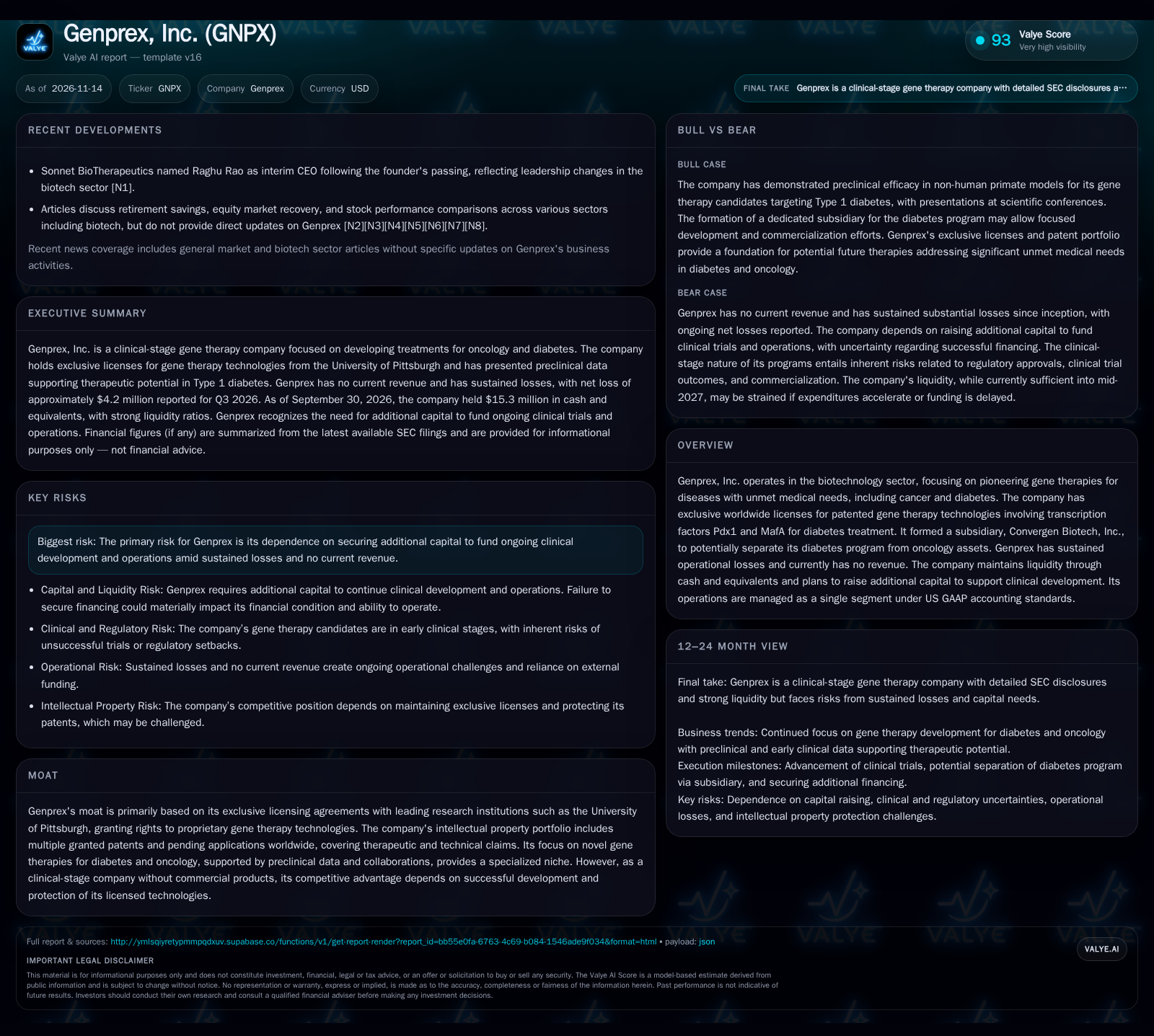
Genprex, Inc. is a clinical-stage biotech focused on gene therapies for diabetes and oncology, leveraging exclusive licenses for innovative technologies. The company has shown preclinical efficacy in non-human primate models for its diabetes program and has established a subsidiary to potentially separate this asset. [S1] [S2]
Genprex, Inc. is navigating the high-stakes transition from preclinical promise to clinical-stage execution in the field of gene therapy, with a focus on unmet needs in diabetes and oncology. The company’s exclusive licenses for patented gene therapy technologies and recent preclinical data underscore its scientific potential, but substantial operational losses and an absence of revenue underscore the urgency of securing additional funding. The formation of a dedicated subsidiary for its diabetes program hints at possible strategic maneuvers to unlock value, yet the path forward will be defined by Genprex’s ability to translate laboratory results into clinical milestones and ultimately, commercial viability.
Recent Developments Shape Genprex’s Strategic and Financial Position
Genprex currently operates without any commercial revenue and continues to incur significant net losses, with these losses persisting through Q3 2026. [S1] [S2]
The company has presented preclinical efficacy data for its diabetes gene therapy candidates in non-human primate models, demonstrating decreased insulin requirements and improved glucose tolerance. In February 2025, Genprex formed Convergen Biotech, Inc., a wholly owned subsidiary, to potentially separate its diabetes program from its oncology assets. This move may signal intentions to streamline operations or position the diabetes program for future partnering or spin-out. [S1]
No new product launches, clinical trial initiations, or major commercial partnerships have been reported in recent months, and Genprex remains a single-segment entity focused on gene therapy discovery and development.
Gene Therapy Business Model: High Fixed Costs and Delayed Revenue Realization
The economics of Genprex’s model are characterized by substantial upfront investment in research, preclinical studies, and clinical trials, followed by a long, uncertain path to regulatory approval and commercialization. With no products on the market and no recurring revenue streams, all spending is currently funded by equity capital or other external sources. The cost structure is dominated by R&D and general administrative expenses, with little operating leverage until a therapy achieves late-stage clinical success or commercial launch.
If Genprex’s therapies eventually reach the market, pricing power in gene therapy for diabetes or oncology could be significant due to high unmet needs and the potential for disease-modifying interventions. However, the path to monetization is long: revenue would depend on regulatory approval, payer acceptance, and physician adoption. Commercial mechanics for gene therapies typically involve high one-time or staged payments, with outcomes-based pricing models sometimes emerging for breakthrough therapies. Manufacturing for gene therapy is capital-intensive and may require significant investment in production scale-up or partnerships with contract manufacturing organizations.
The company’s need for additional capital is acute; without near-term revenue prospects, future fundraising will likely be dilutive to existing shareholders unless non-dilutive sources (e.g., grants, partnerships, or licensing deals) can be secured. The formation of a subsidiary for the diabetes program could facilitate asset-specific partnerships or out-licensing arrangements, though no such deals have been announced.
Intellectual Property and Niche Focus as Potential Competitive Shields—But Barriers Remain
Genprex’s main competitive assets are its exclusive worldwide licenses to gene therapy technologies developed at the University of Pittsburgh, including patents covering the use of Pdx1 and MafA transcription factors delivered via adeno-associated virus vectors for diabetes treatment. This intellectual property portfolio creates a potential barrier to entry for direct competitors targeting the same pathways or vectors.
However, the broader field of gene therapy is highly competitive and rapidly evolving. Large pharmaceutical companies, well-funded biotechs, and academic spinouts are all pursuing gene and cell therapies for diabetes and oncology, often with greater resources and more advanced clinical pipelines. Genprex’s competitive position will depend on its ability to demonstrate clear clinical advantages, secure regulatory exclusivity, and defend its IP against challenges or workarounds.
The formation of Convergen Biotech, Inc. suggests an attempt to create a more focused or flexible structure for the diabetes assets, which could be attractive to potential partners. Nonetheless, as a pre-commercial, single-segment entity, Genprex’s competitive moat remains theoretical until clinical data and commercial partnerships materialize.
How Clinical Success and Strategic Partnerships Could Unlock Transformational Value
A favorable outcome for Genprex would involve successful advancement of its gene therapy candidates through key clinical milestones, particularly for the diabetes program. If early human trials replicate the preclinical efficacy seen in non-human primates—demonstrating meaningful reductions in insulin requirements and improved glucose control—this could position Genprex as a leader in gene therapy for diabetes, a market with substantial unmet need and commercial potential.
The formation of Convergen Biotech, Inc. could facilitate a partnership or licensing deal for the diabetes program, providing non-dilutive capital and external validation. Upfront payments, milestones, and shared development costs from a strategic partner would extend the company’s runway and reduce financing risk. Successful clinical results could also attract investor interest, potentially enabling equity raises on favorable terms.
Confirmation of this scenario would come from initiation and positive readouts of early-phase clinical trials, partnership announcements, or licensing deals for the diabetes or oncology assets. Accelerated regulatory designations (such as Fast Track or Breakthrough Therapy) would further validate the company’s approach.
Clinical Progression and Financing Remain Uncertain as Genprex Pursues Its Pipeline
The most plausible near-term scenario is that Genprex continues to advance its diabetes and oncology gene therapy programs through preclinical and possibly early clinical phases, while seeking additional capital to fund these efforts. Given the absence of revenue and ongoing net losses, the company will likely need to raise funds via equity or convertible debt before Q2 2027.
Clinical trial initiation for the diabetes program may occur if regulatory clearances are obtained and financing is secured. However, progress is subject to the inherent risks of clinical development—delays, setbacks, or negative data could slow momentum. The oncology program’s trajectory is even less clear, with limited recent disclosures.
Evidence confirming the base scenario would include announcements of successful fundraising (even if dilutive), incremental clinical progress, and continued operational cost management. Falsification would come from a failure to secure financing, regulatory setbacks, or adverse preclinical/clinical results that halt program advancement.
Capital Shortfall or Clinical Setbacks Could Force Restructuring or Asset Sales
A negative scenario could unfold if Genprex is unable to secure additional capital before its cash resources are depleted, forcing the company to halt or significantly curtail development activities. Accelerated cash burn—due to higher-than-expected R&D costs, regulatory delays, or additional clinical requirements—would bring this risk forward.
Clinical setbacks, such as inconclusive or negative data in early human trials, could undermine the perceived value of the pipeline and further constrain fundraising options. In such a scenario, Genprex might be forced to pursue asset sales, out-licensing deals on unfavorable terms, or a distressed merger to preserve any remaining value.
Confirmation of this downside would come from public disclosures of failed or delayed clinical trials, inability to close new financing, or announcements of layoffs, program discontinuations, or fire-sale transactions. A useful falsification would be timely completion of a partnership, licensing deal, or successful capital raise.
Milestones and Signals That Will Define Genprex’s Strategic Trajectory
Progression of the diabetes gene therapy program into human clinical trials, including regulatory clearance and patient enrollment announcements.
Updates on the operational status, strategic direction, or potential partnership activity involving Convergen Biotech, Inc.
Announcements of non-dilutive funding, such as grants, partnerships, or licensing deals for either the diabetes or oncology programs.
Disclosure of new preclinical or clinical data—particularly human proof-of-concept results for the diabetes therapy.
Cash burn rate and any updates to the estimated operational runway, especially in the context of new trial initiations or expanded R&D activity.
Details of any equity or convertible debt offerings, including terms and potential dilution to existing shareholders.
Intellectual property developments, such as new patent grants, legal challenges, or changes in the status of exclusive licenses.
If disclosed, early insights into payer, provider, or patient interest in gene therapy approaches for diabetes and oncology, as this would inform commercial adoption potential.
Disclaimer: This is research-only, informational analysis and not investment advice. It may include AI-generated interpretation and general industry context. Always verify important details using primary sources.

Comments