
Tailwind 2.0 Acquisition Corp.: Countdown to a Critical SPAC Milestone in the Electron Economy
Tailwind 2.0 Acquisition Corp. has raised capital and set its sights on the intersection of energy and compute infrastructure. With a defined deadline, no target business selected, and regulatory scrutiny mounting, the company’s fortunes hinge on sourcing and executing a business combination before its window closes.
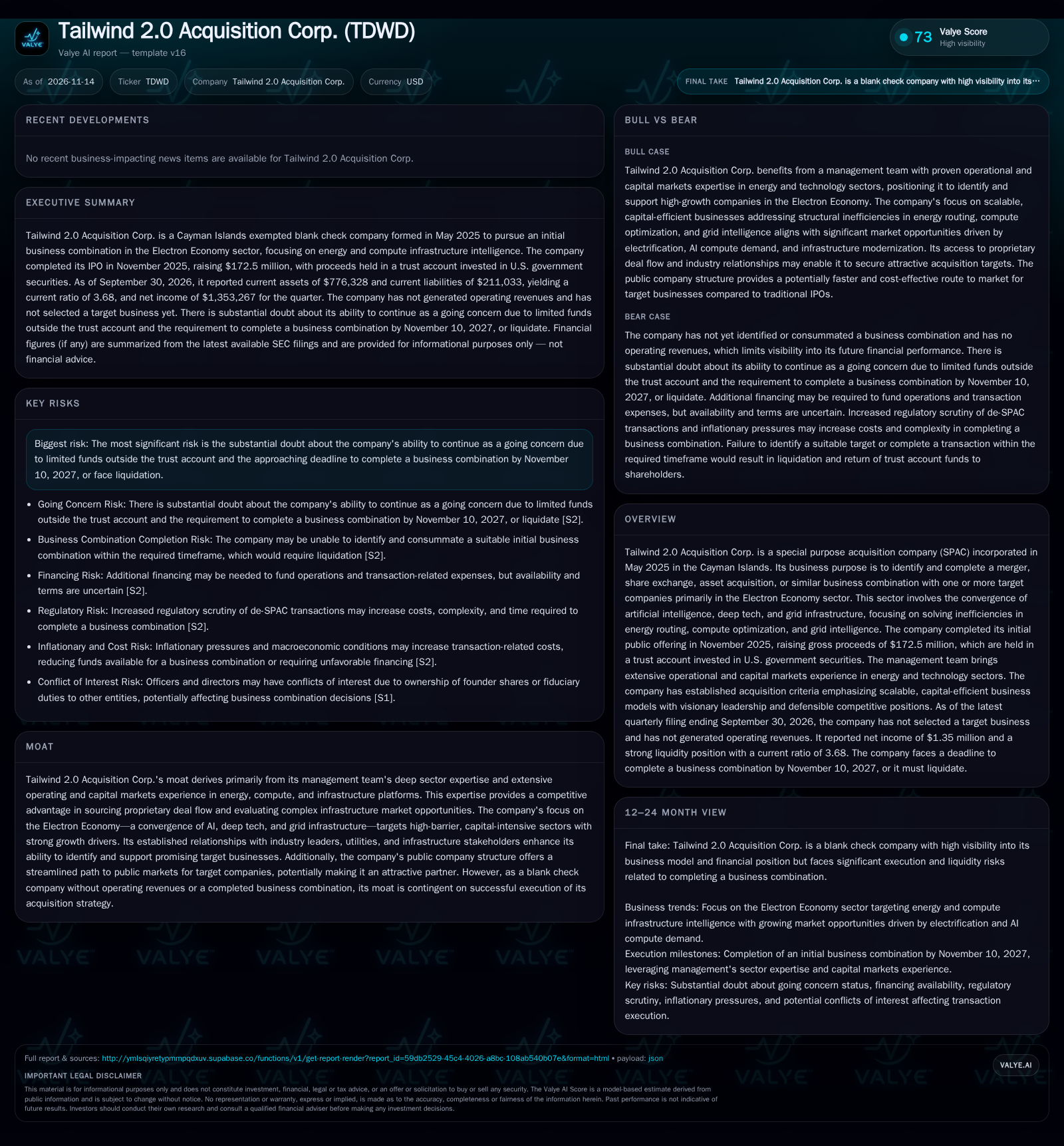
Tailwind 2.0 Acquisition Corp. is a SPAC targeting the Electron Economy, with $172.5 million raised and a business combination deadline of November 2027. The company has not selected a target, faces going concern risks due to limited funds outside the trust, and may require additional financing. Execution against regulatory, market, and timing constraints will determine whether it can deliver value before liquidation looms. [S1] [S2]
Tailwind 2.0 Acquisition Corp. exemplifies the promise and peril of the modern SPAC model. With a $172.5 million war chest and a sector focus on the intelligence layer of energy and compute infrastructure, the company is positioned to capitalize on secular trends in electrification and AI-driven grid modernization—if it can identify and execute a business combination in time. However, the absence of a target, mounting regulatory hurdles, and finite financial resources outside the trust account mean that execution risk is front and center. The next twelve months will reveal whether Tailwind’s management can deliver on its ambitious thesis or face the prospect of liquidation.
Deadline Pressure, Capital Setup, and Execution Challenges Shape Current Outlook
Tailwind 2.0 Acquisition Corp. stands at a critical juncture: it must complete a business combination by November 10, 2027, or face liquidation and return of trust account funds to shareholders. As of September 30, 2026, the company has not identified a target business and does not generate operating revenue. The $172.5 million raised in its IPO and private placement is held in a trust account invested in U.S. government securities, with a reported net income of $1.35 million for the quarter—driven by interest, not operations. Substantial doubt about going concern status has been raised due to limited funds outside the trust and a ticking deadline. These facts put the spotlight on Tailwind’s ability to source, negotiate, and close a transaction under time, regulatory, and financial pressure. [S1] [S2]
Mechanisms Behind Value Creation and Erosion Within the SPAC Framework
Tailwind 2.0’s economics are currently defined by its SPAC structure: it generates non-operating income from interest on trust account assets, while incurring public company costs and due diligence expenses. The real business model will only take shape if and when a business combination is consummated. At that point, the economics depend on the acquired company’s revenue mix, margins, scalability, and capital intensity—factors that are currently unknown. SPACs typically seek targets with high growth potential, scalable business models, and capital efficiency, aiming to deliver value through the public listing premium and operational support.
However, the economics of the SPAC sponsor and public shareholders can diverge. If no deal is completed, the trust is returned (minus expenses), and sponsors’ founder shares become worthless. If a deal is struck but underperforms, dilution from founder shares, warrants, and potential PIPE financing can erode shareholder value. Additional financing may be required to close a transaction or fund the post-merger company, and terms are uncertain. The economics are thus highly path-dependent: value creation hinges on finding a target with strong fundamentals and executing a deal under favorable terms before time and cash run out. [S2]
Operating leverage and capital needs will depend entirely on the eventual target’s business model. If Tailwind acquires a capital-light, software-driven platform, operating leverage could be substantial. Conversely, if the target is asset-intensive (e.g., grid hardware or energy infrastructure), capital requirements and execution risk rise. Without a target, these remain conditional scenarios.
Tailwind’s Competitive Edge: Target Sourcing, Relationship Building, and Navigating Regulations
Tailwind 2.0’s stated edge lies in its management team’s sector expertise and industry relationships in the energy, compute, and infrastructure domains. This may allow it to access proprietary deal flow and evaluate complex opportunities in the Electron Economy—businesses focused on energy routing, compute optimization, and grid intelligence. The competitive set includes other SPACs with similar sector focus, private equity, venture capital, and strategic acquirers all vying for high-quality assets in a crowded market.
The SPAC’s public listing offers target companies a faster and potentially less cumbersome route to public markets compared to a traditional IPO, which can be attractive for founders seeking capital and liquidity. However, post-2022, regulatory scrutiny of de-SPAC transactions has increased, raising the bar for due diligence, transparency, and post-merger performance. This makes the competitive environment more challenging, as targets may command higher valuations or opt for alternative funding routes.
Ultimately, Tailwind’s competitive position will be tested by its ability to translate sector expertise and relationships into a proprietary, actionable deal that meets its quality and valuation criteria under a compressed timeline.
Successful Target Acquisition and Execution Could Propel Tailwind Forward
The favorable scenario for Tailwind 2.0 sees management leveraging its sector experience and network to source a high-quality target in the Electron Economy—such as a company with a defensible position in energy software, AI-driven grid management, or compute optimization. If the SPAC can negotiate a disciplined valuation and structure an attractive deal (possibly with PIPE investment to supplement trust funds), it could bring a growth business public, unlocking value for shareholders and sponsors alike.
Confirmation of this upside would come from announcements of definitive agreement with a well-regarded, scaling business, positive PIPE participation (if any), and market validation upon deal closure. Evidence of strong post-merger fundamentals—revenue growth, margins, customer traction—would further validate the scenario.
Falsification would occur if the announced target is of marginal quality, if the deal is highly dilutive, or if post-merger performance disappoints, leading to redemptions or poor trading.
Expected Trajectory: Navigating Time Constraints and Market Forces
The most plausible trajectory is that Tailwind 2.0 continues to evaluate targets over the next several quarters, incurring ongoing operating and due diligence expenses. As the deadline nears, the pressure to announce a combination mounts, possibly leading to a tradeoff between deal quality and timing. The base scenario anticipates that if a business combination is proposed, it may be with a solid but not category-defining business, potentially requiring PIPE or other financing to close.
Deal terms could reflect the changed SPAC environment: higher redemption rates, more stringent regulatory review, and possible dilution from sponsor and financing structures. Confirmation would come from an executed LOI or definitive agreement, regulatory filings, and the company’s ability to secure shareholder approval and financing. Falsification would be failure to announce a transaction as the deadline approaches, or inability to close due to redemptions or regulatory blocks.
Consequences of a Failed Deal: Liquidation Risks and Sponsor Financial Impact
The adverse scenario is straightforward: Tailwind 2.0 fails to identify or consummate a business combination by November 10, 2027. In this case, the company would be required to liquidate and return trust account funds to shareholders, with sponsors’ founder shares and warrants expiring worthless. This outcome would reflect the challenges of increased competition for targets, heightened regulatory scrutiny, inflationary cost pressures, and possibly an unfavorable market environment for de-SPACs.
Confirmation would be a lack of deal announcements as the deadline nears, disclosures of unsuccessful negotiations, or explicit statements about liquidation plans. Falsification would be a timely deal announcement, regulatory approval, and successful closure.
Factors Influencing Tailwind 2.0’s Potential to Fulfill Its SPAC Objectives
Announcement of a letter of intent (LOI) or definitive agreement with a target business, especially in the Electron Economy sector.
Investor redemptions as a percentage of shares outstanding upon deal announcement—if disclosed—would reveal market confidence.
PIPE (private investment in public equity) participation and terms, if required to supplement trust funds for the business combination.
Regulatory feedback, SEC reviews, or material delays in de-SPAC filings and approvals.
Composition and quality of the proposed target’s management team and board—would help test the thesis of sector expertise.
Projected pro-forma financials of the target (revenue, EBITDA, growth rates), if disclosed in filings.
Operating cash burn and liquidity outside the trust account as the deadline approaches.
Disclaimer: This is research-only, informational analysis and not investment advice. It may include AI-generated interpretation and general industry context. Always verify important details using primary sources.

Comments