
Natural Alternatives International: Margin Pressures, Strategic Partnerships, and the Road to Profitability
Despite maintaining multi-year manufacturing relationships and achieving periodic sales growth, Natural Alternatives International faces persistent net losses and margin compression. The company’s ability to translate strategic partnerships and clinical validation into sustainable profitability remains the central question as competition intensifies and operational costs rise.
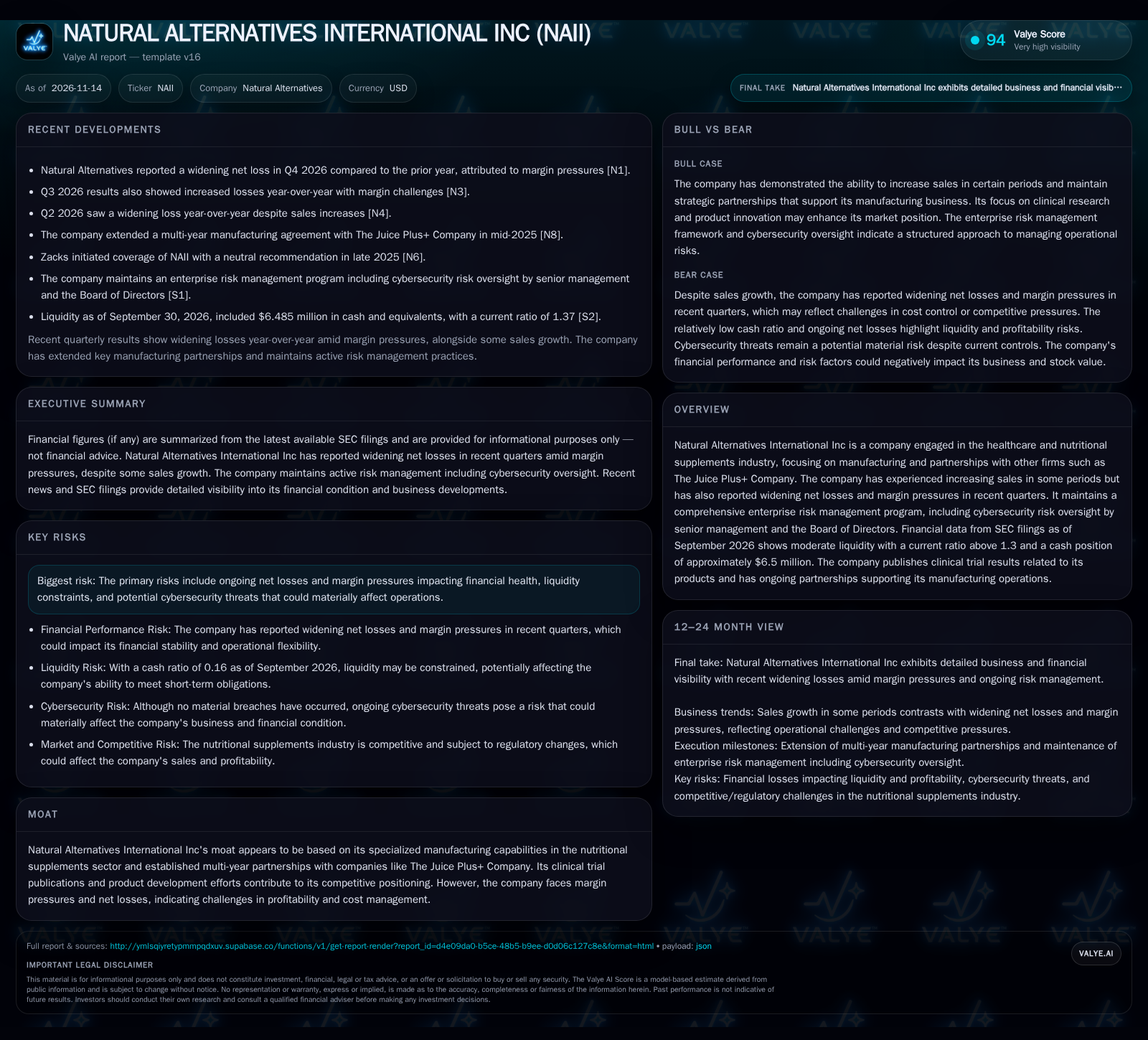
Natural Alternatives International has continued to post net losses and experience margin pressures despite select periods of sales growth and the extension of key manufacturing agreements. The competitive landscape and cost structure will likely determine whether recent losses are cyclical or structural. [N1] [N3] [N4] [N8] [S2]
Natural Alternatives International, a manufacturer in the nutritional supplements sector, finds itself at a crossroads: while strategic partnerships and clinical research support its industry credibility, persistent net losses and margin pressures have raised concerns about the sustainability of its business model. The extension of a multi-year agreement with a major partner and periods of sales growth suggest ongoing demand, yet the company’s ability to convert this demand into profit remains elusive. As competition and operational costs intensify, Natural Alternatives’ future will likely be decided by its capacity to manage costs, maintain key relationships, and adapt to shifting industry dynamics.
Recent Financial Trends and Strategic Moves Shape the Outlook
The company’s most recent filings reveal a net loss of $2.381 million as of September 25, 2026, with basic and diluted EPS at -$0.41 per share. This extends a trend of widening losses observed throughout fiscal 2026, attributed primarily to margin pressures rather than declining sales. In fact, Natural Alternatives reported a 15% year-over-year sales increase in Q4 FY25, indicating that demand for its manufacturing capabilities and products persists despite profitability issues. [N1] [N3] [N4] [N7] [S2]
A significant operational development was the extension of a multi-year manufacturing partnership with The Juice Plus+ Company in 2025, a relationship that likely underpins a meaningful portion of the company’s revenue base and production volume.At the same time, the company reported $6.485 million in cash and equivalents and a current ratio of 1.37 as of September 30, 2026, reflecting reported liquidity position but a reported cash ratio of 0.16. [N8] [S2]
These facts highlight a business with continued market relevance and partnership depth, but with ongoing challenges in cost management and operational leverage.
How Volume Growth Collides with Margin Compression in Nutritional Manufacturing
Natural Alternatives International operates as a contract manufacturer and developer within the nutritional supplements sector. Revenue is primarily generated from manufacturing agreements with third-party brands, such as The Juice Plus+ Company, and potentially from proprietary products supported by clinical research. In this model, top-line growth is driven by production volume, customer retention, and the ability to attract new or expanded contracts.
However, the company’s recent results suggest that rising input costs, labor pressures, or pricing competition are eroding gross margins. Typically, contract manufacturers operate on thin margins and depend heavily on operational efficiency, procurement scale, and process optimization to capture incremental profit as volumes rise. If cost increases—whether from raw materials, labor, or regulatory compliance—outpace the company’s ability to pass through price increases to customers, margin compression can become structural.
Fixed costs in such manufacturing operations (facilities, equipment, regulatory/compliance overhead) may offer operating leverage if volumes grow substantially, but persistent losses despite sales growth suggest that variable costs or price concessions are overwhelming this leverage. Capital requirements remain moderate for ongoing operations, but persistent negative net income could eventually constrain investment in capacity, R&D, or technology upgrades if not addressed.
Competitive Dynamics: Manufacturing Scale, Partnership Depth, and the Threat of Substitution
Natural Alternatives’ competitive positioning relies on its specialized manufacturing capabilities, regulatory compliance, and ability to meet the quality standards of established supplement brands. Multi-year partnerships, such as the extended agreement with The Juice Plus+ Company, provide a degree of revenue stability and validate the company’s operational reliability. Clinical trial publications offer additional credibility and may help differentiate its offerings in a crowded market.
Nevertheless, the contract manufacturing space is highly competitive, with numerous peers ranging from large-scale global contract manufacturers to niche players serving specific supplement categories. Price-based competition is intense, and customers often have the ability to switch suppliers if cost, quality, or service expectations are not met. The threat of vertical integration—where major supplement brands bring manufacturing in-house—or the emergence of lower-cost international competitors could further pressure margins.
Product innovation and clinical validation offer some insulation, but unless these features translate into pricing power or customer stickiness, they may not be enough to offset industry-wide cost pressures. Ultimately, the sustainability of Natural Alternatives’ partnerships and its ability to command premium pricing will be central to its competitive moat.
Margin Recovery and Expanded Partnerships Transform the Profit Profile
A favorable outcome for Natural Alternatives would involve a combination of margin stabilization and new contract wins. If the company can renegotiate terms with existing partners to reflect higher input costs, or successfully implement operational efficiencies that lower its cost base, gross margins could begin to recover. Additional upside could come from leveraging its clinical research reputation to secure new manufacturing agreements with premium brands or expand into higher-margin proprietary products.
Evidentiary signals supporting this scenario would include sequential improvement in gross margin percentage, announcements of new or expanded multi-year contracts, and a return to positive net income. If disclosed, a rising average revenue per customer, improvement in utilization rates, or cost-per-unit reductions would further confirm operational progress.
Falsification would come from continued or worsening margin compression, inability to renew or expand key partnerships, or further deterioration in net income despite sales growth.
Sales Growth Partially Offsets Margin Headwinds, but Losses Persist
The most plausible near-term scenario is that Natural Alternatives continues to experience modest sales growth from existing and extended partnerships, but that ongoing cost pressures keep margins under strain.
Balance-sheet stability could be maintained as long as working capital remains positive and no major negative shocks occur. However, unless there are clear signs of margin improvement or a shift in customer contract economics, the company remains vulnerable to further competitive or cost-driven pressures.
Evidence confirming this scenario would be continued reports of sales growth alongside flat or negative net income, stable but unspectacular liquidity ratios, and no major new contract announcements. Falsification would be signaled by either a rapid deterioration in liquidity or a sudden, sustained improvement in profitability.
Structural Margin Erosion Leads to Financial Strain and Partnership Risk
In a negative scenario, margin pressures could intensify due to further increases in input costs, labor expenses, or price concessions required to retain major customers. If the company is unable to pass these costs through or drive sufficient operating efficiencies, losses could deepen, eventually leading to cash burn that threatens working capital adequacy.
A key risk is the potential loss or downsizing of major partnerships—such as with The Juice Plus+ Company—either due to competitive bids, customer insourcing, or dissatisfaction with pricing or service. Loss of such anchor relationships could trigger a downward spiral of volume loss, further margin compression, and reduced negotiating power with suppliers.
Confirmation of this scenario would include accelerating net losses, declining cash reserves, breaches of financial covenants (if disclosed), or public disclosure of lost or reduced customer contracts. Falsification would require clear evidence of margin stabilization or new contract wins offsetting the loss of any major relationship.
Performance Drivers and Warning Signs for Natural Alternatives’ Next Phase
Gross margin trends: Improvement or further deterioration in gross margin percentage would provide direct evidence of success or failure in managing input costs and pricing.
Net income trajectory: Sustained movement toward profitability, or continued/accelerating losses, will be crucial in determining business viability.
Contract pipeline: Announcements of new, renewed, or expanded manufacturing agreements, especially with anchor customers, would signal commercial momentum.
Customer concentration (if disclosed): Shifts in revenue contribution from top customers would help assess partnership risk and revenue stability.
Clinical research output: New clinical trial publications or product innovations could strengthen differentiation and support new business wins.
Cybersecurity incidents: While no material breaches have been reported, any future disclosure of a material breach could have operational and reputational impacts.
Operational efficiency metrics (if disclosed): Data on cost-per-unit, plant utilization, or supply chain optimization would help test whether margin improvement efforts are gaining traction.
Disclaimer: This is research-only, informational analysis and not investment advice. It may include AI-generated interpretation and general industry context. Always verify important details using primary sources.

Comments