
Oncolytics Biotech: Pelareorep’s Promise and the Race Against Financial Constraint
Oncolytics Biotech is advancing its proprietary viral immunotherapy pelareorep through clinical trials in hard-to-treat cancers, supported by recent FDA alignment and strategic partnerships. However, acute funding challenges and Nasdaq listing risks create a high-stakes environment where clinical momentum must rapidly translate into tangible financing or partnership outcomes.
Oncolytics Biotech’s lead asset, pelareorep, continues to post encouraging clinical signals in gastrointestinal and breast cancers, with the company achieving FDA alignment on registrational studies and forming new partnerships. The next six to twelve months will test whether pelareorep’s promise can be converted into survival and growth for the company.
Oncolytics Biotech stands at a pivotal juncture: its experimental immunotherapy pelareorep has demonstrated promising clinical results in several cancer indications and recently achieved key regulatory alignments and partnerships. With a Nasdaq delisting threat looming, the company must urgently convert its scientific momentum into new capital or transformative deals. The next phase will reveal whether pelareorep’s scientific advances can be parlayed into business viability—or whether financial constraints will halt progress before pivotal data arrives.
Clinical Progress and Acute Financial Pressure Define the Present
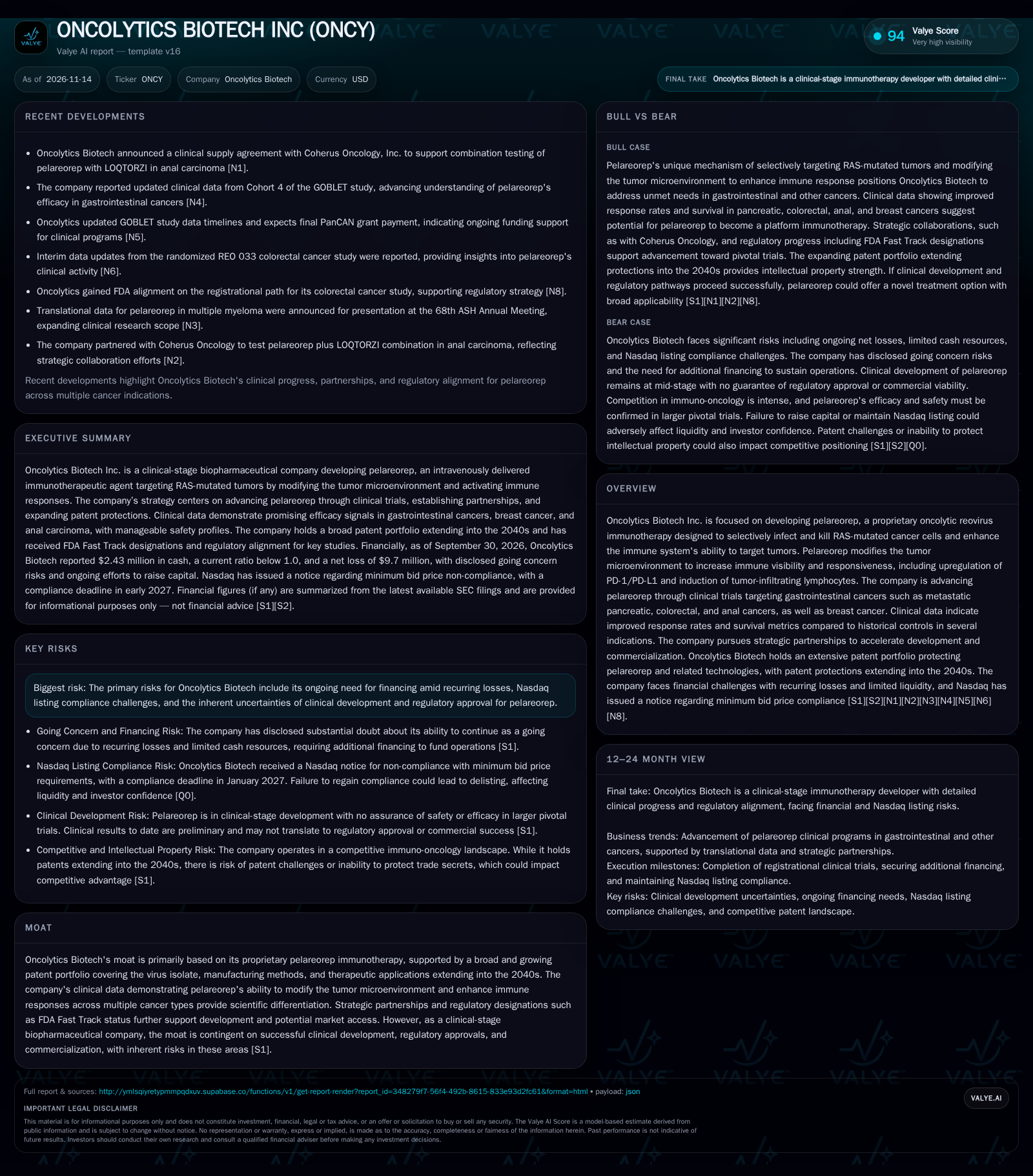
Oncolytics Biotech’s most immediate developments are a blend of clinical and financial turning points. The company has reported updated clinical data from the GOBLET study in gastrointestinal cancers, including a 62% objective response rate and 85% disease control rate for pelareorep-based combinations in first-line metastatic pancreatic cancer—metrics that exceed historical standards in this setting [S1] [N4]. In parallel, Oncolytics has secured FDA alignment on the registrational path for its colorectal cancer program and entered a clinical supply agreement with Coherus Oncology to test combination regimens in anal carcinoma [N1] [N8]. These milestones provide near-term clinical and regulatory momentum.
However, as of September 30, 2026, Oncolytics reported just $2.43 million in cash and equivalents, current liabilities of $5.92 million, and a current ratio of 0.89, alongside a net loss of $9.7 million for the period [S2]. The company has explicitly disclosed going concern risks due to recurring losses and the need for additional financing to fund operations [S1] [S2]. Compounding this, Nasdaq has issued a notice of non-compliance with minimum bid price requirements, setting a January 2027 deadline for corrective action.
Pelareorep’s Commercial Model: Platform Potential, Capital Demands, and Unproven Revenue Path
Oncolytics Biotech’s business model is typical of clinical-stage biopharma: value is created by advancing a proprietary asset—here, pelareorep—through proof-of-concept and registrational trials, with the goal of either securing lucrative partnerships, licensing deals, or direct commercialization if approved. Pelareorep’s mechanism—selective targeting of RAS-mutated tumors and immune activation—could position it as a platform therapy across multiple cancer types if efficacy and safety are confirmed in late-stage trials [S1].
However, the economics are fundamentally high-risk: there is no commercial revenue, and the company is reliant on external financing, grants, and partnership payments to fund expensive multi-arm clinical programs. Operating leverage is negative at this stage, as R&D and overheads are fixed against zero product revenue, and additional capital outlays are required to advance studies to pivotal phases. The need for ongoing patent prosecution and regulatory filings adds to the cash burn. If pelareorep reaches approval, the commercial model could pivot to high-margin specialty drug pricing, but this scenario remains contingent on late-stage trial success and favorable reimbursement dynamics.
Differentiation Amid Intense Immuno-Oncology Rivalry
Oncolytics operates in a hyper-competitive landscape dominated by large pharmaceutical and biotech firms with deep pipelines in immuno-oncology. Pelareorep’s scientific differentiation lies in its dual mechanism: direct tumor cell lysis and immune microenvironment modulation, particularly in turning 'cold' tumors 'hot' to enable checkpoint inhibitor responsiveness [S1]. This could confer a clinical edge in tumor types where immunotherapies have struggled.
The company’s patent portfolio—137 patents with protections into the 2040s—provides a temporal moat, but this is conditional on successful clinical validation and regulatory approval. The existence of FDA Fast Track designations and new partnerships (e.g., with Coherus Oncology) indicates some external validation, but larger players with rival oncolytic viruses, bispecifics, or engineered cell therapies could outcompete pelareorep if their products demonstrate greater efficacy, safety, or commercial traction. Switching costs for oncologists are low unless a therapy demonstrates clear survival or quality-of-life advantages.
Rapid Clinical Wins and Strategic Deals Unlock Value
The most optimistic scenario is that Oncolytics’ ongoing trials—particularly in metastatic pancreatic, colorectal, and anal cancers—deliver clear, reproducible survival and response benefits in larger cohorts, validating pelareorep as a first-in-class or best-in-class immunotherapy platform. If upcoming data from GOBLET and REO 033 studies confirm the early efficacy signals and safety profile, it could drive either a substantial licensing deal, strategic acquisition, or significant equity raise on favorable terms.
Confirmation of this scenario would include: statistically significant improvements in overall survival and progression-free survival in randomized studies; rapid enrollment and positive regulatory feedback on pivotal trial designs; and the announcement of new, non-dilutive funding or major partnerships that alleviate near-term cash constraints. A marked increase in analyst and biopharma partner interest would also be supportive.
Incremental Clinical Progress, Ongoing Financing Struggle
The most plausible near-term outcome is a continuation of measured clinical progress—incremental positive data from ongoing studies and additional regulatory milestones—paired with continued financial stress. Oncolytics may secure small-scale bridge financing or grants to extend runway, but the scale may be insufficient to fully fund pivotal trials without major dilution or partnership concessions.
Evidence supporting this scenario would be modest but positive clinical updates (e.g., disease control rates, manageable adverse events), further FDA guidance or Fast Track designations, and announcements of smaller partnership or grant tranches rather than transformational deals. If the company executes a reverse stock split or other technical actions to maintain Nasdaq listing but does not address underlying cash needs, this would further reinforce the base case.
Liquidity Crisis or Clinical Setbacks Force Restructuring
The principal adverse scenario is that Oncolytics fails to secure new funding before cash is exhausted, leading to workforce reductions, program slowdowns, or loss of Nasdaq listing. Alternatively, if emerging clinical data from pivotal cohorts are equivocal or negative—showing no significant benefit over standard-of-care—partner and investor interest could evaporate, compounding financial distress.
Confirmation of this scenario would include missed payroll or payment obligations, disclosure of halted or delayed studies, resignation of key executives, or formal delisting from Nasdaq. A failed or deeply discounted financing, or negative top-line results from Phase 2/3 studies, would also support the downside thesis.
Milestones That Will Decide Oncolytics’ Fate in the Coming Year
Updates on cash and equivalents, burn rate, and disclosures regarding new financing arrangements or going concern status in quarterly filings [S2].
Interim and final efficacy and safety data from ongoing GOBLET, REO 033, and other registrational studies—particularly overall survival and progression-free survival metrics, if disclosed.
Announcements of new strategic partnerships, licensing deals, or grant payments that materially extend financial runway—especially non-dilutive funding.
Nasdaq compliance developments, including reverse split execution or extension of compliance deadlines, and any communications from the exchange regarding listing status.
FDA regulatory milestones, such as additional Fast Track designations, Special Protocol Assessments, or agreement on pivotal trial endpoints.
Patent litigation, opposition proceedings, or expiration events relating to the core pelareorep IP estate, if disclosed.
Turnover or additions to senior clinical, regulatory, or executive leadership, as these may signal confidence or distress.
Enrollment rates and site activation numbers for pivotal clinical trials, as rapid accrual would signal investigator and patient enthusiasm.
Disclaimer: This is research-only, informational analysis and not investment advice. It may include AI-generated interpretation and general industry context. Always verify important details using primary sources.

Comments