
CO2 Energy Transition Corp.: SPAC Survival Tactics After Massive Redemptions and a Collapsed LOI
CO2 Energy Transition Corp.
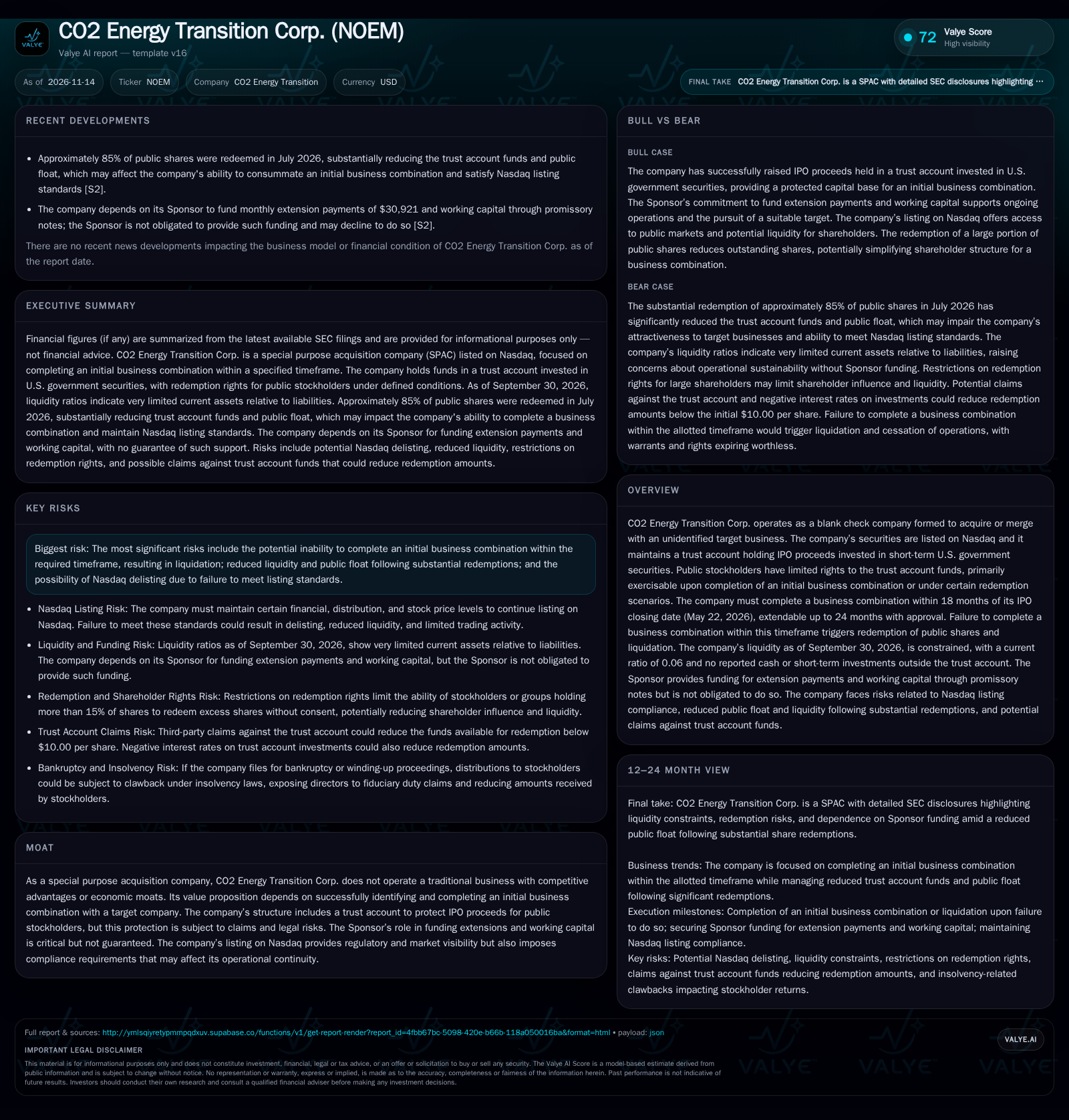
CO2 Energy Transition Corp. is a SPAC in a precarious position: more than 85% of its public shares were redeemed in July 2026, sharply reducing its trust account and public float. The company now operates with almost no liquidity outside the trust, depends entirely on its Sponsor for monthly extension payments and working capital, and recently saw a potential business combination fall through when a non-binding LOI expired without a deal. With Nasdaq listing at risk and a hard deadline for a merger or liquidation, the next few months will determine whether the SPAC survives or winds down [S2].
CO2 Energy Transition Corp. exemplifies the late-cycle SPAC squeeze: after a wave of redemptions that drained over 85% of its public shares and trust account, the company now faces a race against time. The next several months are a test of both dealmaking agility and financial endurance, as Nasdaq listing and shareholder value hang in the balance [S2].
Redemptions, Sponsor Reliance, and a Failed LOI Define Today’s Reality
CO2 Energy Transition Corp. is now operating in a distinctly high-risk phase. In July 2026, approximately 85% of its public shares were redeemed, leading to an aggregate payout of over $62 million and leaving a drastically reduced public float and trust account balance. As of September 30, 2026, the company reported current assets of just $87,469 against current liabilities of $1,475,192, with a cash ratio of zero—meaning it has essentially no liquidity apart from the trust account and is heavily reliant on its Sponsor for monthly extension payments and working capital. The Sponsor has funded recent extensions via promissory notes, but there is no obligation to continue. Further compounding pressure, a non-binding letter of intent for a business combination expired in September 2026 without reaching a definitive agreement, leaving the SPAC still searching for a viable deal as the clock ticks toward forced liquidation and potential Nasdaq delisting [S2].
SPAC Economics in Distress: Funding, Costs, and the Merger Imperative
The economic model of CO2 Energy Transition Corp. is now almost entirely divorced from traditional business operations and is instead a function of SPAC-specific mechanics. The trust account, originally seeded with IPO proceeds invested in U.S. Treasuries, is the principal asset, but has been sharply diminished by redemptions. Post-redemption, the company’s ability to fund ongoing costs—such as Nasdaq fees, legal and audit expenses, and monthly extension payments—depends on Sponsor promissory notes. These notes are not mandatory, introducing real uncertainty about the company’s ability to remain a going concern if the Sponsor withdraws support.
Fixed costs, such as listing maintenance and administrative expenses, are now proportionally high relative to the remaining asset base. The extension structure requires monthly infusions (recently $30,921 per month) into the trust to keep the SPAC alive, but these are effectively sunk costs if no merger is completed. The only meaningful upside comes from the successful completion of a business combination, which could unlock value from the trust and associated founder shares or warrants. However, with the public float and trust so reduced, the economic appeal for both potential targets and existing shareholders is now far less compelling than at IPO. The SPAC faces a classic negative operating leverage situation: every month without a deal erodes remaining options and Sponsor patience, while fixed obligations persist [S2].
Shrinking Float, Diminished Trust: How Redemption and Scale Undercut Deal Attractiveness
CO2 Energy Transition’s competitive posture in the SPAC market has weakened sharply post-redemptions. With only a small fraction of its original trust account and public float remaining, the SPAC is less attractive to potential targets that might seek a robust public listing and access to substantial capital. In the current environment, SPACs with high redemption rates often become less competitive versus peers that have preserved a larger cash pool and broader shareholder base. For many private companies, merging with such a SPAC offers minimal capital infusion and reduced market visibility, undermining the value proposition relative to direct listings, private financings, or mergers with healthier SPACs.
Furthermore, the requirement for Sponsor-funded extensions introduces additional uncertainty for would-be targets, who may question the ongoing viability of the platform. The risk of Nasdaq delisting—triggered by reduced float, sustained low share price, or failure to meet distribution requirements—further erodes negotiating leverage. In aggregate, CO2 Energy Transition is now competing primarily against other distressed or late-cycle SPACs, with its only potential edge being the willingness of its Sponsor to accept a less favorable deal or inject additional capital to sweeten terms for a target [S2].
Deal Salvage: What a Last-Minute Business Combination Could Unlock
The main upside scenario for CO2 Energy Transition is a successful business combination before the extended deadline, enabled by continued Sponsor funding. If the company can secure a merger with a private business willing to accept a smaller trust account and public float—perhaps in exchange for creative deal structuring, Sponsor backstopping, or shared upside through earn-outs—there remains a path to value realization. In this scenario, the Sponsor’s willingness to keep funding extensions is crucial, as is the ability to convince a target that public listing benefits (such as liquidity, potential warrant upside, or future capital raising) outweigh the limited immediate cash proceeds.
Confirmation would come from the announcement of a definitive merger agreement, evidence of Sponsor support for additional extension payments, and a target company willing to accept the reduced capital environment. Falsification would be signaled by Sponsor withdrawal, the inability to fund further extensions, or a public statement from the company that merger negotiations have ceased or all options have been exhausted.
Stalemate and Attrition: The Most Likely Road to Liquidation
Given the scale of redemptions, near-zero liquidity, and the expiration of the last LOI without a deal, the most plausible scenario is that CO2 Energy Transition will be unable to secure a business combination that meets regulatory and shareholder requirements. Unless the Sponsor is unusually motivated to keep funding monthly extensions, the company may run out of working capital or lose its Nasdaq listing before a deal can be reached. In this outcome, the SPAC is likely to proceed to mandatory redemption and liquidation, with residual trust account funds distributed to remaining public shareholders. Warrants and rights would expire worthless.
Evidence supporting this scenario includes ongoing Sponsor hesitancy, lack of new merger announcements, and further erosion of public float or trust assets. It would be contradicted if the company rapidly announced a new, credible definitive agreement with a target and demonstrated continued Sponsor financial support.
Accelerated Collapse: Sponsor Pulls Support and Delisting Follows
The most adverse scenario involves the Sponsor ceasing to fund extension payments or working capital, which would immediately trigger a breach of the SPAC’s extension requirements and force an accelerated liquidation. In this scenario, the company could also face Nasdaq delisting due to non-compliance with minimum listing standards (such as public float, number of shareholders, or share price), further depressing any residual value for shareholders. If third-party claims arise against the trust account or if negative interest rates reduce the trust’s value, liquidation proceeds could fall below the expected $10 per share.
Confirmation would come from missed or late extension payments, Sponsor communications indicating funding cessation, or formal Nasdaq delisting notices. This scenario is further supported if the company publicly discloses that it no longer has the resources to pursue a business combination or maintain listing compliance.
Milestones That Will Determine Whether CO2 Energy Transition Survives or Liquidates
Announcement of a definitive business combination agreement; this is the primary catalyst for any positive outcome.
Sponsor funding of each monthly extension payment—if disclosed—since continued operation depends directly on these infusions.
Nasdaq listing compliance notices or updates, particularly regarding minimum public float, share price, or distribution requirements.
Any new or renewed letter of intent with a target company, indicating live deal negotiations.
Changes in trust account balance due to additional redemptions, claims, or negative interest rates—would help test the risk to per-share liquidation value.
Shareholder communications regarding redemption rights, changes in certificate of incorporation, or potential amendments to trust terms.
Disclaimer: This is research-only, informational analysis and not investment advice. It may include AI-generated interpretation and general industry context. Always verify important details using primary sources.

Comments