
Koil Energy Solutions: Managing Offshore Cycles with Focused Subsea Engineering
Koil Energy Solutions delivers specialized subsea equipment and services to the global offshore energy sector, balancing industry cyclicality and concentrated customer exposure with technical innovation and a foothold in renewables. The company’s recent profitability, proprietary product lines, and ISO 9001-certified operations underpin its competitive standing, but customer and commodity risks remain central to its outlook.
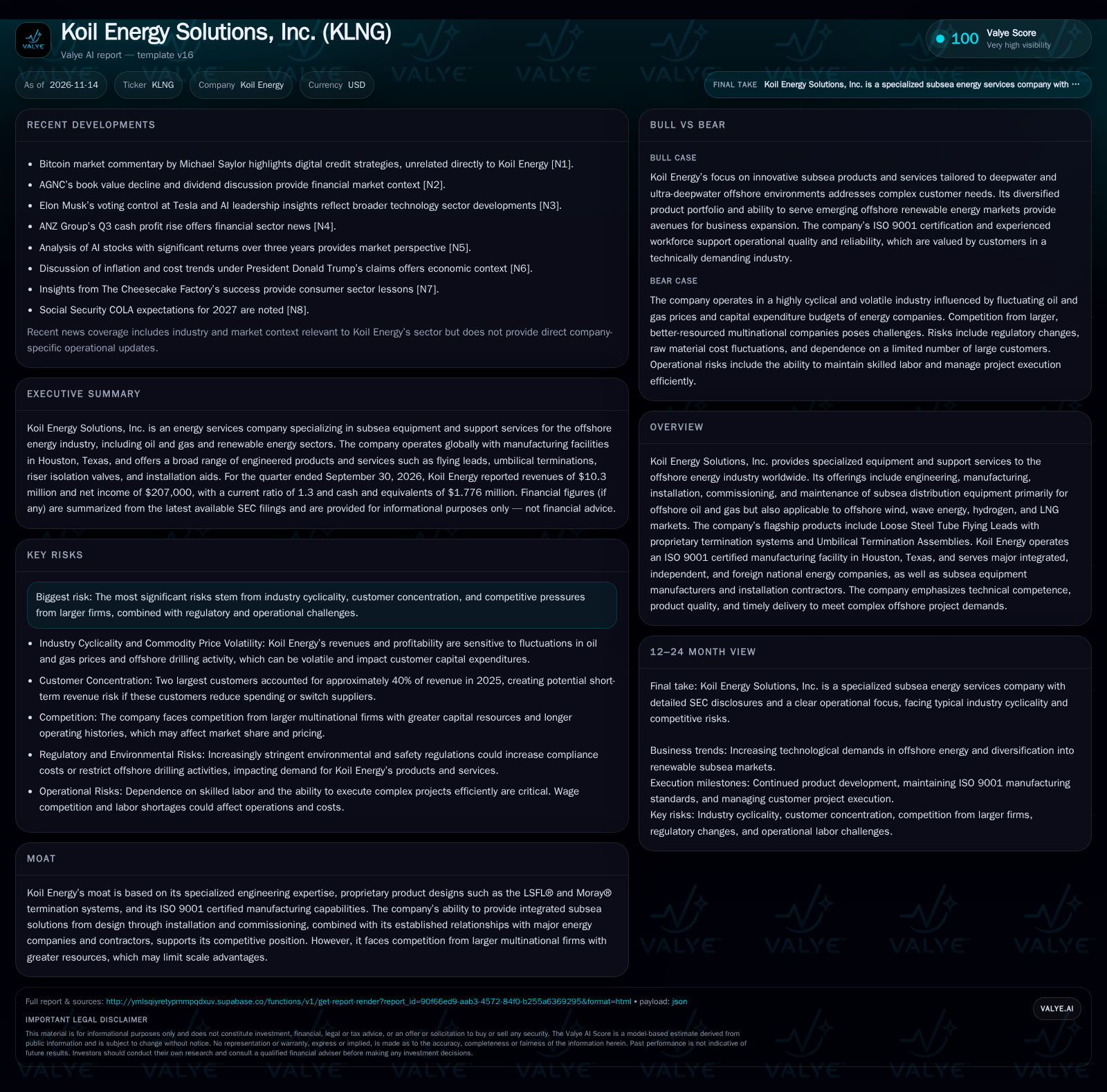
Koil Energy Solutions, Inc. reported $10.3 million in revenue and net income of $207,000 for Q3 2026, with its two largest customers contributing about 40% of 2025 revenue. The company’s proprietary products and ISO 9001-certified Houston facility support its position in offshore oil, gas, and renewables, but concentrated customer exposure and competition from larger players heighten earnings volatility. Future growth may depend on successful expansion into offshore renewables and continued execution in deepwater projects. [S1] [S2]
Koil Energy Solutions, Inc. occupies a specialized niche in the offshore energy value chain, supplying custom-engineered subsea equipment and support services to global oil, gas, and emerging renewable markets. Recent financials show modest profitability, but the company’s fortunes remain closely tied to the capital spending cycles of a concentrated set of major energy customers. With proprietary products and a certified manufacturing base, Koil Energy seeks to build on its expertise in deepwater projects while exploring growth in offshore renewables. The key question is whether the company can leverage its technical edge and diversify its customer base quickly enough to offset the inherent volatility of its core markets. [S1] [S2]
Profitability Trends and Customer Behavior Inform Short-Term Prospects
For the quarter ended September 30, 2026, Koil Energy Solutions reported $10.3 million in revenue and net income of $207,000, translating to $0.02 per share. As of the same date, the company held $1.776 million in cash and equivalents, with a current ratio of 1.3 and a cash ratio of 0.15. These metrics indicate a positive earnings result but signal a reported liquidity position cushion relative to operational scale. [S2]
Customer concentration remains pronounced: the company’s two largest customers constituted approximately 40% of revenue in 2025. While Koil Energy is not dependent on a single customer, this level of concentration exposes it to revenue volatility if either customer alters spending or supplier relationships. [S1]
The company’s operational backbone is its ISO 9001-certified Houston facility, which enables the design, fabrication, and testing of proprietary products such as the LSFL® flying leads and Moray® termination systems. This supports Koil Energy’s positioning as a solutions provider for complex offshore projects in both traditional and renewable segments. [S1]
Revenue Patterns, Project Timing, and Operating Leverage in Subsea Ventures
Koil Energy’s economics are shaped by project-based revenue streams—primarily from engineering, manufacturing, installation, and commissioning of subsea equipment for offshore energy customers. The company employs percentage-of-completion accounting, which can introduce earnings volatility tied to project milestones, change orders, and customer acceptance. [S1]
Gross margins in this segment typically depend on project mix, technical complexity, and the ability to control direct labor and material costs. Proprietary products like the LSFL® and Moray® terminations may command premium pricing if they solve unique customer problems or reduce offshore installation time, but pricing power is ultimately constrained by customer capital budgets and bidding competition.
Fixed costs are anchored in facility overhead, engineering talent, and compliance requirements (notably ISO 9001 and safety standards). Variable costs include raw materials—subject to commodity price swings—and contract labor, which Koil Energy flexes based on project load. This structure may offer some operating leverage during periods of rising revenue, but also exposes the company to margin compression if project volumes or pricing decline.
Working capital requirements can be significant, especially for large, long-cycle projects where cash collection may lag revenue recognition. The company reported cash and liquidity metrics for the period; these figures do not by themselves establish operating runway, investment capacity, financial flexibility, or financing capacity. [S2]
Balancing Technical Edge Against Scale Limitations in Offshore Markets
Koil Energy’s competitive position is built on technical know-how, proprietary product designs, and an ability to deliver custom subsea solutions for demanding offshore environments. ISO 9001 certification and specialized manufacturing processes—such as clean-room welding for stainless steel—enhance credibility with major energy customers who demand quality and reliability. [S1]
However, the company faces formidable competition from larger multinational equipment manufacturers and service providers. These competitors benefit from greater capital resources, global supply chains, and the ability to bundle broader service offerings. Larger firms may also be able to undercut pricing or absorb margin pressures more effectively during industry downturns.
Customer relationships in offshore energy are typically long-term and based on proven execution, but project awards remain competitive, and switching costs can be significant only for highly customized solutions. The question is whether Koil Energy’s proprietary products and engineering agility can consistently win high-value projects or if it will be relegated to niche roles in a market dominated by scale players.
The company’s stated diversification into offshore wind, hydrogen, and LNG may open new addressable markets, but these segments are also attracting large incumbents and new entrants, making sustained differentiation a challenge.
Growth Potential from Renewables Uptake and Expanding Deepwater Activity
A favorable scenario for Koil Energy emerges if global offshore capital expenditures accelerate, driven by both a resurgence in deepwater oil and gas development and a step-change in offshore renewables investment (wind, hydrogen, LNG). In this environment, Koil could leverage its engineering track record and proprietary products to secure higher-margin projects with both existing and new customers.
Evidence supporting this scenario would include: a rising backlog of awarded projects in offshore wind or hydrogen; new customer wins in the renewables segment; and sustained improvements in gross margin tied to proprietary product adoption. Additional confirmation would come from reduced customer concentration as Koil adds new names to its portfolio, and from reported increases in facility utilization and headcount (if disclosed).
This outcome would likely require Koil to demonstrate successful execution on complex, multi-phase projects and to adapt its products to the technical requirements of emerging offshore segments. Early partnerships or pilot projects with leading renewable developers would provide further validation.
Performance Tied to Project Timing and Customer Base Concentration
The most plausible scenario is that Koil Energy continues to operate in a cyclical, project-driven environment where results fluctuate with offshore oil and gas investment, punctuated by early but incremental wins in renewables. Revenue growth would remain lumpy, with earnings and cash flows sensitive to the timing and mix of large project awards.
Customer concentration is likely to persist in the near term, maintaining exposure to the capital spending patterns of a few major clients. Margins may remain under pressure from competitive bidding and input cost volatility, even as the company seeks to differentiate through proprietary products and technical service quality.
Confirmation of this scenario would include continued reporting of modest but positive net income, stable or slightly growing revenue year-over-year, and relatively unchanged customer mix. Gross margin stability would suggest effective cost control, while any disclosed project delays or cancellations would reinforce the lumpy nature of results.
A shift toward more recurring or service-based revenue streams would indicate progress toward smoothing earnings, but such a transition would require evidence of long-term service contracts or maintenance agreements—information not currently disclosed.
Risks from Commodity Slumps and Customer Turnover Heighten Volatility
A negative scenario would unfold if offshore oil and gas capital expenditures decline due to sustained low commodity prices, regulatory headwinds, or macroeconomic shocks. In this case, Koil’s project pipeline could contract sharply, with heightened risk stemming from the loss, deferral, or downsizing of projects from one or both of its largest customers.
Competitive pressures from larger multinationals could intensify during downturns, leading to further margin compression or loss of project bids. Rising raw material costs or labor shortages could exacerbate cost pressures, especially if Koil is unable to pass on these increases to customers.
Evidence confirming this scenario would include sequential declines in reported revenue and net income, increased accounts receivable or inventory balances (if disclosed), and any commentary on project delays, customer order reductions, or heightened pricing competition. Regulatory changes increasing compliance costs or restricting offshore activity would further weigh on results.
Investor and Analyst Priorities for Assessing Koil Energy’s Outlook
Quarterly backlog (if disclosed): A rising or diversifying backlog would indicate success in winning new projects and expanding into renewables.
Customer concentration trend: Shifts in the percentage of revenue from top customers would help gauge progress in portfolio diversification.
Gross margin evolution: Changes in gross margin may reveal pricing power, project mix, or cost control effectiveness.
Project win announcements, especially in offshore wind, hydrogen, or LNG: New awards would signal traction in non-oil and gas markets.
Facility utilization rates and headcount changes (if disclosed): Increased utilization or hiring may indicate ramping demand or execution capacity.
Disclosure of long-term service or maintenance contracts: Evidence of recurring revenue streams would support a more stable business model.
Raw material cost trends and labor market commentary: Insights into cost pressures and operational risks.
Regulatory developments impacting offshore work: Changes in compliance requirements or market access could materially shift the outlook.
Disclaimer: This is research-only, informational analysis and not investment advice. It may include AI-generated interpretation and general industry context. Always verify important details using primary sources.

Comments