
21Shares Ethereum ETF: Fee Structure, Market Volatility, and the Stakes in Passive Ether Exposure
As the 21Shares Ethereum ETF navigates a maturing digital asset fund landscape, its low fee, passive structure, and regulatory navigation define both its appeal and its vulnerabilities. Recent ETF outflows across the sector and the approaching end of fee waivers sharpen the focus on scale, cost competitiveness, and demand resilience.
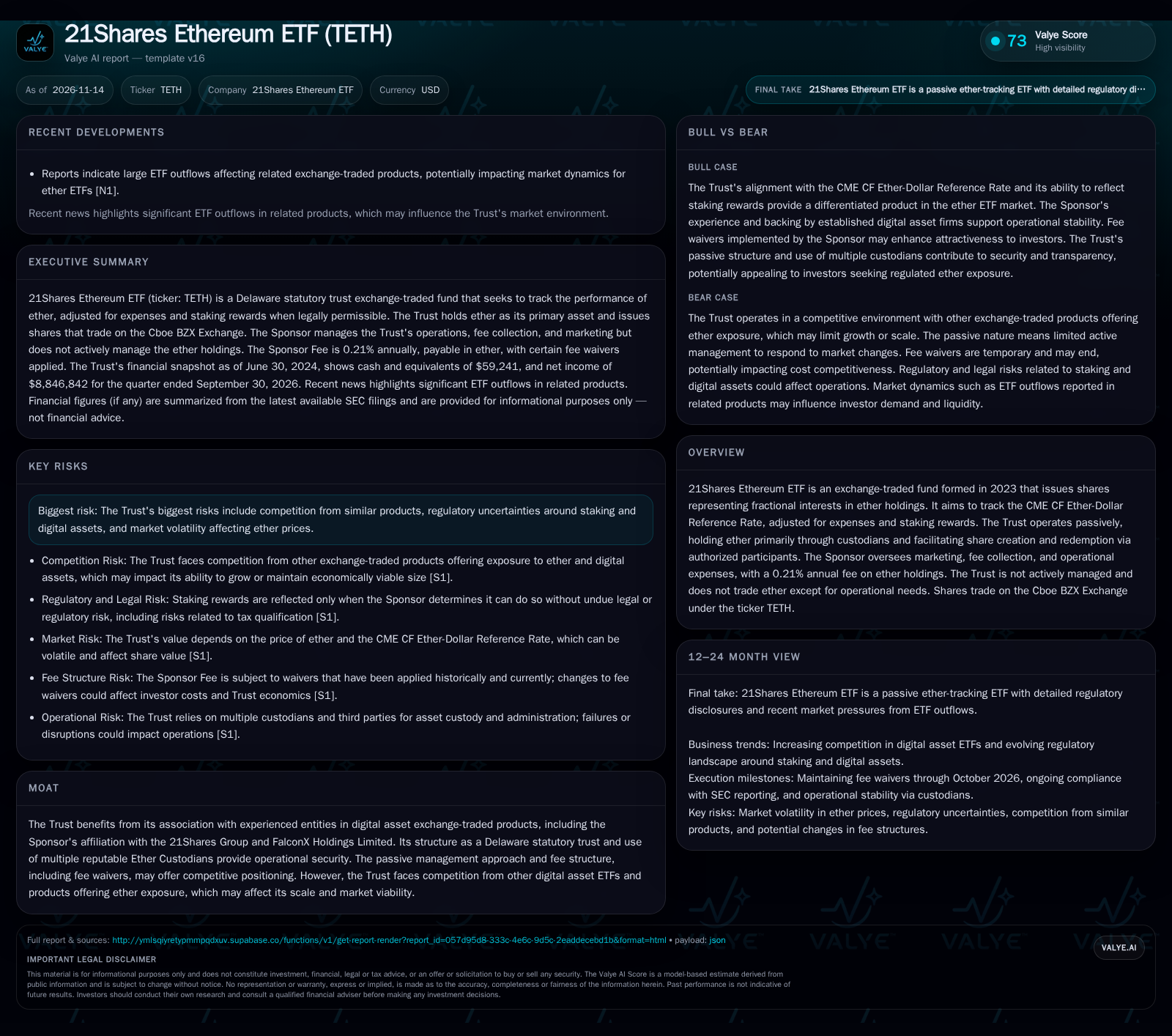
21Shares Ethereum ETF (TETH) offers regulated, passive ether exposure with a 0.21% sponsor fee—currently subject to waivers through October 2026. The ETF's financials reflect net income and modest cash, but sector-wide ETF outflows and looming changes to fee waivers highlight ongoing competitive and market risks. The trust’s future will hinge on its ability to retain assets, maintain operational efficiency, and adapt to regulatory and market dynamics. [S1] [S2]
The 21Shares Ethereum ETF (TETH) has carved out a role as a regulated vehicle for passive ether exposure, attracting investors with its low sponsor fee and transparent structure. However, as digital asset ETFs mature and fee competition intensifies, the trust faces new headwinds: sector-wide outflows, the scheduled expiration of fee waivers, and persistent questions around differentiation and scale. How TETH balances its cost structure, operational reliability, and investor appeal amid volatile ether markets will determine whether it can sustain and grow its asset base—or become one of many undifferentiated offerings in a crowded field.
Recent Financials and Sector Flows Shape the Near-Term Outlook
The 21Shares Ethereum ETF reported net income of $8,846,842 for the quarter ended September 30, 2026, with cash and equivalents of $59,241 as of June 30, 2024 [S2]. While these figures reflect a period of profitability, they must be interpreted in the context of a broader digital asset ETF landscape that has recently experienced significant outflows, as reported in related news. The ETF’s sponsor fee of 0.21%—waived in part through October 2026—remains a cornerstone of its cost appeal, but the pending end of these waivers could alter competitiveness. The trust’s passive, non-actively managed structure means it does not attempt to hedge, time, or otherwise actively respond to ether price volatility, and instead tracks the CME CF Ether-Dollar Reference Rate with adjustments for expenses and staking rewards when legally permissible [S1].
How Passive Ether Funds Generate Revenue—and Where Cost Pressures Lurk
The trust’s business model is straightforward: it charges a 0.21% annual fee on ether holdings, payable in ether weekly, with the sponsor covering all ordinary operating expenses out of this fee [S1]. This aligns its economics with asset scale: as assets under management (AUM) rise, fee revenue grows proportionally, while most costs—marketing, administration, custody—are relatively fixed or only partially variable. This creates the potential for significant operating leverage if AUM increases, but exposes the trust to margin compression if outflows or fee competition erode scale.
The trust does not actively manage its ether position; it only buys or sells ether in response to share creations or redemptions, or to pay expenses. Staking rewards, when legally permissible, may provide an incremental source of value, but regulatory ambiguity means these are not guaranteed or consistent. The sponsor’s fee waivers, set to expire in October 2026, have temporarily reduced the effective fee burden, enhancing short-term competitiveness. Once waivers lapse, the trust’s net revenue per dollar of AUM may fall if investors shift to lower-cost alternatives.
Capital requirements for the trust are modest; it holds ether as its primary asset and maintains only minimal cash for operational needs. However, the viability of the fund is highly sensitive to AUM: below a certain scale, fee income may not cover fixed costs, especially if fee waivers end or outflows accelerate.
Differentiation in a Crowded Ether ETF Arena: What Sets TETH Apart?
TETH competes directly with a growing roster of ether-tracking ETFs and exchange-traded products. Its main differentiators are its relatively low sponsor fee (currently mitigated further by waivers), the promise of reflecting staking rewards when possible, and operational backing from established digital asset firms [S1]. The use of multiple reputable custodians and a Delaware statutory trust structure may also reassure institutional allocators regarding security and regulatory compliance.
However, these advantages are not unique and can be replicated by competitors. Larger funds may benefit from even lower fees through scale, and aggressive fee compression across the sector could put pressure on TETH’s economics once waivers expire. The trust’s passive structure, while appealing for transparency, means it cannot offer active management or tactical flexibility—a feature some investors may seek in volatile markets.
Competition is not limited to ETFs: direct ether ownership, closed-end trusts, and even crypto-native staking services represent alternative ways for investors to gain ether exposure. The question is whether TETH can maintain sufficient scale and cost competitiveness to avoid being marginalized as a commodity product in a fee-driven marketplace.
What a Surge in Institutional Adoption Could Mean for TETH
A favorable scenario for TETH would be driven by renewed investor inflows into ether and digital asset ETFs, perhaps sparked by regulatory clarity on staking rewards, a rebound in ether prices, or increased institutional allocation to crypto assets. In this environment, TETH’s regulated structure and transparent fee schedule could attract significant AUM, driving up fee revenue and enabling operating leverage as fixed costs are spread over a larger asset base.
Confirmation of this scenario would include a reversal of recent sector-wide ETF outflows, increased creation basket activity, and sustained or growing AUM. Regulatory developments that clearly permit the inclusion of staking rewards could further differentiate TETH, providing a modest yield advantage over competing products. If the sponsor extends fee waivers or lowers the base fee, TETH could solidify its position as a cost leader, attracting flows from cost-sensitive institutional allocators.
Falsification would be signaled by continued outflows, failure to capitalize on positive regulatory changes, or an inability to maintain operational scale despite an improving market backdrop.
If Fee Competition and Market Churn Persist: The Most Likely Trajectory
The most plausible near-term scenario is a competitive equilibrium: TETH retains a portion of its AUM as fee competition intensifies, while overall sector demand ebbs and flows with macro sentiment and crypto-specific volatility. The expiration of fee waivers in October 2026 is likely to trigger some investor turnover, especially if rival funds undercut the 0.21% fee or offer more compelling staking arrangements.
In this scenario, TETH’s economics remain stable but not exceptional; income covers expenses, but growth is limited by competitive and market headwinds. The trust’s passive structure continues to appeal to a subset of investors seeking straightforward, regulated ether exposure, but it does not command premium pricing or rapid asset growth. Evidence confirming this path would be flat or modestly declining AUM, stable fee income, and continued sector-wide ETF churn. A shift in regulatory stance or a large-scale competitor fee cut would challenge this equilibrium.
How Sustained Outflows and Fee Pressure Could Threaten TETH’s Viability
A negative scenario would see sector-wide outflows persist or accelerate, driven by weak ether prices, loss of investor confidence in digital asset funds, or aggressive fee compression from larger rivals. As AUM falls, TETH’s fee revenue could dip below the level needed to cover fixed costs—especially after fee waivers end—forcing the sponsor to absorb losses or consider restructuring, mergers, or even closure.
Further downside risk arises if regulatory changes restrict or complicate the inclusion of staking rewards, reducing TETH’s potential yield advantage. Operational disruptions at custodians or administrative bottlenecks could further undermine investor confidence. Confirmation of this scenario would be rapid AUM attrition, public sponsor statements about fund viability, or forced fee reductions to stem outflows. Falsification would require observable net inflows, stabilization of AUM, or successful cost reductions that restore economic sustainability despite sector headwinds.
Milestones and External Shifts That Will Determine TETH’s Competitive Fate
Changes in assets under management (AUM) and net creation/redemption flows, especially relative to sector peers, will be pivotal for testing scale sustainability.
Expiration of fee waivers in October 2026 and any announced sponsor fee adjustments; actual investor response to fee changes will clarify price sensitivity.
Regulatory updates or legal clarity regarding the permissibility of staking rewards in ETF structures—confirmation would impact both yield and differentiation.
Sector-wide ETF inflows or outflows, especially in ether and digital asset products, as a signal of broader demand trends and liquidity conditions.
Operational performance and continuity of Ether Custodians and Prime Broker partners—any disruptions or security incidents would directly affect investor trust.
Sponsor disclosures or commentary on cost structure, marketing spend, or plans for further fee waivers, as these signal strategic intent and capacity to compete.
If disclosed, tracking error versus the CME CF Ether-Dollar Reference Rate and realized staking reward contributions would help validate product execution.
Disclaimer: This is research-only, informational analysis and not investment advice. It may include AI-generated interpretation and general industry context. Always verify important details using primary sources.

Comments