
SC II Acquisition Corp.: The Countdown to a Business Combination and the Mechanics of SPAC Value Creation
With $172.5 million in trust and a management team seasoned in SPAC transactions, SC II Acquisition Corp. faces intensifying competition, dilution risks, and a fixed deadline to deliver a business combination. The coming year will test the team's sourcing acumen and the structural economics underpinning blank check companies.
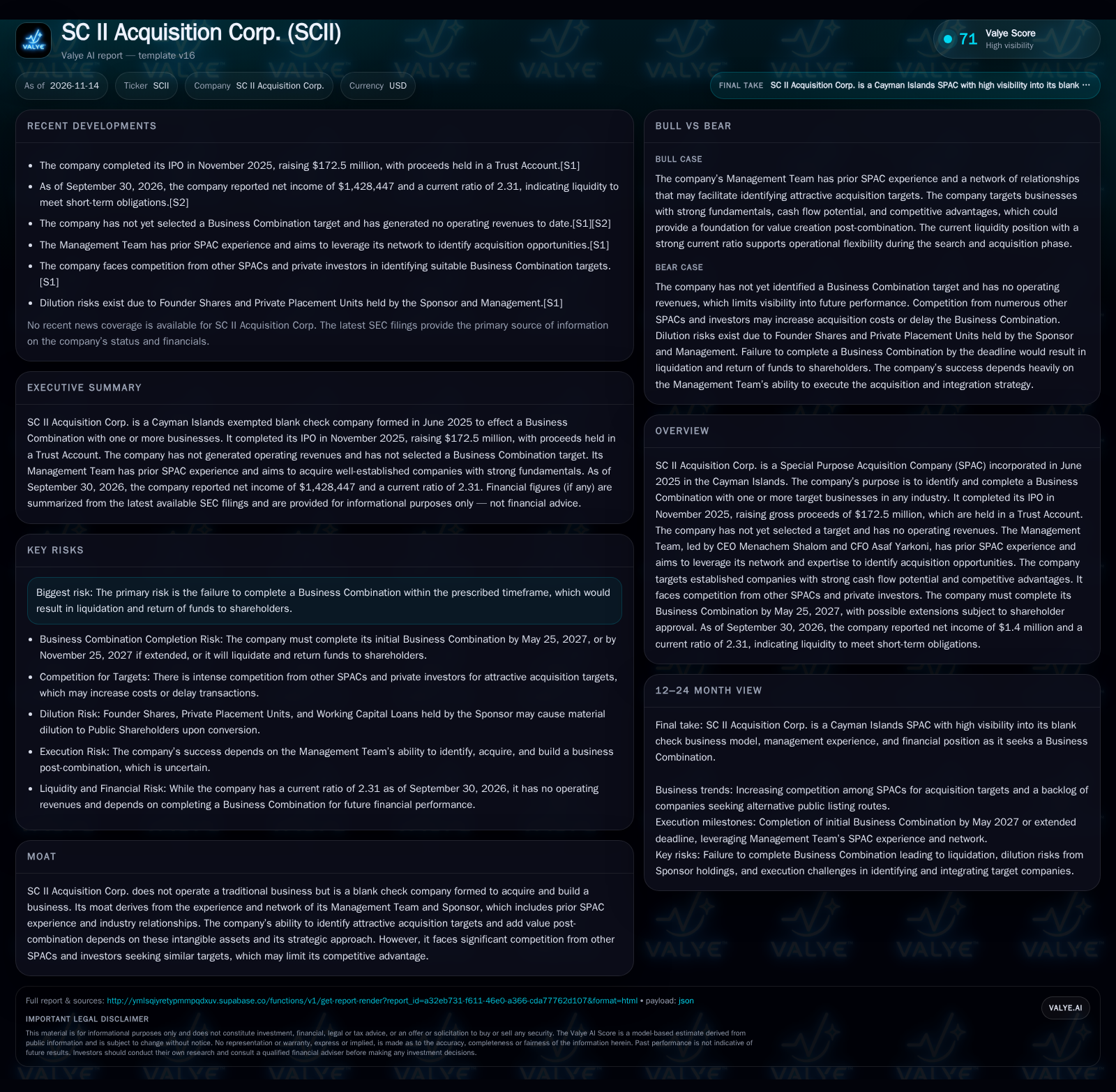
SC II Acquisition Corp. has raised $172.5 million and must secure a business combination by May 2027 or face liquidation. The management team’s SPAC experience, trust account structure, and the sponsor's ties to defense may shape target selection, but competition for quality targets and dilution remain central risks. Success depends on efficient sourcing and value creation post-merger, with the next 12 months as the critical window for execution.[S1] [S2]
SC II Acquisition Corp. enters the critical phase of its SPAC lifecycle: the search and negotiation for a business combination before its mid-2027 deadline. Armed with $172.5 million in trust and led by a team with proven SPAC credentials, the company’s ability to identify, secure, and integrate a value-creating target will determine whether it avoids the fate of liquidation that has befallen many of its peers. Dilution mechanics, fierce competition for quality targets, and the sponsor's defense-sector ties all shape the strategic possibilities—yet the clock is ticking, and execution risk remains high in this rapidly evolving blank check landscape.
IPO Proceeds, Trust Structure, and the Looming Deadline
SC II Acquisition Corp. completed its IPO in November 2025, raising $172.5 million through the sale of 17,250,000 public units at $10 each, with all proceeds placed in a trust account. An additional $2.55 million was raised from a private placement to the sponsor. The company reported cash and liquidity metrics for the period; these figures do not by themselves establish operating runway, investment capacity, financial flexibility, or financing capacity. Critically, SC II has not yet announced or selected a business combination target, and must close a deal by May 25, 2027 (with a possible extension to November 25, 2027, subject to shareholder approval), or face mandatory liquidation and return of trust assets to shareholders. The management team’s SPAC experience and the sponsor’s connections to the defense sector may influence both sourcing and value-add strategy, but the window for action is finite and closing.[S1] [S2]
How SPAC Economics Shape Incentives and Outcomes
SC II’s economic model is classic SPAC: capital is raised upfront and held in secure, low-yield instruments until a business combination is completed. The sponsor and management team typically receive founder shares and private placement units, which convert into equity in the post-merger entity, creating strong incentives to close a deal before the deadline. For public shareholders, the trust structure offers downside protection (via redemption rights if they disapprove of the target), but also exposes them to dilution if a merger occurs, as founder shares and warrants convert.
The fixed costs of running the SPAC—legal, financial advisory, regulatory, and search expenses—are largely pre-funded. Variable costs escalate with deal complexity and target size. The model creates acute time pressure: if no deal occurs, the trust is returned to shareholders, and the sponsor’s investment (and sweat equity) is lost. If a deal is struck but at unattractive terms (due to competition or misaligned incentives), public shareholders may suffer dilution or end up with a suboptimal business. Ultimately, the economics reward speed and deal closure, but penalize poor target selection and value destruction post-merger.
The SPAC’s Challenge: Sourcing Differentiation in a Crowded Arena
The SPAC universe remains crowded, with numerous blank check firms and private equity vehicles chasing a finite pool of attractive targets. SC II faces direct competition from other SPACs with similar capital bases and mandates, as well as from private investors who may offer greater certainty or operational value-add. The sponsor’s defense-sector ties could provide differentiated sourcing, especially for targets in national security, aerospace, or dual-use technology sectors—areas that may be overlooked by generalist vehicles.
However, the absence of a sector restriction also means SC II is exposed to the full spectrum of competition, including from sector-focused SPACs and traditional acquirers. The management team’s prior SPAC experience could help in deal negotiation and diligence, but the structural incentive to get a deal done—rather than necessarily the best deal—remains a persistent counterforce. The risk is that intense competition for quality businesses leads to overpaying or settling for less-than-ideal targets, eroding post-merger value.
A High-Quality Target, Defensive Differentiation, and Value Creation
The most favorable scenario for SC II involves leveraging its sponsor’s defense-sector relationships and the management team’s SPAC track record to secure a high-quality business with strong cash flows, competitive advantages, and scalability. If the team can identify a target that is overlooked by other SPACs—perhaps due to specialized regulatory, technological, or geopolitical considerations—SC II could negotiate favorable terms, minimize dilution, and unlock value for all stakeholders.
Evidence that would confirm this scenario includes a definitive agreement with a well-established, profitable target in a sector aligned with the sponsor’s expertise, a relatively low redemption rate among public shareholders, and post-merger operational synergies or growth opportunities. Falsification would come from the announcement of a generic or marginal target, high shareholder redemptions, or unfavorable deal terms that signal a lack of differentiation or negotiating leverage.
Most Likely Trajectory: Conventional Deal Under Competitive Pressure
The most plausible outcome is that SC II, under time pressure, secures a business combination with a solid but not exceptional target, likely in a competitive process. This could involve a private company seeking a public listing or liquidity, where SC II’s terms are broadly in line with other recent SPAC deals. Dilution for public shareholders is moderate to high, especially if redemptions spike and additional PIPE (private investment in public equity) capital is required.
Confirmation would come from a deal announcement with a business possessing established revenues and management, but without clear sectoral or strategic differentiation. Shareholder redemptions are neither minimal nor extreme, and post-merger performance tracks industry averages. Falsification would be a failure to announce a deal by early 2027, a high-profile target with clear competitive advantages, or unusually favorable terms for public shareholders.
Deal Failure, Liquidation, and Value Erosion for Sponsors
The adverse scenario is that SC II is unable to secure a business combination before the May 2027 (or November 2027, if extended) deadline. This could result from a combination of competitive pressures, overvaluation of available targets, or shareholder resistance to proposed deals. In this case, the trust is liquidated and returned to public shareholders, while the sponsor and management lose their investment and any upside from founder shares.
Evidence supporting this scenario would be continued silence or delays in deal announcements as the deadline approaches, withdrawal from negotiations, or public filings signaling the impossibility of completing a transaction on acceptable terms. A wave of SPAC liquidations in the broader market or a lack of PIPE funding appetite would further reinforce this risk.
Milestones That Will Reveal SC II’s Business Combination Trajectory
Announcement of a definitive business combination agreement, including target sector and financial profile.
Redemption rates among public shareholders upon deal announcement—if disclosed—as a proxy for deal quality and shareholder alignment.
PIPE (private investment in public equity) commitments or other external financing arrangements that accompany a proposed transaction.
Dilution impact for public shareholders, especially the conversion mechanics and resulting ownership structure post-merger—if disclosed.
Any evidence of sectoral focus or differentiation in the target selection, particularly in defense or technology verticals.
Extension requests or proxy filings signaling the need for more time beyond the initial May 2027 deadline.
Management’s public communication about target criteria, value creation plans, or sourcing progress—would help test the thesis.
Changes in the broader SPAC market, such as rising liquidation rates or shifting PIPE investor sentiment, that could influence deal feasibility.
Disclaimer: This is research-only, informational analysis and not investment advice. It may include AI-generated interpretation and general industry context. Always verify important details using primary sources.

Comments