
Monroe Federal Bancorp: Local Real Estate Risks and a New Loan Management Approach
Monroe Federal Bancorp, Inc. pursues a community banking model anchored in Ohio real estate lending, but faces mounting pressure from negative earnings and intense competition. The upcoming move to sell residential mortgage loans to the secondary market could reshape its risk profile—and will test its ability to adapt amid cyclical and structural headwinds.
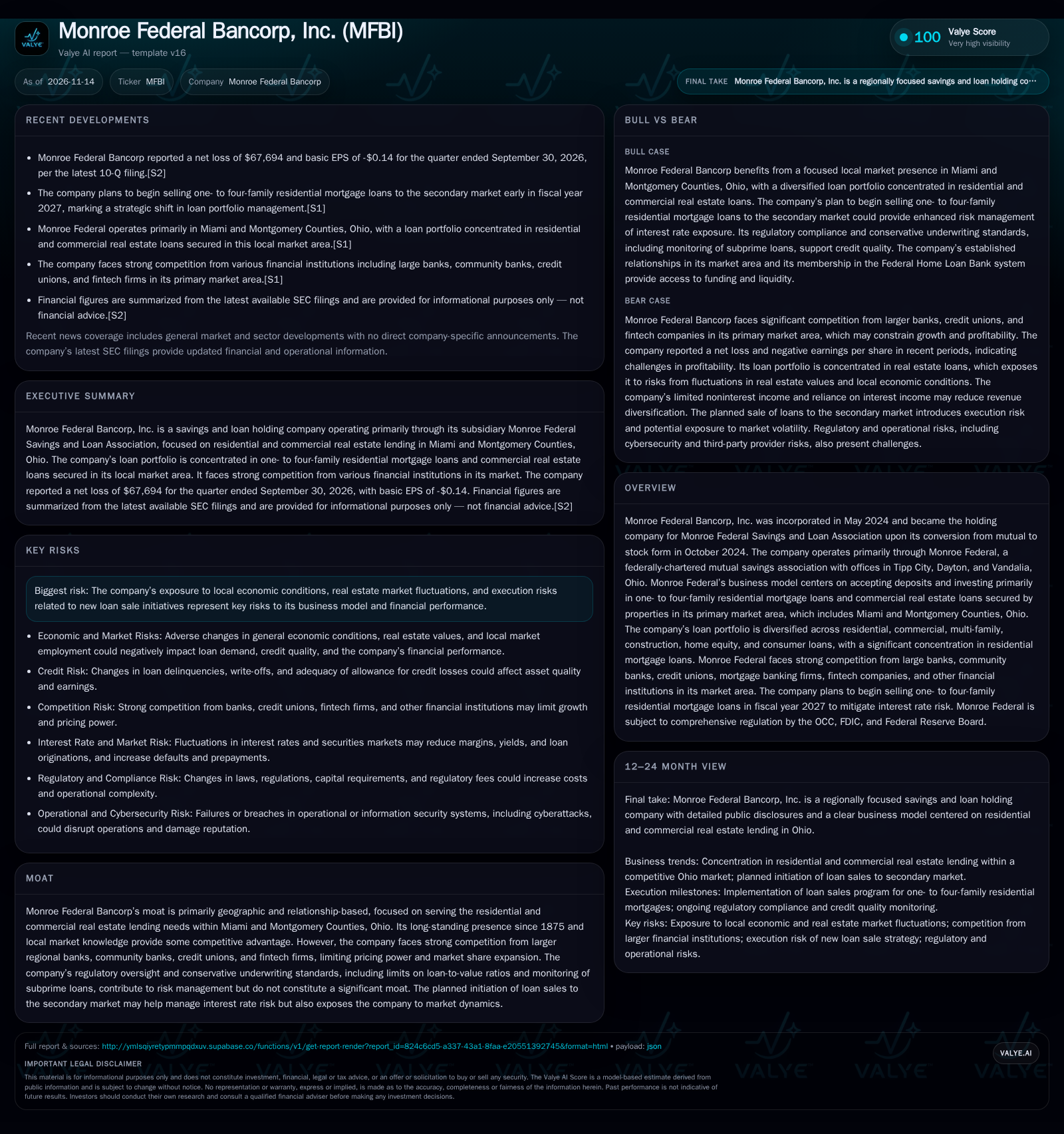
Monroe Federal Bancorp, Inc. is a newly public savings and loan holding company deeply concentrated in residential and commercial real estate lending in Miami and Montgomery Counties, Ohio. The company recently posted a net loss and negative EPS, reflecting profitability challenges. A pivotal strategic change is imminent: beginning in early fiscal 2027, Monroe Federal plans to sell one- to four-family residential mortgage loans to the secondary market, aiming to manage interest rate risk. Success will depend on execution, loan quality, and the ability to differentiate amid fierce competition from larger banks and fintechs. [S1] [S2]
Monroe Federal Bancorp, Inc. is at an inflection point. As a newly public holding company for a long-established Ohio savings association, it is grappling with negative earnings and a loan book tightly bound to local real estate. The company's planned entry into the secondary mortgage market in early 2027 signals both a response to margin and risk pressures and a test of its operational adaptability. The outcome of this strategic shift—and its ability to navigate intense local competition—will shape the bank’s prospects in an era where community banks face structural challenges from both market cycles and digital disruption.
Recent Losses Highlight Need for Loan Strategy Adjustment
Monroe Federal Bancorp reported a net loss of $67,694 and basic earnings per share of -$0.14 for the quarter ending September 30, 2026. This marks a period of negative profitability soon after its conversion to stock form and public listing, signaling immediate earnings pressure. [S2]
The company’s loan book remains highly concentrated in its core markets—approximately 61% of loans are one- to four-family residential mortgages, and roughly 25% are commercial real estate loans, all secured by property in Miami and Montgomery Counties, Ohio. [S1]
A significant strategic development is Monroe Federal’s plan to begin selling newly originated one- to four-family residential mortgage loans into the secondary market starting in early fiscal 2027. This represents a departure from its historical practice of retaining all originated loans and could materially alter its balance-sheet risk exposure and revenue mix. [S1]
Competition remains fierce, with the company’s deposit market share at 2.8% in Miami County and just 0.61% in Montgomery County as of June 2025, underscoring its modest scale and vulnerability to larger or more technologically advanced peers. [S1]
Revenue Sources and Emerging Margin Challenges at Monroe Federal
The company’s primary revenue stream is interest income from its loan and investment portfolio. With minimal noninterest income, Monroe Federal’s earnings profile is acutely sensitive to net interest margin dynamics. Its traditional business model—gathering local deposits and lending primarily against residential and commercial real estate—features relatively predictable but narrow margins, especially in a low-rate or highly competitive environment.
The decision to begin selling one- to four-family mortgages to the secondary market could reshape the economics materially. Selling loans can generate immediate fee income and reduce long-term interest rate risk and capital requirements, but may also compress total interest income if the volume of retained loans declines. The mix between loans held for investment and loans held for sale will determine the bank’s future revenue stability and risk profile.
Fixed costs for a small institution like Monroe Federal are significant relative to scale, especially given regulatory compliance and branch operations. Without substantial noninterest income or fee-based businesses, operating leverage is limited: growth in loan volume or fee income from loan sales could enhance profitability, but negative operating leverage is a risk if loan volumes or spreads compress.
Capital needs are modest relative to large banks, but the thin equity base ($12.4 million as of March 2026) constrains aggressive expansion or risk-taking. The upcoming shift to loan sales may reduce risk-weighted assets but will require robust secondary market relationships and operational capability to meet investor guidelines.
Strong Local Presence Faces Broad Competitive Pressures
Monroe Federal’s competitive position is defined by its deep roots and relationships in Miami and Montgomery Counties, a presence dating back to 1875. Local knowledge and customer familiarity may provide some stickiness among long-standing clients, but these advantages are limited by the bank’s small scale and lack of broader service breadth.
The company competes against a spectrum of rivals: large money center and regional banks with digital capabilities, community banks with similar local focus, credit unions with tax advantages and member loyalty, as well as mortgage originators and fintech lenders offering more seamless digital experiences. The low deposit market share—2.8% in its core county—suggests limited pricing power and a vulnerability to customer attrition if competitors offer more attractive rates or products. [S1]
Technology-driven entrants, including online mortgage lenders and neobanks, threaten to erode the convenience and relationship advantages that once anchored community banks. Without significant investment in digital infrastructure or differentiated product offerings, Monroe Federal risks further commoditization of its core lending and deposit franchise.
The upcoming entry into the secondary mortgage market may help level the playing field on funding cost and interest rate risk management, but execution will be critical: larger peers often have more sophisticated hedging, servicing, and loan sale operations.
Loan Sales Could Improve Risk Controls and Boost Fee Revenue
A favorable scenario emerges if Monroe Federal executes its secondary market loan sale strategy effectively. By underwriting new residential mortgages to secondary market standards and selling them promptly, the company could generate origination and sale fees, reduce interest rate and duration risk, and recycle capital into additional lending or investment opportunities.
Success in this strategy would likely manifest as improved net interest margin stability, reduced exposure to long-term rate changes, and a gradual increase in noninterest (fee) income. If the company can maintain or even grow origination volumes while selling loans, profitability could rebound—especially if local housing demand remains resilient and credit quality holds.
Confirmation would come from reported increases in noninterest income, stable or rising origination volume, and evidence of successful execution (e.g., low repurchase demands from investors, minimal operational disruptions). Falsification would include operational missteps, inability to meet investor standards, or falling origination volumes due to competitive pressure or local economic weakness.
Projected Growth Faces Margin and Volume Limitations
The most plausible trajectory is one of incremental progress offset by persistent headwinds. Monroe Federal may successfully initiate loan sales, but the scale of fee income may only partially offset lower interest income from a shrinking retained loan book. Margins could remain under pressure if deposit competition intensifies or if the company is forced to price aggressively to maintain loan volumes.
Modest improvements in risk management are possible as the balance sheet becomes less sensitive to interest rate swings, but gains may be muted by ongoing competition and limited ability to significantly increase market share. The company’s small size and thin capital base may constrain further investment in technology or product expansion.
This scenario would be confirmed by gradual improvement in quarterly profitability, stable or slightly higher noninterest income, and maintenance of credit quality with no major uptick in delinquencies or charge-offs. Falsification would be persistent quarterly losses, declining loan originations, or material credit deterioration.
Potential Setbacks from Execution Issues and Regional Market Decline
The principal downside risk is a combination of execution challenges in the new loan sale strategy and adverse local economic conditions. Should Monroe Federal struggle to meet secondary market underwriting and compliance requirements, it could face increased costs, repurchase demands, or reputational damage—without achieving the intended risk reduction.
A downturn in local real estate or employment could sharply increase credit losses in the highly concentrated loan portfolio, especially if subprime exposures or commercial real estate loans begin to underperform. With limited noninterest income and little ability to offset higher loan losses, profitability could deteriorate further.
Downside confirmation would include missed or delayed implementation of the loan sale program, rising loan delinquencies or charge-offs, shrinking deposit base, or negative trends in capital ratios. Falsification would be smooth operational execution, stable credit metrics, and evidence of growing fee income from loan sales.
Strategic Developments That Will Shape Monroe Federal’s Future
Quarterly trends in noninterest income, especially fee income from loan sales, if disclosed, to assess the impact and scale of the new secondary market strategy.
Loan origination volumes for one- to four-family residential mortgages—growth or decline will signal competitive traction and local market health.
Credit quality indicators: delinquency rates, charge-offs, and the performance of subprime loans, which are monitored quarterly.
Deposit growth or attrition, particularly relative to local peers, to test the durability of Monroe Federal’s funding base amid competition.
Operating expense trends, as scale and efficiency gains (or lack thereof) will affect the company’s ability to absorb margin compression.
Capital adequacy ratios, especially as the loan sale strategy alters the balance sheet and risk-weighted assets.
Timely and effective execution of the loan sale initiative, including meeting secondary market underwriting standards and minimizing repurchase demands.
Local economic indicators—unemployment rates, home price trends, and commercial real estate activity in Miami and Montgomery Counties—as proxies for future credit risk and loan demand.
Disclaimer: This is research-only, informational analysis and not investment advice. It may include AI-generated interpretation and general industry context. Always verify important details using primary sources.

Comments