
American Shared Hospital Services: Balancing Revenue Growth with Capital Intensity
American Shared Hospital Services has shown consistent revenue growth through its medical equipment leasing and patient service model, but ongoing net losses and a sub-1 current ratio highlight the capital and liquidity pressures inherent in its business. The company’s ability to sustain its asset base and manage counterparty risk will shape its trajectory as healthcare systems evolve their technology adoption and procurement strategies.
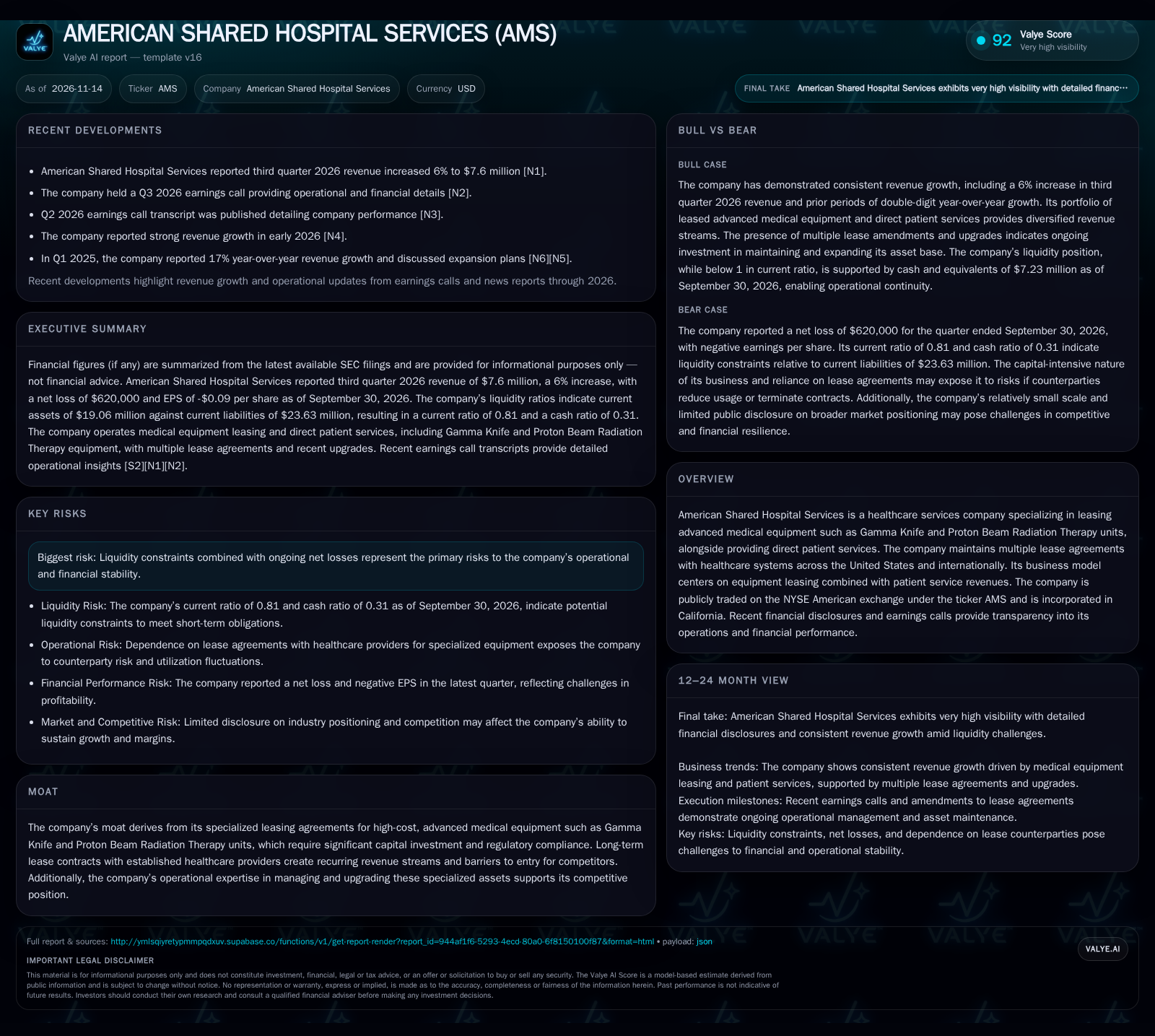
AMS reported Q3 2026 revenue of $7.6M (up 6% YoY), but posted a net loss of $620K and a current ratio of 0.81. Its model—leasing advanced radiation therapy equipment to hospitals—offers recurring revenue potential but requires heavy capital and exposes it to utilization and counterparty risks. The key question is whether growth and asset upgrades can outpace costs and liquidity pressures as the healthcare landscape shifts. [S2] [N1] [N2]
American Shared Hospital Services (AMS) has carved out a niche in the healthcare sector by leasing advanced radiation therapy equipment—such as Gamma Knife and Proton Beam systems—to hospitals and providing direct patient services. Recent quarters have seen consistent revenue growth, but this expansion comes with persistent net losses and liquidity ratios below industry norms. The company’s future will be shaped by its ability to manage the capital-intensity of its asset base, maintain favorable lease terms, and adapt to evolving competitive and technological landscapes in medical technology procurement. [S2] [N1] [N2]
Recent Results Highlight Revenue Growth, Ongoing Losses, and Liquidity Constraints
American Shared Hospital Services reported third quarter 2026 revenue of $7.6 million, a 6% increase compared to prior periods, continuing a multi-quarter trend of top-line growth [N1] [S2]. Despite this, the company posted a net loss of $620,000 for the quarter, with basic and diluted EPS of -$0.09, indicating ongoing profitability challenges [S2]. As of September 30, 2026, the company’s current assets stood at $19.06 million against current liabilities of $23.63 million, resulting in a current ratio of 0.81 and a cash ratio of 0.31—both below the conventional threshold for reported liquidity position [S2]. These facts underscore a core tension: while the company is growing its revenues, it remains in a negative earnings position and faces working capital pressure.
How Leasing High-Cost Medical Equipment Shapes AMS’s Economic Model
AMS generates revenue primarily by leasing advanced radiation therapy equipment—such as Gamma Knife and Proton Beam systems—to hospitals, often under multi-year agreements, and by providing associated patient services. This model can produce relatively predictable, recurring revenue streams if utilization remains steady and lease rates are competitive. However, it is fundamentally capital-intensive: acquiring, installing, and upgrading such equipment requires substantial upfront and ongoing investment, reflected in the company’s $27.33 million in net property and equipment as of September 30, 2026 [S2].
Operating leverage is significant: fixed costs are high due to asset depreciation, maintenance, and the need to periodically upgrade or replace technology to remain competitive. Variable costs—mainly related to service delivery—are lower by comparison, so higher utilization of installed equipment can improve margins. Cash flow dynamics can be volatile if asset utilization drops or if counterparties delay payments or renegotiate terms. The company’s current liquidity constraints suggest that internal funding of further growth or upgrades could be challenging without external capital or improved cash generation.
AMS’s ability to command premium lease rates or expand its installed base is sensitive to hospital capital budgets, reimbursement rates for advanced therapies, and the pace of technological innovation. If hospitals shift toward direct ownership, alternative financing, or competing modalities, AMS’s pricing power and volume could be pressured. Conversely, if capital constraints at hospitals persist, the leasing model may remain attractive, supporting stable demand.
Specialization, Barriers, and Competitive Threats in Equipment Leasing
AMS’s competitive position is built on its specialization in high-cost, regulated medical equipment and its portfolio of established lease relationships with healthcare systems. The capital required to acquire and maintain Gamma Knife and Proton Beam units, combined with regulatory compliance for radiation equipment, creates a moderate barrier to entry for new competitors. Long-standing lease agreements and technical expertise in equipment management can further entrench AMS with existing clients.
However, the company’s relatively small scale may limit its bargaining power with equipment suppliers and its ability to absorb shocks from lost contracts or underutilized assets. Potential competitors include larger medical equipment lessors, hospital-owned purchasing groups, and even original equipment manufacturers (OEMs) offering their own leasing or managed-service programs. Technology substitution is an ongoing risk: advances in alternative cancer treatment modalities or disruptive business models (such as pay-per-use or bundled care contracts) could pressure AMS’s economics or erode its relevance.
Moreover, counterparty risk remains significant. If a hospital partner consolidates, faces financial distress, or shifts to a different procurement strategy, AMS could face abrupt drops in utilization or loss of recurring cash flows.
When Investment in Upgrades and Expanding Leases Outpaces Cost Pressures
A favorable scenario for AMS involves sustained revenue growth driven by successful upgrades to its equipment fleet and expansion of lease agreements with new or existing hospital partners. If recent amendments and upgrades translate into higher lease rates or improved asset utilization, AMS could achieve operating leverage—spreading fixed costs over a larger revenue base and moving toward break-even or profitability. The company’s prior periods of double-digit growth (17% YoY in Q1 2025) suggest that demand for advanced radiation therapy remains robust in some markets [N6].
Confirmation of this scenario would come from future quarters showing continued revenue acceleration, narrowing net losses, and improvement in liquidity metrics (e.g., current ratio rising above 1). Additional evidence would include new lease signings, successful renegotiation of existing contracts at favorable rates, or disclosures of increased utilization rates for installed equipment—if disclosed in future filings or calls. Expansion into new geographies or modalities could further amplify the upside.
Falsification would occur if revenue growth stalls, lease renewals occur only on less favorable terms, or if asset upgrades do not result in improved economics or utilization.
Steady Growth, Ongoing Capital Demands, and Tight Liquidity Define the Most Likely Outcome
The most plausible path for AMS is continued but moderate revenue growth, largely tracking the pace of hospital adoption of advanced radiation therapy equipment and the company’s ability to retain and incrementally expand its lease portfolio. Net losses may persist in the near term as depreciation, interest, and upgrade costs offset incremental gains from revenue growth.
This scenario would be confirmed by a pattern of single-digit revenue growth, stable or slightly improving net losses (but not a shift to profitability), and current and reported liquidity-ratio trends. Disclosures of continued lease amendments and gradual asset portfolio growth—but without major step-changes—would reinforce this base case.
Evidence against this scenario would include a sudden and sustained improvement in net income and liquidity, or, conversely, a sharp contraction in revenue or a spike in asset impairments and write-offs.
Liquidity Crunch and Utilization Shocks Could Disrupt the Business Model
The adverse case for AMS centers on a convergence of liquidity constraints and demand-side shocks.
Confirmation of this scenario would be signaled by a sharp drop in quarterly revenues, widening net losses, further deterioration in liquidity metrics, or disclosures of missed payments, renegotiated leases on disadvantageous terms, or asset impairments. Additional warning signs would include delays in planned upgrades, inability to secure external financing, or public disclosures of counterparty distress among major lessees.
A partial falsification would be evidence of stable or improving utilization rates and lease renewals on similar or better terms, even in the face of broader hospital budget pressures.
What Will Determine Whether AMS Can Sustain Growth While Addressing Capital Pressure?
Quarterly revenue growth rate—continued acceleration or deceleration will help test demand resilience and the company’s ability to grow its lease base.
Net income and EPS trends—sustained improvement or a move toward break-even would challenge the thesis of persistent losses.
Current and cash ratios—movement toward or above 1 would suggest improved liquidity management or access to external capital.
Lease renewal and amendment disclosures—if disclosed, the terms and frequency of contract renewals or upgrades will indicate customer stickiness and pricing power.
Utilization rates for leased equipment—a useful metric would be the percentage of time assets are in use, as higher utilization could drive margin improvement.
Capital expenditure levels—tracking ongoing investment in equipment upgrades or new asset deployment will reveal the pace and sustainability of growth.
Counterparty concentration and credit quality—if disclosed, shifts in the mix or financial health of major lessees could materially alter risk.
External financing events—such as new debt or equity raises, their terms, and timing, would help assess AMS’s ability to fund ongoing operations and growth.
Disclaimer: This is research-only, informational analysis and not investment advice. It may include AI-generated interpretation and general industry context. Always verify important details using primary sources.

Comments