
Tavia Acquisition Corp.: SPAC Progress and the Sustainability Sector Opportunity
Tavia Acquisition Corp. advances toward a business combination with Vita Inclinata Technologies, leveraging sector focus and experienced management in the sustainability and innovation space. Success now hinges on deal execution, market conditions, and the value of its chosen target.
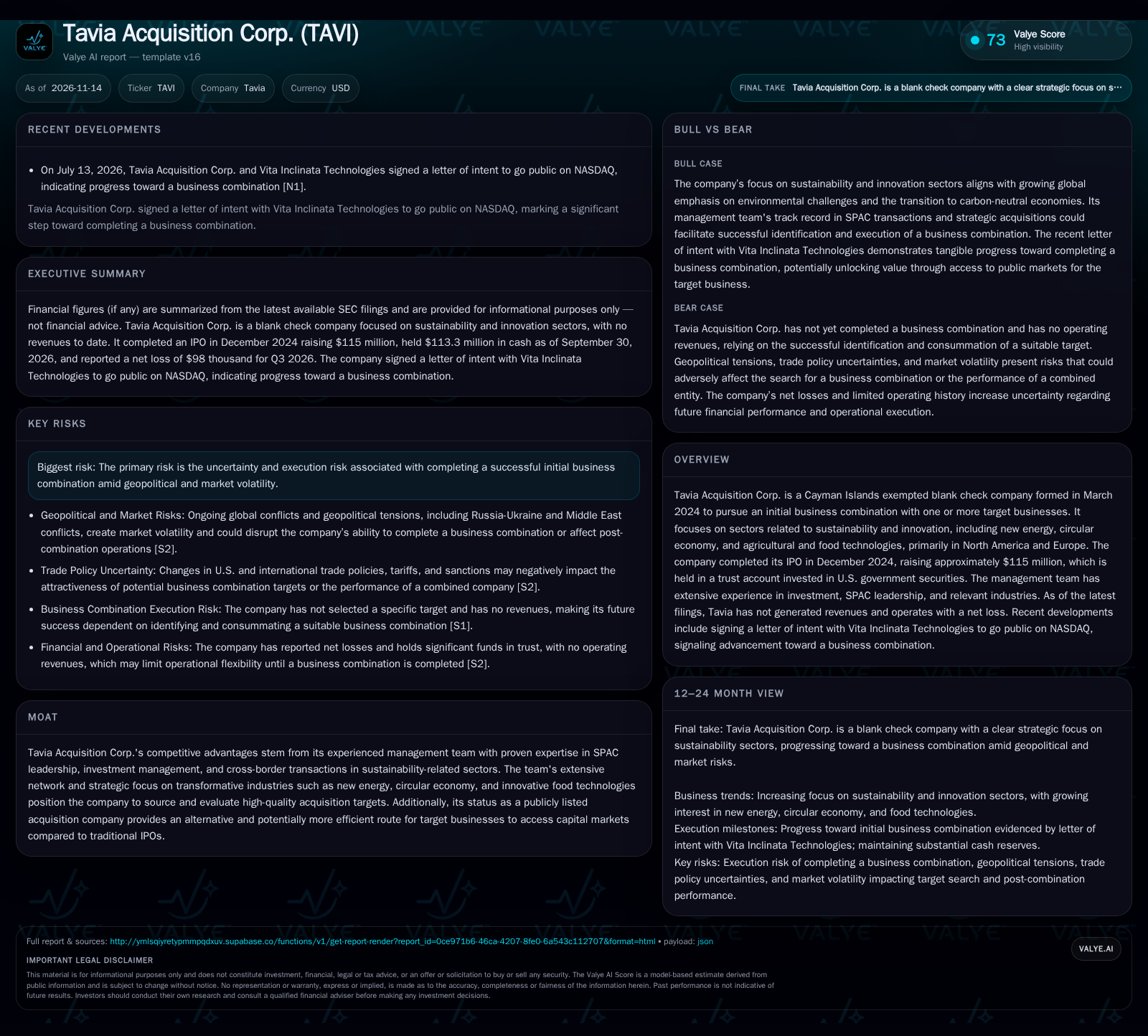
Tavia Acquisition Corp. is a blank check company with $113.3 million in cash as of Q3 2026 and a strategic focus on sustainability, new energy, and circular economy sectors. The recent letter of intent with Vita Inclinata Technologies to go public on NASDAQ represents tangible movement toward a business combination, the critical next step for unlocking value. Execution risk, sector volatility, and post-merger target quality will determine long-term outcomes. [S2] [N1]
Tavia Acquisition Corp., a blank check company targeting transformative sustainability and innovation businesses, has taken a concrete step toward its first business combination by signing a letter of intent with Vita Inclinata Technologies. With $113.3 million in cash as of Q3 2026 and a mandate focused on new energy, circular economy, and food technology sectors, Tavia’s future is now tied to its ability to execute this merger and the prospects of the chosen target. Execution risk, sector cyclicality, and external uncertainties will shape whether Tavia can deliver value for its shareholders or become another SPAC cautionary tale.
SPAC Extension, Redemption, and Letter of Intent: A Snapshot of Tavia’s 2026 Position
As of September 30, 2026, Tavia Acquisition Corp. held $113.3 million in cash and cash equivalents, with total current assets of $166.6 million. The company posted a net loss of $98,000 for the third quarter, consistent with its pre-combination SPAC status and lack of operating revenues. [S2]
On June 2, 2026, shareholders approved an extension to the SPAC’s business combination deadline to March 5, 2027, accompanied by redemptions of 7.17 million shares at $10.66 per share, drawing roughly $76.4 million from the trust. This leaves 8.75 million shares outstanding, reducing the SPAC’s float and capital base but extending its deal-making runway. [S2]
Most notably, on July 13, 2026, Tavia signed a letter of intent to merge with Vita Inclinata Technologies and take the company public on NASDAQ, marking a shift from target search to transaction execution. This is a pivotal development for a SPAC, as the LOI is often the precursor to a definitive agreement and proxy process. [N1]
Deal-Driven Economics: How Tavia’s Value Will Be Determined
Tavia Acquisition Corp., like all SPACs, does not generate operating revenues pre-combination. Its business model is to raise capital through an IPO, invest the proceeds in secure instruments, and search for a private company (the target) to merge with, allowing that company to access public markets. All value accrues from the quality and pricing of the eventual deal.
The economics hinge on several levers: the amount of cash remaining post-redemptions, the valuation and growth prospects of the target, and the deal structure (e.g., use of earnouts, PIPE financings, or sponsor incentives). The $113.3 million in cash as of Q3 2026 is the maximum available for the merger, but post-redemption adjustments and any additional capital raises will determine the final transaction size. [S2]
If the merger with Vita Inclinata Technologies proceeds, Tavia’s residual cash—net of further redemptions—will serve as growth capital for the combined entity. SPACs typically face significant dilution from sponsor shares and warrants, and the economics for public shareholders are highly sensitive to post-merger performance and the ability of the target to meet its growth and profitability projections.
Fixed costs for Tavia pre-merger are minimal, but the transaction process incurs legal, advisory, and listing expenses, all of which are paid from the trust or sponsor contributions. Operating leverage and capital needs become relevant only after the combination, depending on Vita Inclinata’s business model (which is not detailed here).
Target Sourcing in a Crowded SPAC and Sustainability Arena
Tavia’s competitive edge comes from its management’s SPAC and sector experience, and its focus on sustainability and innovation—fields that are attracting both investor capital and regulatory tailwinds. The CEO and CFO bring backgrounds in investment management and cross-border transactions, which may help in sourcing and negotiating with high-quality targets. [S1]
However, the SPAC market is highly competitive, with many vehicles chasing a limited pool of attractive, scalable businesses in the new energy, circular economy, and agri-food tech spaces. Direct competitors include other SPACs with similar mandates, as well as growth-focused private equity and late-stage venture capital funds.
A key advantage for Tavia may be its North America and Europe focus, aligning with markets that have robust regulatory support for sustainability and innovation. Still, the sector is prone to hype cycles, and valuations can be volatile. Target companies may choose traditional IPOs, direct listings, or M&A with strategics as alternatives to a SPAC merger, especially if public market sentiment is weak or SPAC stigma persists.
Ultimately, Tavia’s differentiation will be tested by its ability to source a compelling target, negotiate reasonable terms, and support post-merger performance—areas where management expertise and network are necessary, but not always sufficient, for success.
If Vita Inclinata Delivers: Pathway to Value Creation
The most favorable scenario is that Tavia completes its merger with Vita Inclinata Technologies, and the combined company performs well as a public entity. Vita Inclinata would need to demonstrate a compelling growth story, clear path to profitability, and strong alignment with public market interest in sustainability and innovation.
Upside would be confirmed by several developments: the signing of a definitive merger agreement; positive investor reception (limited redemptions, strong PIPE demand if needed); and Vita Inclinata meeting or beating its financial forecasts post-deal. Evidence of commercial momentum, such as customer wins, revenue growth, or regulatory milestones, would further support the bull case.
If Vita Inclinata is a differentiated technology leader in its field, and the merger provides sufficient capital for scaling, Tavia’s public shareholders could benefit from value creation and potential re-rating as the market rewards execution in high-priority sustainability segments.
The scenario is falsified if due diligence reveals material issues, the deal structure is excessively dilutive, or the target’s business model fails to resonate with public market investors—leading to high redemptions or a failed transaction.
Post-Merger Integration and Market Volatility Define the Middle Ground
The most plausible path is that Tavia proceeds to a completed merger with Vita Inclinata, but faces the typical post-SPAC headwinds: moderate to high redemptions, public market volatility, and a period of scrutiny as the combined company adjusts to life as a listed entity.
In this scenario, the deal closes but the residual cash is less than initially planned due to redemptions, and the new company must balance growth investments with capital discipline. The market’s reception will depend on the credibility of Vita Inclinata’s projections, governance, and ability to communicate a roadmap for value creation.
Evidence supporting this scenario would include the completion of the definitive merger, SEC and shareholder approval, and eventual NASDAQ listing, but with initial trading marked by volatility and mixed analyst/investor sentiment. Falsification would occur if the deal is abandoned before closing, or if initial trading is marked by extreme volatility and negative news flow.
Deal Failure or Target Disappointment: Risks of Value Erosion
The adverse scenario unfolds if Tavia is unable to close the merger with Vita Inclinata—whether due to failed due diligence, regulatory hurdles, market shock, or an inability to secure sufficient shareholder support. In this case, Tavia may be forced to return capital to remaining shareholders or scramble to find an alternate target on a compressed timeline before its extended deadline.
Alternatively, the merger may close but Vita Inclinata underperforms as a public company, facing execution challenges, missed forecasts, or sector headwinds. This could result in sustained share price weakness, further redemptions, or even a return to the private markets.
Downside would be confirmed by public disclosure of deal termination, a high percentage of redemptions leaving little capital for the combined entity, or negative surprises in Vita Inclinata’s business fundamentals revealed during or after the transaction process.
Milestones and Metrics That Will Shape Tavia’s SPAC Outcome
Progression from letter of intent to a definitive merger agreement with Vita Inclinata Technologies.
Level of shareholder redemptions during the merger process, as this will determine residual cash for the combined entity.
Any PIPE or additional financing commitments announced alongside the merger to supplement trust proceeds.
SEC review process and proxy filing timeline, including any material changes to deal terms or disclosures.
Vita Inclinata’s disclosed financials, customer traction, and growth projections, if provided in public filings.
Market and investor reception once the merger is announced and upon initial trading, including trading volumes and volatility.
Updates on geopolitical or regulatory developments that could impact the sustainability sector or cross-border deal execution.
Disclaimer: This is research-only, informational analysis and not investment advice. It may include AI-generated interpretation and general industry context. Always verify important details using primary sources.

Comments