
Franklin XRP Trust: A Passive Gateway to XRP Exposure—Mechanics, Risks, and the ETF’s Strategic Place in Crypto Investing
Franklin XRP Trust’s ETF structure offers investors regulated, low-cost access to XRP price movements without direct token custody. The simplicity and transparency of its model, together with its operational dependencies and latent counterparty risks, shape both its appeal and its vulnerabilities. Understanding the mechanics of share creation, custody, and fee waivers is central to evaluating its resilience and future relevance as crypto ETFs proliferate.
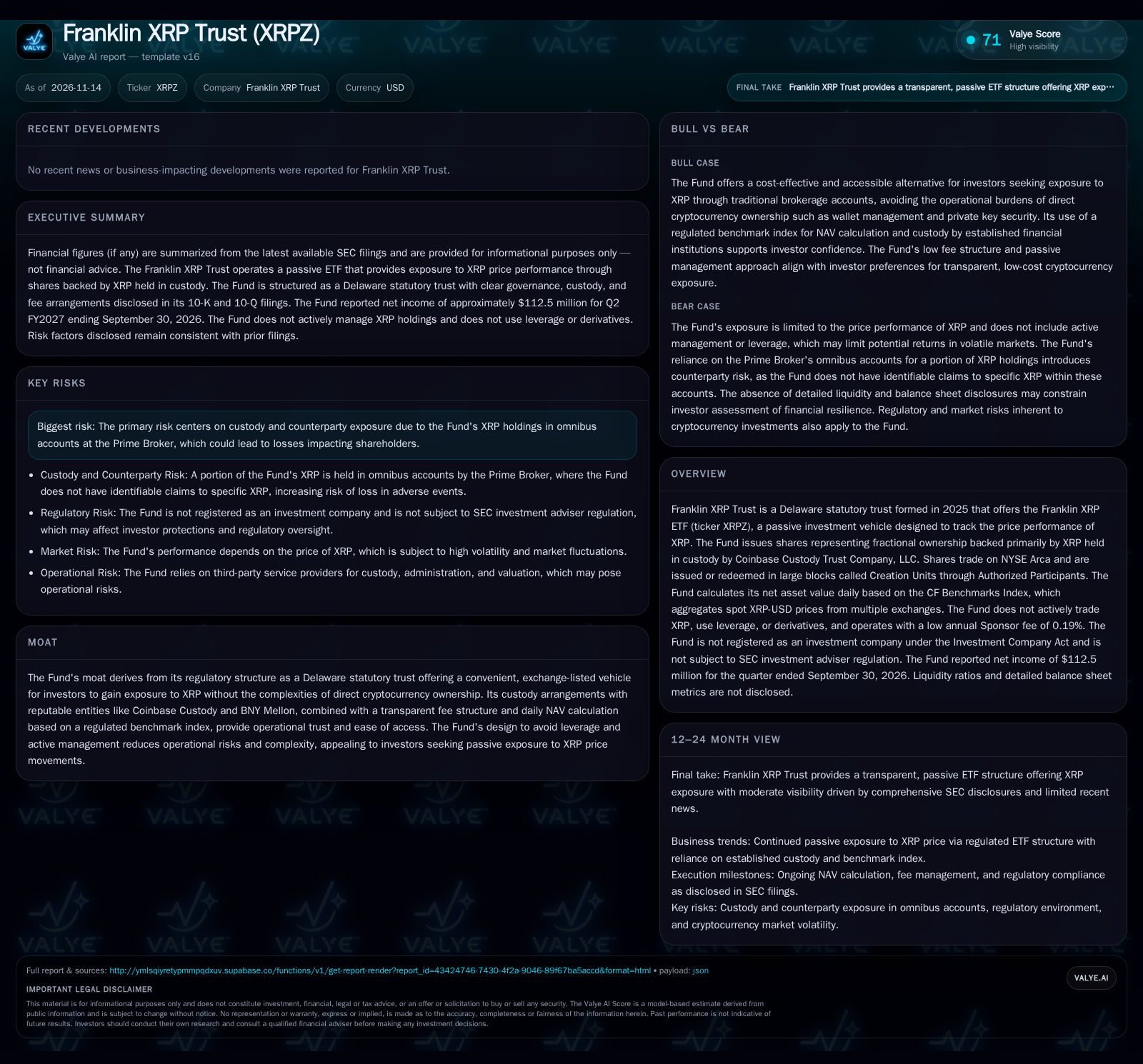
Franklin XRP Trust (XRPZ) delivers passive exposure to XRP through a regulated ETF structure, with shares backed by XRP held primarily in Coinbase Custody. The fund’s ultra-low fee, fee waivers on early assets, and daily NAV calculation based on a regulated benchmark index support its appeal for mainstream investors. The ETF’s long-term competitive position will hinge on continued investor preference for simplicity, regulatory clarity, and operational reliability in crypto-backed funds. [S1] [S2]
Franklin XRP Trust’s launch of the XRPZ ETF marks a significant step in the evolution of regulated crypto investment vehicles, offering investors a passive, exchange-listed route to XRP exposure without the operational headaches of private keys or direct wallet management. With its low fee structure, robust custody arrangements, and reliance on a regulated benchmark, the fund positions itself as a transparent and accessible alternative to direct token ownership. Yet, the ETF’s operational simplicity comes with tradeoffs: counterparty exposures in omnibus custody, limited balance-sheet transparency, and sole dependence on XRP price movements. The fund’s trajectory will be shaped by how these mechanics interact with investor preferences, regulatory developments, and the competitive landscape for crypto ETFs. [S1] [S2]
Recent Financial Performance, Structure, and Operational Exposures
Franklin XRP Trust reported net income of $112.5 million for the quarter ended September 30, 2026, reflecting the fund’s passive exposure to XRP price appreciation during a volatile period for digital assets [S2]. This income is not the result of active management or leverage but a function of the net asset value’s sensitivity to XRP market price. The ETF’s shares are backed primarily by XRP held in cold storage at Coinbase Custody, with some operational balances managed in omnibus accounts at the Prime Broker. Shares are created and redeemed in blocks of 50,000, facilitating institutional liquidity. The sponsor charges a 0.19% annual fee, with waivers on the first $5 billion of assets through May 2026, enhancing early cost competitiveness [S1]. [S2]
How the ETF Earns: Fee Revenue, Scale, and the Cost of Simplicity
Franklin XRP Trust’s economic model is straightforward: it collects a 0.19% annual sponsor fee on net assets, which—after waivers expire—forms the fund’s primary recurring revenue stream [S1]. The fund’s expenses are largely absorbed by the sponsor, with the fee designed to cover administration, custody, and regulatory compliance. Because the ETF is passive and does not use leverage or derivatives, its earnings are not a function of trading profits or active asset allocation, but instead scale directly with assets under management (AUM) and XRP price appreciation. The fee waiver on the first $5 billion of assets, set to expire on May 31, 2026, reduces the effective cost for initial investors and may accelerate AUM growth, which is critical for ETF liquidity and long-term viability.
The fund’s fixed costs are relatively low due to its passive structure, but operational dependencies—such as third-party custody, NAV calculation, and reliance on the Prime Broker for liquidity management—introduce variable costs and counterparty exposures. Because the fund does not hedge, rebalance, or engage in securities lending, its margin profile is stable but capped. Long-term profitability hinges on maintaining scale and competitive fees as more crypto ETFs enter the market.
ETF Structure as Differentiator—But for How Long?
Franklin XRP Trust’s core advantage lies in providing regulated, exchange-listed access to XRP for investors who would otherwise face operational and security challenges with direct token custody. The ETF’s transparent fee structure, daily NAV calculation via a regulated benchmark, and reputable custody arrangements with Coinbase and BNY Mellon help build trust among mainstream investors. However, as more sponsors launch similar crypto-backed ETFs, the competitive moat may narrow to fee differentials, brand trust, and operational transparency.
The fund’s reliance on large Creation Units for share issuance and redemption benefits institutional liquidity but may limit price efficiency for smaller retail traders. In the absence of active management, the fund does not offer potential alpha, leverage, or enhanced yield, making it most attractive to investors seeking simple, pure-play XRP exposure. The fund’s operational resilience and the perceived safety of its custody arrangements will be key differentiators, especially as regulatory scrutiny and investor sophistication increase.
If Institutional Adoption Accelerates and Regulatory Clarity Grows
The most favorable outcome for Franklin XRP Trust is a scenario in which institutional and retail demand for regulated crypto exposure surges—driven by increased acceptance of digital assets, improved regulatory clarity, and continued migration from direct token holding to ETF wrappers. In this world, the fund’s low fee, operational simplicity, and strong custody arrangements help it capture significant AUM. The expiration of the fee waiver could be offset by scale-driven cost efficiencies and sticky investor assets, especially if the fund achieves leading liquidity and tight trading spreads.
Evidence that would confirm this scenario includes rapid AUM growth, sustained net share creations, and consistently narrow bid-ask spreads on NYSE Arca. Further, positive regulatory developments—such as expanded ETF eligibility in retirement accounts or relaxed custody requirements—would likely support inflows. Falsification would come from persistent low trading volumes, high tracking error, or a major custody incident undermining investor trust.
Mainstream Adoption Stabilizes, Fee Competition Intensifies
The most plausible near-term outcome is that Franklin XRP Trust maintains steady AUM and trading activity as part of a growing but competitive field of crypto ETFs. Investors seeking regulated, passive exposure to XRP continue to use the ETF, but as rival sponsors introduce similar products, fee compression and marketing intensity increase. The fund’s operational resilience, ability to maintain tracking accuracy, and reputation for safety support its retention of core investor segments.
Confirmation would come from moderate but continuous AUM growth, manageable outflows around fee-waiver expiration, and absence of major custody or operational incidents. Falsification could involve sudden AUM declines, significant NAV tracking error, or regulatory actions that restrict ETF operations or investor access.
Custody Incidents or Regulatory Shocks Undermine Investor Trust
Downside risk centers on a major custody or counterparty event—such as a failure at the Prime Broker’s omnibus account, leading to loss or inaccessibility of XRP held for the fund. Such an event could trigger forced redemptions, investor panic, and sharp AUM contraction, especially if insurance coverage is limited or payout is delayed. Alternatively, adverse regulatory developments—such as restrictions on crypto ETFs, new custody requirements, or unfavorable tax treatment—could reduce the fund’s appeal and force structural changes.
Evidence confirming this scenario would include abrupt and sustained AUM outflows, spikes in redemptions, NAV discounts widening, or regulatory investigations. Falsification would be indicated by continued operational stability, robust custody audit results, and clear, supportive regulatory guidance.
Factors That Could Redefine the ETF’s Role in Crypto Portfolios
AUM growth rate and net share creation/redemption activity, which signal investor confidence and ETF liquidity.
Tracking error between the fund’s NAV and the underlying CF Benchmarks XRP-USD index, as persistent discrepancies would undermine trust.
Bid-ask spreads and daily trading volumes on NYSE Arca, as indicators of market depth and ease of entry/exit for investors.
Incidence (if any) of custody or counterparty events, particularly with respect to omnibus Prime Broker accounts.
Changes in the regulatory environment affecting ETF structure, custody, or investor eligibility for crypto-backed funds.
Fee structure changes or waivers post-May 2026, and the fund’s ability to retain assets as effective costs rise.
Announcements of new, directly competing XRP or broader crypto ETFs, which could alter the competitive landscape and fee dynamics.
Disclaimer: This is research-only, informational analysis and not investment advice. It may include AI-generated interpretation and general industry context. Always verify important details using primary sources.

Comments